
You’ll find XR Healthcare Simulation Library, VRpatients, and Embodied Labs leading the market with extensive content libraries that enhance nursing education and clinical training. These platforms offer AI-driven patient interactions, multiplayer scenarios, and extensive skill modules that reduce required clinical hours while improving retention rates by up to 230%. With ROI potential reaching 3,000% and the market projected to grow from $4.18 billion to $46.37 billion by 2032, understanding each platform’s unique capabilities will guide your selection process.
Leading VR Healthcare Simulation Platforms and Their Capabilities
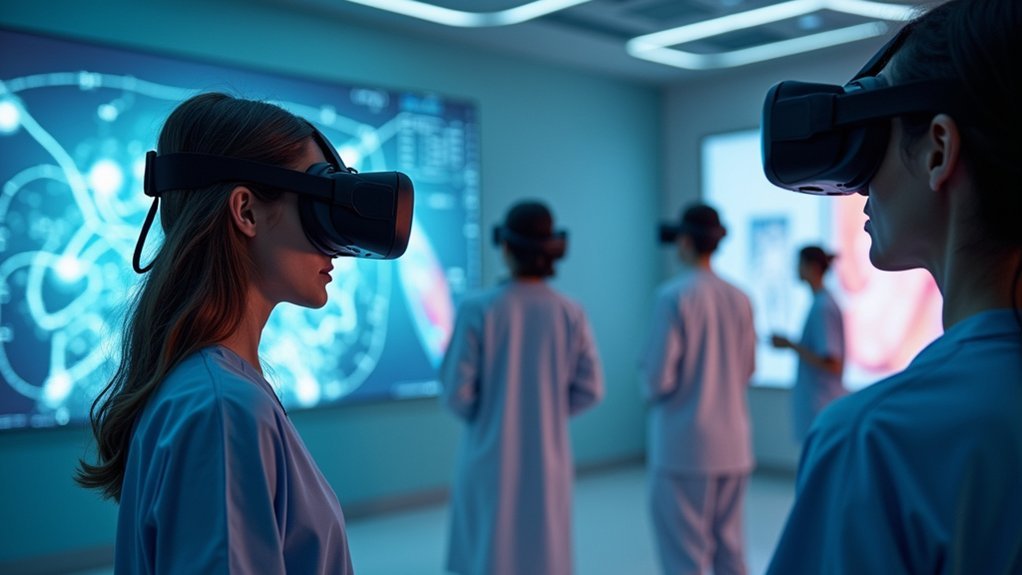
As healthcare education evolves rapidly, several VR simulation platforms have emerged as industry leaders, each offering distinct capabilities that transform how medical professionals train.
The XR Healthcare Simulation Library provides independent simulations you can access anytime, anywhere without needing moderators, boosting training efficiency.
VRpatients delivers a no-code platform offering unlimited patient encounters with flexible authoring tools, letting you create scenarios aligned with your learning objectives.
Embodied Labs specializes in first-person immersive experiences that enhance your confidence and retention through specialized training for diverse patient populations.
Meanwhile, partnerships like the Heart Rhythm Society and MedVR Education collaboration focus on building extensive VR healthcare libraries for clinical and interprofessional skills development across diverse medical environments.
Comprehensive Nursing Education VR Content Libraries
You’ll find that extensive nursing education VR content libraries transform traditional learning through three essential components that revolutionize clinical training.
These platforms integrate core nursing skill modules with AI-driven patient interactions, creating realistic scenarios that respond dynamically to your clinical decisions.
You can also engage in multiplayer clinical scenarios where you’ll collaborate with peers in complex patient care situations, building both technical competencies and critical teamwork skills.
Core Nursing Skill Modules
Modern nursing education demands practical experience that’s often difficult to obtain in traditional clinical settings. However, Core Nursing Skill Modules within extensive VR content libraries bridge this gap by delivering immersive, hands-on training that mirrors real-world patient care scenarios.
These immersive training modules target essential nursing competencies through realistic simulations that let you practice procedures repeatedly without patient risk. You’ll engage with AI-driven patient assessment tools that simulate authentic conversations, improving your communication and evaluation skills.
The growing library continuously updates with new scenarios, ensuring you’re exposed to diverse clinical situations. Multiplayer capabilities enable collaborative learning with peers, developing interprofessional teamwork skills vital for modern healthcare environments while noticeably reducing required clinical practice hours.
AI-Driven Patient Interactions
Beyond mastering technical procedures, nursing students must develop sophisticated communication abilities that enable them to connect authentically with patients across diverse backgrounds and conditions.
AI-driven patient interactions within VR content libraries revolutionize how you’ll practice these essential skills, offering realistic conversation scenarios that adapt to your responses in real-time.
These immersive experiences prepare you for complex clinical situations through:
- Dynamic patient responses that challenge your empathy and active listening skills
- Cultural sensitivity training across diverse patient populations and communication styles
- Crisis communication modules for delivering difficult news and managing emotional situations
- Collaborative scenarios where you’ll work with virtual healthcare teams
You’ll engage with photorealistic patients who respond naturally, building confidence before entering actual clinical environments.
Multiplayer Clinical Scenarios
While individual practice builds foundational skills, healthcare’s collaborative nature demands that nursing students master teamwork dynamics within high-pressure clinical environments.
The XR Healthcare Simulation Library delivers vast multiplayer clinical scenarios that enable you to engage collaboratively in realistic virtual environments. You’ll enhance your teamwork skills and clinical competencies through photorealistic XR scenarios that prepare you for emergencies and diverse healthcare settings.
These multiplayer clinical scenarios bridge theory and practice through immersive experiences. Dynamic training modules align with your nursing curriculum, helping you polish essential skills while reducing required clinical practice time.
The library’s focus on multiplayer interactions fosters a supportive learning community, allowing you to collaborate with fellow students and practice critical scenarios together from various locations worldwide.
Clinical Procedures Training Through Immersive Simulations
Anyone entering the healthcare field knows that mastering clinical procedures requires countless hours of practice, but traditional training methods often limit learning opportunities due to safety concerns and resource constraints.
Immersive virtual reality transforms this landscape by creating risk-free environments where you can repeatedly practice complex procedures until you’ve achieved mastery.
These simulations boost your confidence and competence through realistic scenarios that mirror actual clinical settings. You’ll interact with AI-driven virtual humans who provide personalized feedback on both technical skills and patient communication abilities.
Key benefits of immersive clinical procedure training include:
- Safe practice environment – Master procedures without patient safety risks
- Enhanced skill retention – Immersive experiences improve long-term learning outcomes
- Curriculum alignment – Training modules complement nursing and medical education programs
- Reduced training time – Accelerated skill development through focused practice sessions
Soft Skills Development With Ai-Driven Virtual Patients
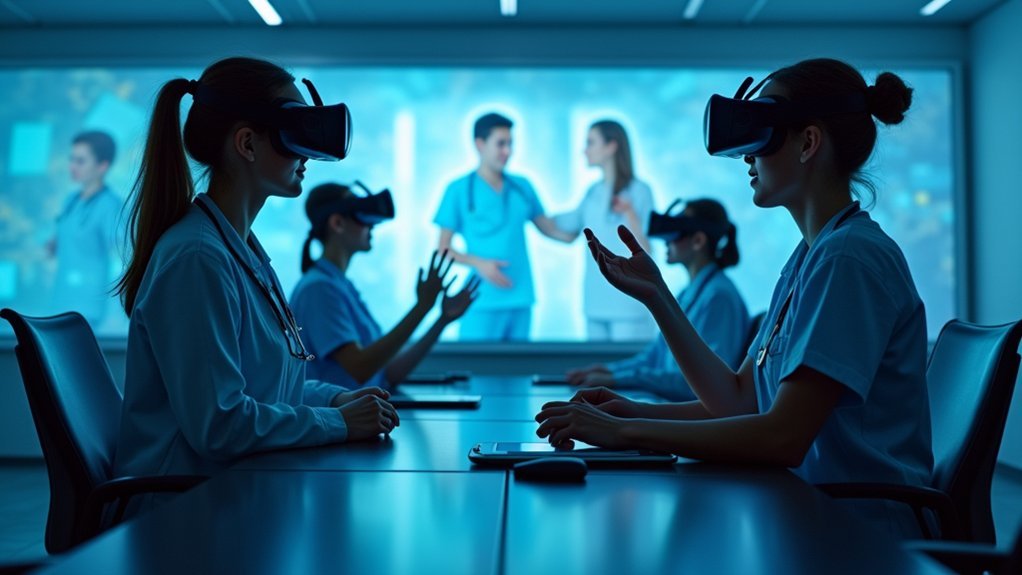
Technical proficiency alone won’t make you an exceptional healthcare provider—your ability to connect with patients, demonstrate empathy, and communicate effectively determines the quality of care you deliver.
AI-driven virtual patients revolutionize how you develop these vital soft skills through realistic conversation scenarios and interactive role-play experiences. These simulations create safe environments where you’ll practice communication, empathy, and decision-making without real-world consequences.
You’ll encounter diverse patient avatars representing various cultural backgrounds, helping you build adaptability and cultural competence essential for modern healthcare delivery.
The immersive nature of these virtual interactions greatly improves your learning outcomes and retention rates. AI assessment capabilities provide targeted feedback on your performance, identifying specific areas for improvement and supporting your continuous professional development in clinical settings.
Multi-User Collaborative VR Learning Environments
Because healthcare requires seamless team coordination, multi-user collaborative VR learning environments transform how you’ll train alongside colleagues and peers.
These immersive platforms enable real-time interaction during shared healthcare simulation experiences, regardless of your physical location. You’ll develop essential teamwork and communication skills while practicing diverse emergency scenarios together.
The XR Healthcare Simulation Library’s multiplayer features prepare you for complex medical situations through cutting-edge collaborative technology.
Here’s what makes these environments effective:
- Flexible scheduling – You can participate in asynchronous simulations at your convenience
- Live instructor oversight – Facilitators provide immediate feedback during collaborative sessions
- Enhanced engagement – 91% of users confirm VR improves educational programs
- Increased retention – Companies report notably higher learning retention rates
Multi-user collaborative VR learning environments revolutionize healthcare training through immersive, team-based experiences.
Enterprise-Grade XR Healthcare Training Solutions
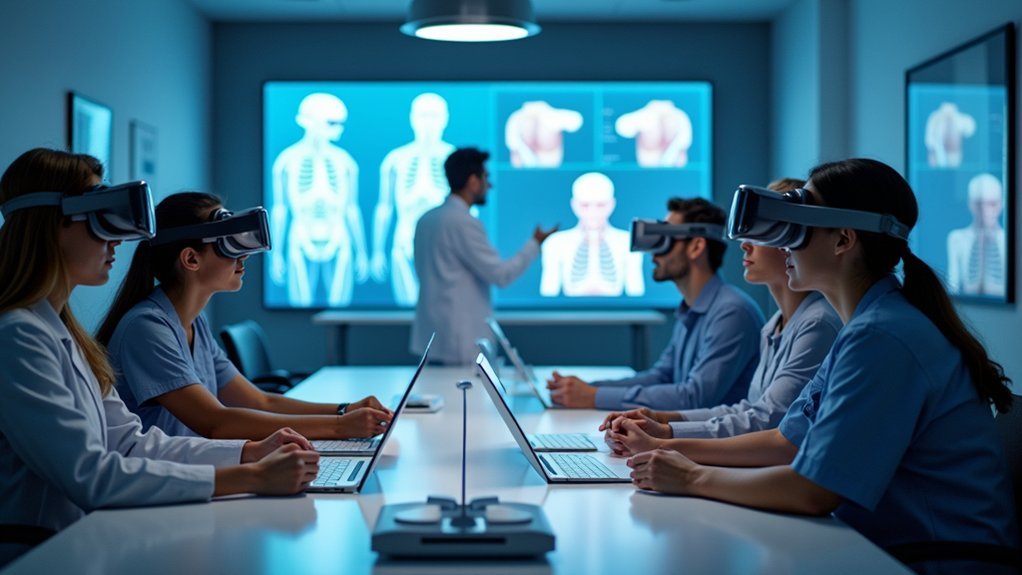
Modern healthcare organizations need scalable training solutions that adapt to their unique requirements and operational demands.
Enterprise-grade XR healthcare training platforms deliver customizable SAAS-based systems that let you deploy VR training apps tailored to your specific needs and branding requirements. You’ll benefit from multi-user VR capabilities that enable real-time collaboration between learners and instructors across different locations, creating truly immersive learning experiences.
These platforms feature centralized web-based dashboards where you can track training progress and analyze performance data effectively.
Strategic partnerships with organizations like the Heart Rhythm Society help build extensive VR simulation libraries covering diverse healthcare training scenarios.
With the healthcare VR market projected to grow from $4.18 billion in 2024 to $46.37 billion by 2032, you’re investing in proven technology that’s transforming medical education.
Specialized Medical Training Modules by Discipline
While general healthcare training provides a solid foundation, you’ll find that specialized medical training modules deliver targeted skill development for specific disciplines and clinical scenarios.
These discipline-specific solutions address unique challenges across medical specialties through immersive simulations.
Leading platforms offer extensive specialty training:
- Surgical Precision Training – Level Ex provides specialized VR modules focusing on surgical techniques, precision movements, and procedural rehearsals for complex operations.
- Cardiology Simulations – Interactive training covers routine and complex cardiac procedures, enabling practitioners to practice critical interventions safely.
- Emergency Management – High-pressure scenario training prepares teams for crisis situations and rapid decision-making under stress.
- Empathy Development – Embodied Labs delivers first-person experiences simulating conditions like Alzheimer’s disease, enhancing provider understanding and communication skills.
Custom VR modules can be developed through academic collaborations to address specific institutional needs.
Partnership Networks Driving VR Healthcare Innovation
You’ll find that strategic healthcare collaborations are reshaping how medical professionals access VR training content through powerful partnership networks.
Multi-institutional VR networks like those connecting Johns Hopkins, Harvard, and Oxford create shared repositories that accelerate innovation and expand educational reach across borders.
These partnerships don’t just pool resources—they’re building extensive XR libraries that transform isolated training modules into interconnected learning ecosystems.
Strategic Healthcare Collaborations
As healthcare institutions recognize VR’s transformative potential, strategic partnerships are reshaping medical education through collaborative innovation networks.
You’ll find that leading organizations aren’t working in isolation—they’re forming powerful alliances to develop thorough training solutions that address the complex needs of modern healthcare education.
These strategic collaborations are creating unprecedented opportunities for knowledge sharing and resource pooling.
Here’s how partnerships are driving innovation:
- Specialized Content Development – Organizations like the Heart Rhythm Society partner with MedVR Education to create targeted electrophysiology training.
- Resource Optimization – Institutions share development costs and expertise to build larger content libraries.
- Quality Standardization – Collaborative efforts guarantee consistent educational standards across platforms.
- Market Expansion – Joint initiatives like EU investments accelerate VR adoption across regions.
Multi-Institutional VR Networks
When leading medical institutions join forces to create VR training networks, they’re building the foundation for tomorrow’s healthcare education ecosystem.
You’ll find prestigious institutions like Johns Hopkins, Harvard, and Oxford spearheading collaborative efforts that leverage VR simulation technology to transform medical training.
These multi-institutional partnerships, including the Heart Rhythm Society’s collaboration with MedVR Education, focus on creating extensive electrophysiology training programs that enhance clinical skills across multiple healthcare organizations.
You’re witnessing an ambitious initiative to build the world’s largest XR healthcare library through these strategic alliances.
With the VR healthcare market projected to grow from $4.18 billion in 2024 to $46.37 billion by 2032, these collaborative networks guarantee you’ll have access to diverse clinical and interprofessional skills training that prepares confident healthcare professionals for real-world challenges.
Assessment and Performance Analytics in VR Medical Training
One of the most significant advantages of VR medical training lies in its sophisticated assessment capabilities that transform how educators evaluate student performance.
These platforms deliver extensive performance analytics that provide real-time insights into your learning progress, enabling immediate identification of skill gaps and areas requiring improvement.
Modern VR systems leverage AI-driven evaluations to offer personalized feedback through realistic simulations, creating immersive scenarios that test both technical proficiency and interpersonal skills.
AI-powered VR creates personalized learning experiences that evaluate both technical medical skills and critical patient communication abilities in realistic healthcare environments.
Here’s what makes VR assessment revolutionary:
- Real-time performance tracking during clinical procedures and patient interactions
- Thorough evaluation metrics covering both hard skills and soft skills development
- Data aggregation capabilities that measure program effectiveness across multiple learners
- Continuous content updates based on user feedback and evolving healthcare practices
This data-driven approach guarantees you’re receiving training that’s both relevant and measurable.
Cost-Effective Implementation Strategies for Healthcare Institutions
You’ll need to establish clear budget parameters that account for both initial VR infrastructure investments and ongoing content library subscriptions to maximize your training ROI.
Scalable deployment models let you start with pilot programs in specific departments before expanding institution-wide, spreading costs over time while demonstrating measurable training outcomes.
This phased approach helps you identify the most effective VR training modules for your needs while building internal support and expertise gradually.
Budget Planning Essentials
Although implementing VR healthcare training systems requires substantial upfront investment, strategic budget planning can transform these costs into significant long-term savings for your institution.
Understanding these budget planning essentials guarantees you’ll make informed decisions about your VR training systems investment.
Consider these critical budget components:
- Hardware costs – Factor in varying expenses based on simulation complexity and interactivity requirements you’ll need.
- Development approach – Choose between expensive custom solutions or cost-effective off-the-shelf alternatives.
- Annual maintenance – Allocate 10% of system costs yearly for updates and hospital system integration.
- Subscription models – Explore VR content libraries offering scalable access without massive upfront investments.
With proper planning, you’ll achieve ROI between 120% to 3,000%, making VR training a profitable long-term investment.
Scalable Deployment Models
Implementing VR healthcare training doesn’t require an all-or-nothing approach that strains your budget from day one.
Scalable deployment models let you start small and expand strategically. You can begin with free demos to test effectiveness, then gradually add more simulations as you identify what works best for your institution.
SAAS-based platforms like VRpatients offer subscription models with unlimited simulations and flexible authoring tools, eliminating hefty upfront costs.
These solutions distribute tailored content across multiple devices while maintaining cost-effectiveness. Integration with existing Learning Management Systems guarantees seamless implementation without disrupting current workflows.
With the VR healthcare market projected to reach $46.37 billion by 2032, adopting scalable deployment models positions your institution to meet growing educational demands efficiently while controlling expenses.
Equipment and Hardware Requirements for VR Training Libraries
When establishing a VR training library for healthcare education, you’ll need robust hardware that can handle complex medical simulations without compromising performance.
Your computer setup requires powerful GPUs like NVIDIA RTX series to run immersive training content smoothly. You’ll also need compatible VR headsets and motion controllers for realistic interactions during medical procedures.
Essential hardware components include:
- High-performance computers with NVIDIA RTX series GPUs or equivalent for ideal simulation rendering
- Compatible VR headsets such as Meta Quest series or HTC VIVE for varying immersion levels
- Motion controllers for precise hand tracking and interaction within virtual medical environments
- High-speed internet connectivity to support multi-user collaborative training sessions and real-time interactions
Consider integrating haptic feedback devices to provide realistic tactile sensations during surgical training scenarios.
Customization and White-Label Solutions for Medical Organizations
You’ll find that white-label VR platforms offer your medical organization the freedom to brand training content with your own identity while maintaining full control over educational standards.
These solutions let you customize simulations to match your specific protocols, techniques, and organizational requirements without starting from scratch.
You can collaborate directly with development teams to create tailored content that addresses your unique training objectives and clinical workflows.
White-Label Platform Benefits
Because medical institutions require training solutions that align with their unique protocols and branding standards, white-label VR platforms offer unprecedented flexibility for healthcare organizations.
These solutions empower you to maintain complete control over educational materials while ensuring seamless integration with existing systems.
Key advantages of white-label solutions include:
- Complete Brand Control – You’ll customize platforms with your organization’s branding, creating a cohesive educational identity across all training modules.
- Tailored Content Development – You can align VR scenarios with specific curriculum requirements and institutional standards.
- LMS Integration – You’ll achieve seamless administration by connecting VR training with existing Learning Management Systems.
- Multi-User Collaboration – You can facilitate collaborative learning experiences among healthcare professionals from various locations simultaneously.
Custom Content Development
Moving beyond platform branding, custom content development transforms how you create VR training scenarios that address your organization’s specific educational objectives.
You can collaborate with production teams like Acadicus to quickly update training content, guaranteeing it adapts to evolving healthcare practices and technologies. The flexible nature of VR platforms lets you create and modify unique scenarios without extensive programming knowledge, streamlining your development process.
Through partnerships with academic institutions and care facilities, you’ll engage in co-creation approaches that tackle real-world challenges.
This custom content development guarantees your training modules address specific learning objectives while maintaining relevance to your healthcare field’s current demands and organizational standards.
Success Metrics and ROI Measurement in VR Healthcare Education
When implementing VR healthcare education programs, you’ll need concrete metrics to justify your investment and demonstrate value to stakeholders.
Tracking success metrics helps you optimize training effectiveness and secure ongoing funding support.
Key ROI measurement approaches include:
- Learning Outcome Improvements – Monitor knowledge retention increases up to 230% and skills development progress across hard and soft competencies.
- Cost Analysis – Calculate reduced expenses from equipment dependency and traditional training methods against VR implementation costs.
- Engagement Metrics – Track completion rates, time-to-competency, and learner satisfaction scores to measure program effectiveness.
- Organizational Impact – Assess workforce confidence improvements and training program enhancement rates, with 91% of organizations reporting positive educational outcomes.
Leading institutions like Oxford Medical Simulation demonstrate ROI ranging from 120% to 3,000%, proving VR’s transformative potential.
Future Market Trends and Emerging Technologies in Medical VR
As healthcare organizations witness VR’s proven ROI potential, you’re positioned to capitalize on an industry experiencing unprecedented growth.
The VR healthcare market’s explosive trajectory from $4.18 billion in 2024 to $46.37 billion by 2032 represents a 35.1% CAGR that’s reshaping medical education landscapes.
You’ll find yourself among forward-thinking institutions, with 34% of organizations already implementing VR training and 43% planning adoption.
This momentum stems from overwhelming evidence—91% of respondents confirm VR enhances educational programs markedly.
Prestigious institutions like Johns Hopkins, Harvard, and Oxford are establishing new benchmarks for VR integration.
Meanwhile, the European Union’s Central Europe initiatives signal expanding global adoption.
You’re entering a transformative era where virtual training solutions aren’t just innovative—they’re becoming essential infrastructure for competitive healthcare education.
Frequently Asked Questions
How Do VR Training Libraries Address Cultural Sensitivity in Healthcare Delivery?
You’ll experience diverse patient scenarios reflecting various cultural backgrounds, religious practices, and language barriers. VR simulations teach you culturally appropriate communication techniques, respect for traditions, and how to navigate sensitive healthcare situations across different communities.
What Patient Privacy Protections Exist When Using Real Medical Scenarios?
You’ll find patient data gets completely de-identified or anonymized before integration into training scenarios. Real cases undergo HIPAA compliance reviews, removing identifying details while preserving educational value for your learning experience.
Can VR Training Replace Traditional Clinical Rotations for Medical Students?
You can’t completely replace clinical rotations with VR training. While VR provides excellent skill practice and standardized scenarios, you’ll still need real patient interactions to develop communication skills, clinical judgment, and hands-on experience.
How Do Licensing Agreements Work for Multi-Institutional VR Content Sharing?
You’ll negotiate consortium agreements that define usage rights, revenue sharing, and content ownership. Each institution pays licensing fees based on student enrollment or usage metrics. You’re responsible for compliance monitoring and maintaining standardized technical specifications across platforms.
What Accessibility Features Accommodate Healthcare Trainees With Disabilities?
You’ll find closed captions for audio content, adjustable text sizes, color contrast options, voice commands for navigation, haptic feedback alternatives, and customizable interface layouts that guarantee trainees with visual, auditory, or motor impairments can participate effectively.