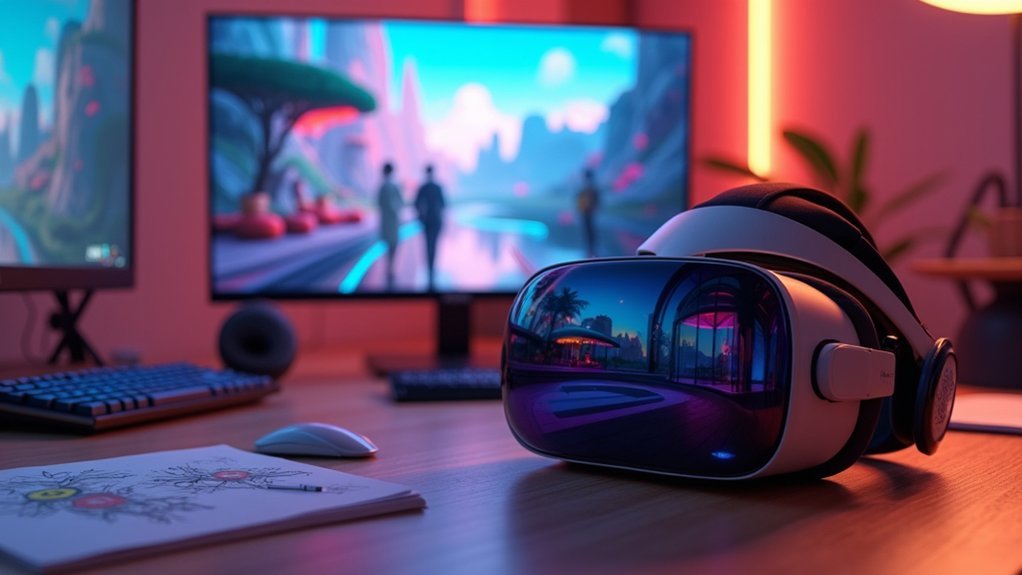
You can create immersive WebVR experiences using five powerful frameworks that streamline development. A-Frame simplifies VR with familiar HTML markup, while React VR extends component-based architecture into virtual reality. The WebVR API provides browser-native standards without plugins, and Three.js offers sophisticated 3D graphics with WebGL acceleration. PlayCanvas combines WebGL power with visual development tools for accessible VR creation. These frameworks eliminate coding barriers and support cross-platform compatibility, making professional VR development more approachable than you’d expect.
A-Frame: Mozilla’s HTML-Based VR Development Platform
A-Frame revolutionizes VR development by bringing virtual reality creation directly into the web browser through familiar HTML markup.
You’ll find this Mozilla-developed framework eliminates complex coding barriers that typically discourage game developers from entering the VR space. Instead of learning specialized engines, you can build VR environments using HTML and JavaScript you already know.
The framework’s entity-component architecture lets you compose 3D scenes effortlessly while maintaining compatibility across desktop and mobile browsers.
You won’t need different builds for various VR headsets – A-Frame supports Oculus Rift, HTC Vive, and other devices seamlessly.
With extensive documentation and an active community, you’ll have the resources needed for immersive content creation, whether you’re a beginner or experienced developer exploring WebVR possibilities.
React VR: Component-Based Virtual Reality Applications
While A-Frame simplifies VR through HTML markup, React VR takes a different approach by extending React’s component-based philosophy into virtual reality development.
You’ll leverage your existing React knowledge to build virtual reality applications using familiar JavaScript API patterns and component structures.
React VR streamlines 3D models integration into web applications, eliminating the need for extensive 3D programming expertise. You can compose and reuse components modularly, enhancing team collaboration during VR development.
The framework’s user interface system maintains React’s declarative approach while creating immersive experiences.
You’ll benefit from cross-platform compatibility across various VR headsets and devices, ensuring broader accessibility.
The active community provides extensive documentation, helping you quickly master techniques for creating engaging virtual reality applications that feel natural to React developers.
WebVR API: Browser-Native VR Experience Standard

Although frameworks like A-Frame and React VR provide powerful development tools, the WebVR API serves as the foundational technology that enables virtual reality experiences to run natively in web browsers.
You’ll find this experimental JavaScript API eliminates the need for additional plugins while supporting diverse VR hardware configurations. The WebVR API simplifies your development process by providing consistent interfaces for rendering and interacting with 3D content across different devices, from standalone headsets to mobile browsers.
You can create immersive experiences that handle VR controller input, head tracking, and multi-viewpoint rendering.
As an open standard, the WebVR API encourages broader participation in VR development, allowing you to build interactive environments and VR applications that reach wider audiences through standard web browsers.
Three.js: JavaScript 3D Library for WebVR Content
Three.js stands as one of the most powerful JavaScript libraries for creating sophisticated 3D graphics and WebVR experiences directly in web browsers.
This versatile development tool leverages WebGL for hardware-accelerated rendering, eliminating the need for plugins while delivering stunning visual performance.
You’ll benefit from Three.js’s extensive feature set that streamlines virtual reality development:
- Built-in WebXR API support – Seamlessly develop immersive experiences that work across various VR devices
- Rich 3D toolkit – Access extensive geometries, materials, lights, textures, and shaders for complex scenes
- Strong community resources – Leverage open-source documentation, examples, and developer support
Three.js transforms complex WebVR development into manageable workflows, enabling you to create interactive immersive experiences without deep graphics programming knowledge.
PlayCanvas: Open-Source WebGL Game Engine for VR

PlayCanvas emerges as a compelling open-source alternative that combines the power of WebGL with an intuitive visual development environment for VR creation.
PlayCanvas delivers professional-grade WebGL capabilities through an intuitive visual interface, making VR development accessible without sacrificing power or functionality.
You’ll appreciate how this game engine lets you create immersive VR applications directly in web browsers without requiring extensive coding expertise. The platform’s visual editor simplifies 3D scene management, while built-in asset optimization tools guarantee your web applications load quickly across devices.
What sets PlayCanvas apart is its real-time collaboration feature, allowing your entire team to work simultaneously on projects. You can create models and manage assets efficiently through the thorough toolset.
The extensive documentation and active community support make learning VR development straightforward. For developers seeking to create immersive experiences with professional-grade tools, PlayCanvas delivers enterprise-level capabilities in an accessible package.
Frequently Asked Questions
What Are the Main Performance Differences Between Webvr Frameworks?
You’ll find A-Frame offers easier development but slower rendering, while Three.js provides better performance with steeper learning curves. React 360 excels in UI-heavy experiences, and Babylon.js delivers superior graphics optimization for complex scenes.
Which Webvr Frameworks Offer the Best Cross-Platform Compatibility?
You’ll find A-Frame and Three.js offer excellent cross-platform support across desktop, mobile, and VR headsets. They’re framework-agnostic and work consistently on different browsers, making them your best choices for universal compatibility.
How Do Licensing Costs Compare Across Different Webvr Development Frameworks?
You’ll find most WebVR frameworks are free and open-source, including A-Frame, Three.js, and Babylon.js. However, you might pay for premium plugins, hosting services, or enterprise support packages depending on your project’s requirements.
What Hardware Requirements Are Needed for Optimal Webvr Framework Performance?
You’ll need a modern GPU with WebGL 2.0 support, at least 8GB RAM, and a multi-core processor. VR headsets require additional USB 3.0 ports and DisplayPort connections for peak performance.
Which Frameworks Provide the Most Comprehensive Documentation and Community Support?
You’ll find A-Frame offers the most thorough documentation with extensive tutorials and active community forums. Three.js also provides excellent resources and strong developer support. Both frameworks maintain detailed guides that’ll help you build immersive experiences efficiently.



Leave a Reply