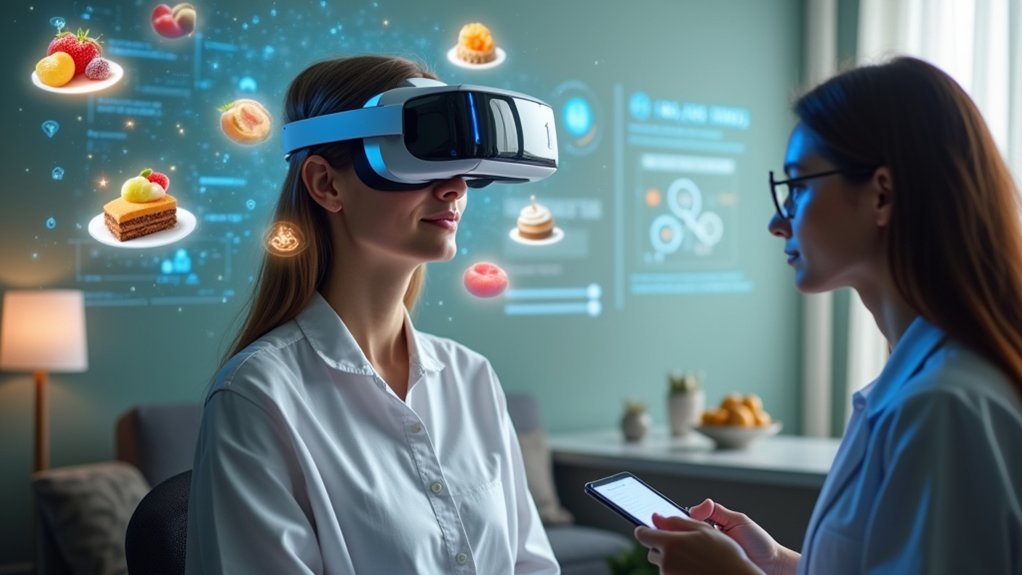
You’re experiencing a breakthrough in eating disorder treatment because virtual reality creates safe, controlled environments where you can confront food-related fears without real-world consequences. VR addresses body image distortion through customizable avatars that help you visualize realistic body perception, while immersive scenarios let you practice dining out, cooking, and healthy decision-making. Clinical trials show you’ll have better engagement, lower dropout rates, and superior outcomes when VR enhances traditional cognitive behavioral therapy, building confidence that transforms your relationship with food and body image into lasting recovery skills.
Virtual Reality Creates Safe Exposure Environments for Food-Related Fears

When you’re struggling with an eating disorder, facing food-related situations can trigger overwhelming anxiety that makes recovery feel impossible.
Virtual reality exposure therapy transforms this challenge by creating controlled environments where you can safely confront your food-related fears. Through immersive VR experiences, you’ll gradually expose yourself to anxiety-inducing scenarios like restaurant dining without real-world consequences.
VR therapy creates safe spaces to practice facing food anxieties without real-world risks or consequences.
Customizable avatars help you visualize accurate body image versus distorted perceptions, promoting self-awareness.
These virtual environments allow you to practice coping strategies repeatedly until they become natural responses. The systematic exposure reduces your anxiety over time while building confidence for real-life situations.
This controlled approach to eating disorders treatment guarantees you’re never overwhelmed, making recovery more achievable than traditional methods.
Advanced VR Programs Target Body Image Distortion and Self-Perception
Since body image distortion lies at the heart of most eating disorders, advanced VR programs have developed sophisticated tools that directly address how you perceive your physical self. These immersive environments utilize customizable avatars that help you visualize your body perception against reality, creating powerful moments of recognition.
| Before VR Therapy | After VR Therapy |
|---|---|
| Distorted self-perception dominates daily thoughts | Realistic body awareness emerges gradually |
| Body-related anxiety controls eating decisions | Reduced fear empowers healthier choices |
| Avoidance of mirrors and social situations | Increased confidence in social settings |
| Overwhelming fear of weight gain | Manageable concerns about body changes |
VR therapy combines exposure therapy with cognitive behavioral therapy techniques, systematically desensitizing you to body image fears. Research shows significant improvements in anorexia nervosa patients, with decreased focus on weight-related body parts while developing healthy eating habits.
Immersive Technology Enhances Traditional Cognitive Behavioral Therapy Methods
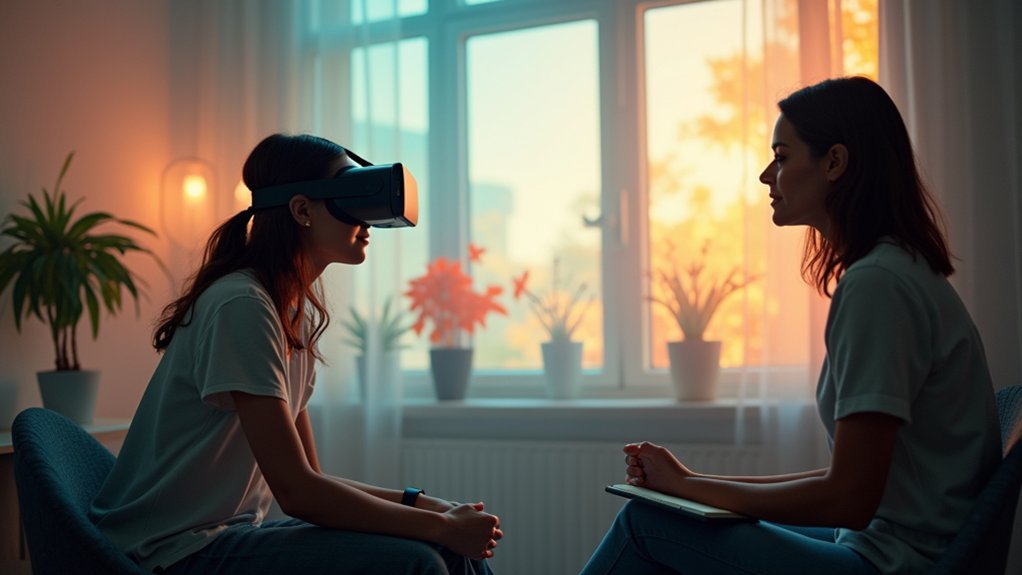
While traditional cognitive behavioral therapy has long served as the gold standard for eating disorder treatment, immersive VR technology transforms how you’ll experience and engage with therapeutic interventions.
VR technology revolutionizes eating disorder therapy by creating immersive, transformative experiences that go beyond traditional cognitive behavioral approaches.
This innovative approach creates a virtual environment where you’ll confront anxiety-inducing food situations safely, making exposure therapy more accessible and effective.
VR enhances cognitive behavioral therapy through:
- Controlled exposure scenarios that gradually introduce food-related situations without real-world consequences
- Customizable avatars helping you address body image distortions and improve self-perception
- Reduced dropout rates compared to standard methods, keeping you engaged throughout treatment
- Simulated real-life practice allowing you to develop healthy eating habits and decision-making skills
- Improved treatment outcomes with measurable reductions in anxiety and fear of weight gain
Virtual Scenarios Build Real-World Coping Skills and Confidence
As you navigate virtual kitchens and practice portion control through VR scenarios, you’re developing essential skills that translate directly into confident real-world decision-making.
Virtual reality therapy for eating disorders creates immersive food-related scenarios where you can safely confront your anxieties without real-world consequences. You’ll practice cooking, dining out, and making healthy choices while building robust coping strategies through repeated exposure.
These virtual environments let you challenge distorted body image perceptions using customizable avatars, helping bridge the gap between your actual appearance and internal perception.
As you face anxiety-inducing situations repeatedly in VR, you’re strengthening your emotional resilience and developing practical skills. This immersive approach enhances traditional cognitive behavioral therapy by providing controlled practice opportunities that build genuine confidence for real-life eating situations.
Research Evidence Demonstrates Improved Treatment Outcomes and Engagement
Although eating disorder treatment has traditionally relied on talk therapy alone, compelling research now proves that virtual reality integration markedly enhances recovery outcomes.
Clinical trials demonstrate that VR combined with cognitive behavioral therapy produces superior results compared to traditional methods alone.
The research reveals powerful evidence for VR’s transformative impact:
- Body image improvements: VR exposure therapy helps patients achieve healthy BMI levels and reduces body-related anxiety with sustained results over five months.
- Enhanced patient engagement: Virtual environments increase motivation and notably reduce treatment dropout rates.
- Controlled anxiety management: Immersive food-related scenarios allow safe confrontation of fears while building resilience.
- Stronger coping strategies: VR enhances retention of therapeutic techniques learned during sessions.
- Healthy food relationships: Evidence shows VR facilitates positive behavioral changes around eating patterns.
Frequently Asked Questions
How Virtual Reality Is Used in Treating Mental Health Disorders?
You’ll experience immersive environments that let you confront fears safely. VR enhances traditional therapy by increasing engagement, providing exposure therapy for anxiety, social skills training, and body image work, improving your coping strategies considerably.
What Is the VR Treatment for Anorexia?
You’ll experience systematic exposure to your virtual body silhouette with progressively increasing BMI during five VR sessions integrated into cognitive behavioral therapy, helping reduce your fear of weight gain and body-related anxiety.
Which Disorder Is a Therapist Most Likely to Use Virtual Reality for Treating?
You’d find therapists most commonly using virtual reality for treating anorexia nervosa. VR effectively addresses core symptoms like body image disturbances and fear of weight gain that’re central to this specific eating disorder.
Why Does Virtual Reality Therapy Work?
You experience controlled exposure to challenging situations, retain therapeutic information better, visualize realistic body perception, reduce anxiety symptoms effectively, and normalize eating patterns through repeated virtual scenarios that support lasting recovery.


Leave a Reply