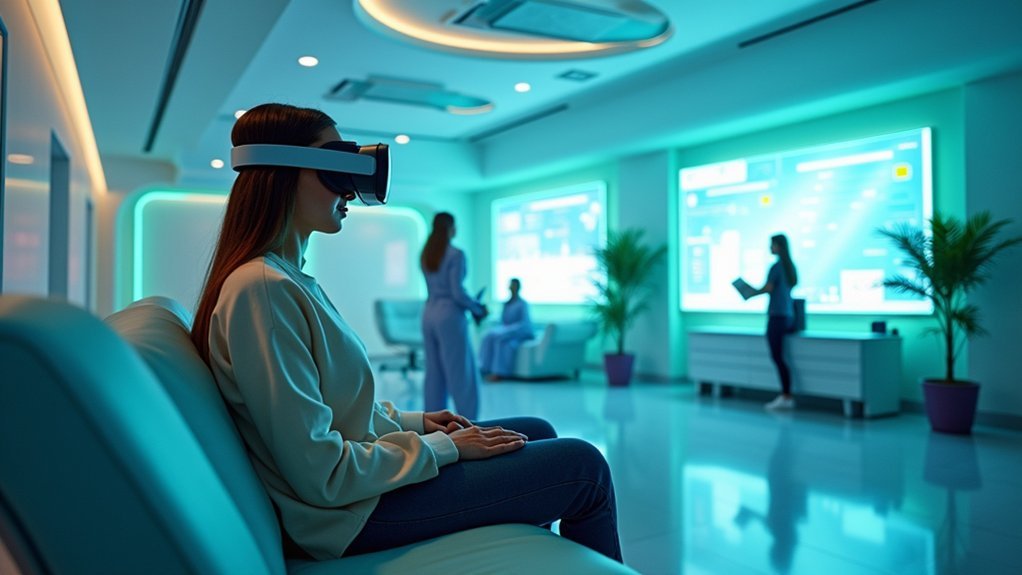
You can transform rehabilitation through virtual worlds by implementing the DATA model to diagnose, assess, and treat patients systematically. Start with personalized VR programs that match individual goals, then combine virtual reality with traditional techniques for ideal outcomes. Create custom protocols using real-time feedback to enhance performance while leveraging immersive environments for safe practice of high-risk activities. Track progress through digital documentation, train your clinical staff properly, and utilize VR’s distraction therapy for pain management. These strategies will reveal rehabilitation’s full potential.
Implement the DATA Model for Systematic Patient Care
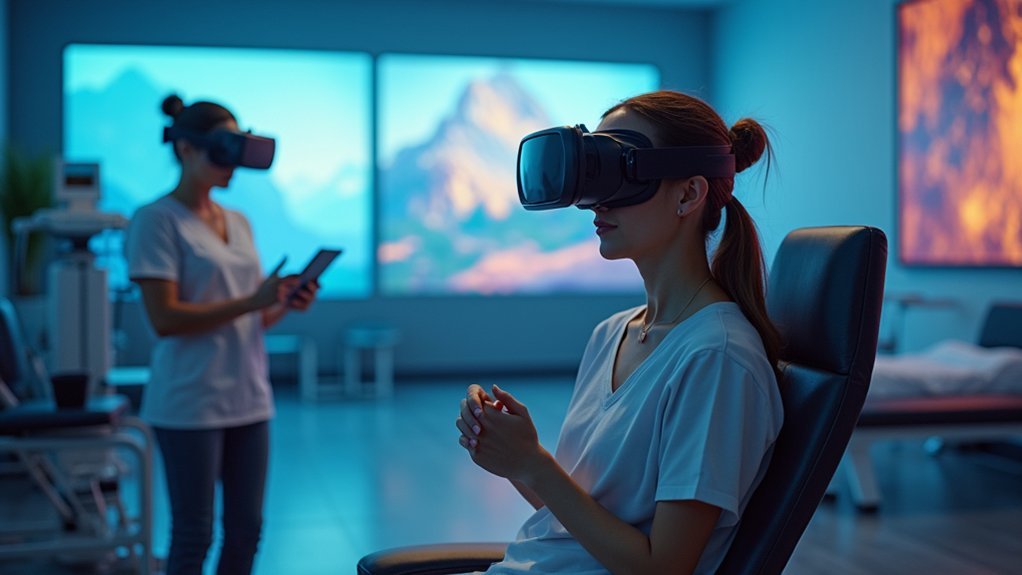
When transforming rehabilitation through virtual worlds, you’ll need a systematic approach that guarantees every patient receives personalized care tailored to their specific needs.
The DATA model provides this framework through four essential phases. You’ll start by diagnosing each patient’s condition, then assess their functional limitations using tools like the Limits of Stability assessment.
During the training phase, you’ll select VR therapy modules that match daily activity demands, incorporating therapeutic exercises within immersive environments that boost patient engagement.
The final assessment phase lets you re-evaluate progress through real-time feedback, adjusting your rehabilitation programs accordingly.
This systematic approach assures cognitive rehabilitation stays relevant while maintaining motivation throughout treatment.
You’ll discover that implementing DATA enhances efficiency by creating truly personalized, engaging therapeutic experiences.
Personalize VR Programs to Match Individual Patient Goals
You’ll need to assess each patient’s current functional abilities before designing their VR rehabilitation program.
Set exercise intensity levels that challenge patients appropriately without overwhelming them or causing setbacks.
Create customized treatment protocols that align with their specific recovery goals and address their unique physical limitations.
Assess Individual Functional Levels
Before you can harness VR’s transformative power in rehabilitation, you must first conduct a thorough assessment of each patient’s current functional level. This extensive evaluation serves as your foundation for selecting appropriate VR training modules that directly address patient needs.
When you assess individual functional levels, you’re gathering vital data about motor skills, balance, coordination, and cognitive functions. This information enables you to design VR programs with tailored exercises that match each person’s specific capabilities and limitations.
The assessment informs your selection of immersive VR technology environments and difficulty settings. You’ll identify which rehabilitation tasks require modification and determine realistic progression timelines.
Set Appropriate Exercise Intensity
Once you’ve established baseline measurements through thorough assessment, the next step focuses on setting appropriate exercise intensity that aligns with each patient’s unique rehabilitation goals.
Personalized VR programs must challenge patients without overwhelming them, maintaining the delicate balance that drives patient motivation.
Here’s how to set appropriate exercise intensity effectively:
- Start conservatively – Begin with lower intensity levels and gradually increase difficulty as patients demonstrate competency and confidence.
- Implement real-time progressions – Adjust challenges dynamically based on immediate patient performance and feedback during sessions.
- Leverage immersive VR environments – Use engaging virtual worlds that naturally encourage higher participation while masking perceived exertion.
- Monitor patient progress continuously – Track performance metrics and modify intensity accordingly to optimize rehabilitation outcomes and prevent plateaus.
Create Customized Treatment Protocols
Successful rehabilitation hinges on protocols that precisely match each patient’s unique functional capabilities and recovery objectives.
You’ll need to assess each patient’s specific functional level before selecting tailored training modules that align with their rehabilitation goals. Personalizing VR programs guarantees you’re delivering truly customized treatment plans rather than one-size-fits-all approaches.
Immersive environments allow you to make real-time adjustments based on individual performance during therapy sessions. You can transform traditional exercises into interactive games, incorporating patients’ preferred activities to boost adherence.
Set appropriate intensity levels and progressively challenge each patient while maintaining safety.
Create systematic protocols for saving and accessing these customized treatment plans across multiple patients. This streamlined approach enhances therapy efficiency while guaranteeing consistent, personalized care delivery.
Combine Virtual Reality With Traditional Rehabilitation Techniques
While traditional rehabilitation methods have proven their worth over decades, integrating Virtual Reality technology creates a powerful synergy that amplifies therapeutic outcomes.
You’ll discover that VR doesn’t replace conventional approaches but enhances them through immersive environments that boost patient engagement and motivation.
Here’s how you can effectively combine these approaches:
- Transform routine exercises into gamified experiences – Turn standard movements into balloon-popping games or obstacle courses that patients actually want to complete.
- Leverage real-time feedback systems – Use VR’s instant data to adjust difficulty levels and customize exercises based on performance during sessions.
- Simulate real-world scenarios – Practice daily activities like grocery shopping or stair climbing in safe, controlled virtual environments.
- Enable progressive challenges – Push patients beyond traditional methods’ limitations through incremental difficulty increases that therapists can precisely control.
Create Custom Protocols for Streamlined Treatment Sessions

You’ll revolutionize your rehabilitation practice by developing personalized protocols that store favorite training modules and custom configurations for different patient conditions.
Your session efficiency skyrockets when you leverage the “launch from previous session” feature and history tab to maintain treatment continuity without starting from scratch each time.
You can streamline documentation and communication by generating PDF reports instantly, allowing more time to focus on actual patient care rather than administrative tasks.
Protocol Development Strategies
When developing custom protocols for virtual reality rehabilitation, you’ll maximize treatment efficiency by selecting specific training modules that align with each patient’s unique needs and progress levels.
These protocol development strategies guarantee personalized rehabilitation experiences that adapt to individual capabilities while maintaining thorough care standards.
Your treatment plans become more effective when you implement these key approaches:
- Store favorite modules using the “Create Protocols” feature to build reusable treatment plans for multiple patients with similar conditions.
- Enable seamless shifts with the “Launch from Previous Session” feature, allowing patients to resume exactly where they stopped.
- Access session history to quickly retrieve previous parameters for tailored adjustments during ongoing therapy.
- Generate PDF reports effortlessly to document progress and communicate patient’s specific needs with your healthcare team.
Session Efficiency Optimization
By implementing session efficiency optimization techniques, you can dramatically reduce setup time while delivering more focused, personalized care to your patients.
Creating custom protocols allows therapists to store favorite modules for multiple patients, streamlining each session’s workflow. You’ll maximize session efficiency by using the “launch from previous session” feature, continuing exactly where you left off without repetitive configuration.
The history tab becomes your strategic tool for tracking patient progress and making real-time adjustments. Generate PDF reports to simplify documentation and share outcomes with healthcare teams seamlessly.
Most importantly, tailoring protocols to individual patient needs maintains engagement and motivation throughout treatment. This personalized approach directly improves treatment outcomes while ensuring every minute of therapy delivers maximum therapeutic value for sustained rehabilitation success.
Leverage Real-Time Feedback to Enhance Patient Performance
As patients engage in VR rehabilitation exercises, they receive instant performance metrics that illuminate their progress and pinpoint areas requiring improvement.
Real-time feedback transforms virtual reality rehabilitation by enabling immediate movement adjustments that enhance patient performance and boost confidence.
This innovative approach delivers measurable benefits:
- Instant corrections – You’ll visualize movements and adjust technique immediately, accelerating skill development
- Increased motivation – Real-time metrics show progress instantly, keeping you engaged throughout sessions
- Customized intensity – Therapists can customize therapy dynamically based on your live performance data
- Superior outcomes – Studies demonstrate improved motor function compared to traditional methods
Real-time feedback helps therapists enhance effectiveness by tailoring exercises to your unique needs, ensuring ideal challenge levels that promote recovery without overwhelming you during rehabilitation.
Design Immersive Environments That Boost Motivation and Engagement
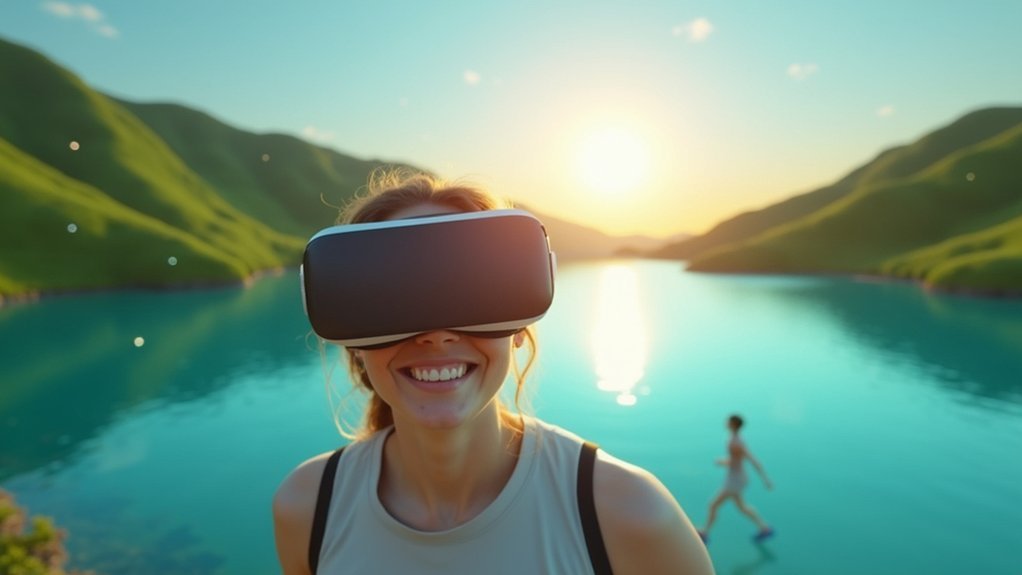
While traditional rehabilitation often feels like tedious work, immersive VR environments transform therapy into engaging experiences that you’ll actually want to participate in.
Virtual reality creates enchanting worlds where you can practice rehabilitation exercises within customizable scenarios tailored to your specific needs. Whether you’re walking through calming beach scenes or playing interactive games, these immersive environments distract from pain while making challenging movements enjoyable.
The gamification elements built into these virtual worlds greatly boost patient motivation by turning therapy sessions into meaningful activities. You’ll receive real-time feedback that tracks your performance, creating a sense of accomplishment as you progress.
Utilize VR for Safe Practice of High-Risk Activities
You can transform dangerous rehabilitation scenarios into safe learning opportunities through VR’s controlled environments.
Your patients will practice high-risk movements like maneuvering stairs, crossing busy streets, or recovering from stumbles without facing real-world consequences.
This approach lets you focus on simulated fall prevention training while building their confidence in challenging situations they’ll eventually encounter outside the clinic.
Simulated Fall Prevention Training
When traditional fall prevention therapy puts you at risk of actual falls, VR technology creates a revolutionary solution that lets you practice dangerous scenarios without real-world consequences.
Virtual reality transforms how patients approach fall prevention by offering immersive training in a completely controlled environment. You’ll experience realistic situations while therapists monitor your progress and customize scenarios to address your specific balance deficits.
Here’s how VR revolutionizes fall prevention training:
- Safe practice – Navigate high-risk scenarios without fear of injury
- Real-time feedback – Instantly adjust movements and reinforce proper techniques
- Customized training – Target your unique balance challenges with tailored scenarios
- Proven results – Achieve improved balance and coordination compared to traditional methods
This innovative approach reduces fall-related injuries while building confidence through practical experience.
High-Risk Movement Practice
Because high-risk movements like reaching across your body or stepping over obstacles can trigger falls in real life, VR technology creates a protective barrier that lets you master these challenging activities without physical danger.
Virtual reality (VR) transforms rehabilitation by offering immersive experiences that replicate real-world scenarios safely. You’ll practice complex motor tasks through task-specific training that challenges your coordination while eliminating injury risks.
Real-time feedback during these sessions helps you understand your performance instantly, allowing precise movement adjustments. As you navigate virtual obstacles and perform demanding activities, you’ll build essential motor skills without fear.
This approach considerably boosts patient confidence, encouraging independence as you develop strength and coordination. VR’s controlled environment makes previously risky rehabilitation exercises accessible and effective.
Controlled Environment Benefits
While traditional rehabilitation settings present genuine safety concerns during challenging exercises, VR environments eliminate these barriers by providing complete control over every aspect of your therapeutic experience.
Virtual reality (VR) creates risk-free spaces where you can practice complex movements without physical harm.
The immersive nature of VR transforms how patients improve through:
- Complete safety control – You’ll practice high-risk activities like balance training on virtual cliffs without actual falling consequences.
- Customizable difficulty levels – Therapists can tailor challenges to your specific needs and progress gradually.
- Instant performance tracking – Real-time feedback shows your movement patterns and improvements immediately.
- Unlimited practice opportunities – You can repeat challenging scenarios until mastery without therapist supervision concerns.
This controlled environment maximizes therapeutic benefits while minimizing injury risks during rehabilitation.
Track Progress Through Comprehensive Digital Documentation
As rehabilitation shifts toward digital integration, you’ll discover that exhaustive documentation becomes the backbone of effective patient care.
Digital documentation systems transform how you track progress by automatically generating all-encompassing PDF reports that capture every detail of your patient’s journey. You’ll access previous session parameters through intuitive history tabs, making it simple to monitor improvements and adjust rehabilitation programs accordingly.
Digital documentation systems automatically generate comprehensive PDF reports capturing every detail of your patient’s rehabilitation journey through intuitive history tracking.
Real-time feedback during exercises enhances patient engagement while providing you with instant performance analytics.
This data-driven approach enables personalized care that adapts to each individual’s needs. You can store protocols and favorite modules for multiple patients, streamlining your workflow while maintaining detailed records.
The result is enhanced accountability, improved motivation, and evidence-based treatment decisions that optimize rehabilitation outcomes.
Establish Proper Training Protocols for Clinical Staff
Effective digital documentation systems require skilled operators who understand the technology’s full potential.
Your healthcare professionals need extensive training protocols to maximize virtual reality (VR) rehabilitation effectiveness. Proper preparation guarantees clinical staff can confidently operate VR systems and deliver effective patient care.
Here’s how you’ll establish successful training protocols:
- Access tailored resources – Use your Virtualis serial number to gain entry to specialized training materials from Interacoustics.
- Schedule regular workshops – Keep your team updated on latest VR rehabilitation techniques and best practices.
- Emphasize hands-on practice – Build staff confidence through direct experience with virtual reality equipment.
- Monitor performance continuously – Evaluate how well clinical staff use VR systems and identify improvement areas.
This systematic approach transforms your team into VR rehabilitation experts who consistently deliver ideal patient outcomes.
Optimize Pain Management Through Immersive Distraction Therapy
How can virtual reality revolutionize your approach to pain management during rehabilitation?
You’ll discover that immersive distraction therapy transforms patient experiences during painful procedures. Studies show VR reduces pain scores by an average of 1.7 points compared to traditional methods, with severe pain patients experiencing three-point reductions.
Your patients can escape into calming virtual environments—serene beaches or peaceful landscapes—while completing therapy exercises.
This immersive approach doesn’t just mask discomfort; it enhances patient motivation and adherence to rehabilitation plans. When patients feel accomplished exploring virtual worlds during physical therapy, they’re more likely to continue treatment.
Virtual reality provides dual benefits: immediate pain relief through engaging distraction and long-term therapeutic success through improved patient cooperation.
You’re not simply managing pain—you’re creating positive associations with rehabilitation.
Frequently Asked Questions
What Are the Typical Costs Associated With Implementing VR Rehabilitation Systems?
You’ll face initial hardware costs of $15,000-50,000 for headsets and equipment, plus $5,000-20,000 annually for software licenses, maintenance, staff training, and technical support depending on your facility’s size and requirements.
How Do Insurance Companies Handle Coverage for Virtual Reality Therapy Sessions?
You’ll find most insurance companies don’t yet cover VR therapy sessions as standard practice. You’re typically required to pay out-of-pocket, though some progressive insurers are beginning pilot programs for coverage.
What Happens if Patients Experience Motion Sickness During VR Rehabilitation?
If you’re experiencing motion sickness during VR rehabilitation, your therapist will immediately pause the session, adjust settings like movement speed, provide breaks, or switch to less intensive exercises until you’re comfortable.
Are There Age Restrictions for Patients Using Virtual Reality Rehabilitation Programs?
You’ll find most VR rehabilitation programs don’t have strict age restrictions, but they’re typically designed for patients over six years old. Your healthcare provider will assess individual cognitive abilities and physical coordination before starting treatment.
How Long Does It Take to See Measurable Results From VR Therapy?
You’ll typically notice initial improvements within 2-4 weeks of consistent VR therapy sessions. However, significant measurable results usually emerge after 6-8 weeks, depending on your condition’s severity and treatment frequency.


Leave a Reply