
Gesture recognition revolutionizes your immersive experiences by eliminating the barrier between thought and action, translating your natural hand movements and body gestures into instant digital commands with less than 10ms latency. You’ll discover 64% of VR users prefer this intuitive interaction over traditional controllers because it creates seamless, authentic engagement without memorizing complex button combinations. This technology transforms virtual environments into accessible, natural spaces where your slightest motions become meaningful interactions that’ll reshape how you connect with digital worlds.
Understanding Gesture Recognition Technology Fundamentals
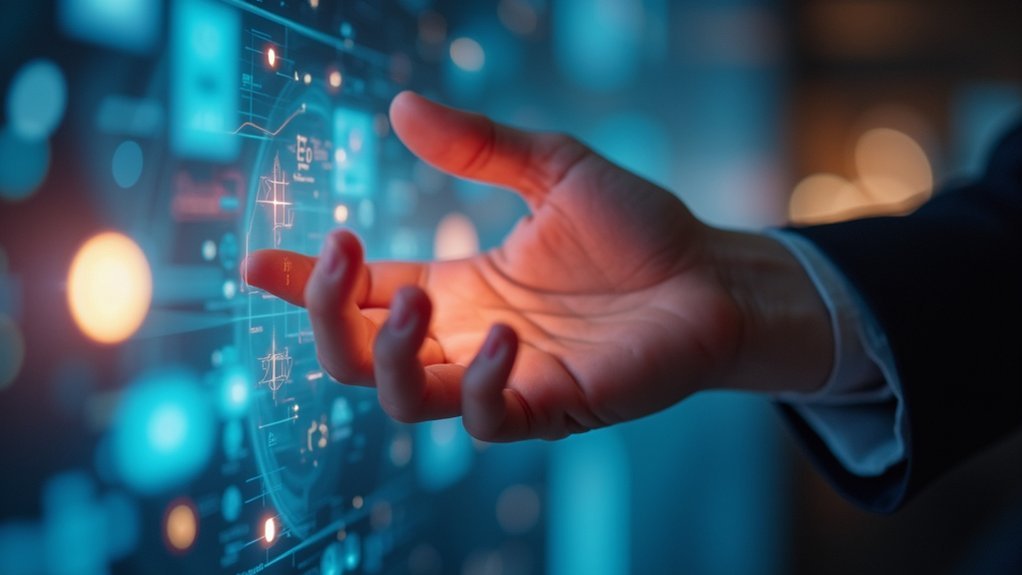
When you wave your hand or point at a virtual object, gesture recognition technology captures these movements through sophisticated sensors and cameras. It then processes them using machine learning algorithms to create seamless interaction without keyboards, mice, or controllers.
This technology works by combining computer vision with advanced algorithms to interpret human gestures in real-time, transforming your natural movements into digital commands.
The system recognizes diverse gestures including hand waves, finger taps, and facial expressions, making immersive experiences more intuitive and engaging.
Modern gesture recognition transforms natural human movements into seamless digital interactions, creating intuitive virtual experiences that feel genuinely responsive and engaging.
As machine learning models continuously improve, the accuracy and reliability of gesture recognition systems enhance dramatically. You’ll find that modern implementations can distinguish subtle movements and respond instantly, creating responsive virtual environments that feel natural and eliminate traditional input barriers.
Natural Movement Translation in Virtual Environments
When you wave your hand in a virtual environment, sophisticated algorithms instantly capture and translate that movement into digital commands that feel completely natural.
You’ll find that this real-time movement mapping creates seamless interactions where your physical gestures directly control virtual objects without any noticeable delay.
Through intuitive physical gesture control, you’re able to manipulate virtual elements using the same hand movements you’d naturally use in the real world, making the experience feel authentic and effortless.
Real-Time Movement Mapping
As you move your hand through the air, sophisticated sensors capture every nuance of your gesture and instantly translate it into precise digital commands within virtual environments.
This real-time processing of sensor data creates seamless interactions that feel natural and responsive. Advanced sensors work alongside machine learning algorithms to accurately interpret your movements, ensuring fluid navigation through virtual spaces.
Gesture recognition enhances immersion by letting you manipulate objects through intuitive hand movements and body positioning.
You’ll find these interactions markedly more engaging than traditional input methods, leading to extended time spent in virtual environments. The technology also improves accessibility, allowing individuals with mobility challenges to customize gesture controls that suit their specific needs and capabilities.
Intuitive Physical Gesture Control
Natural hand movements become powerful tools for virtual interaction through intuitive physical gesture control systems that bridge the gap between your body’s instinctive actions and digital responses. Gesture recognition enables seamless translation of your natural movements into digital commands, eliminating the learning curve associated with traditional controllers.
When you reach, grasp, or point, the technology can make these actions meaningful within virtual spaces. This intuitive physical gesture control creates fluid experiences where interaction with virtual environments feels as natural as real-world activities. Studies reveal 64% of users prefer gesture-based systems, proving immersive worlds are accessible through natural movement patterns.
- Enhanced emotional connection through natural body language translation
- Reduced reliance on complex controller schemes and button combinations
- Expanded accessibility options for users with mobility limitations
- Lower learning barriers for newcomers to virtual reality experiences
- Seamless object manipulation through familiar hand gestures and movements
Enhanced User Engagement Through Intuitive Controls
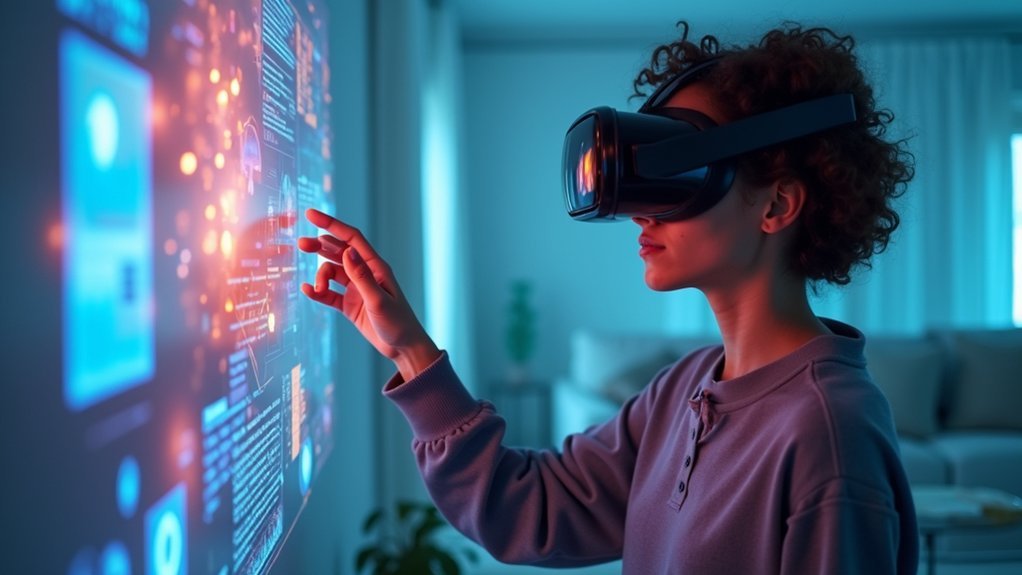
Since gesture recognition eliminates the barrier between thought and action, you’ll find yourself naturally reaching, pointing, and manipulating virtual objects as if they were physically present.
This seamless gesture control creates enhanced user engagement by making interactions feel instinctive rather than learned. When you don’t need to memorize complex button combinations or navigate through menus, you can focus entirely on the experience itself.
These intuitive controls transform how you connect with immersive experiences.
Studies reveal that 64% of VR users prefer gesture-based interactions over traditional controls, resulting in longer engagement times and higher satisfaction.
You’ll spend more time exploring virtual worlds because the learning curve disappears. Your natural hand movements become the interface, making every interaction feel personal and meaningful while strengthening your emotional connection to the digital environment.
Breaking Down Barriers to VR Accessibility
When physical limitations prevent you from gripping controllers or pressing buttons, gesture recognition technology transforms VR from an exclusive experience into an inclusive playground.
This breakthrough eliminates traditional barriers that’ve kept individuals with mobility impairments from accessing immersive experiences. You’ll discover that body movements become your primary interface, creating intuitive control systems that respond naturally to your capabilities.
Research shows 64% of users find gesture-based interactions more engaging than conventional methods. Systems like Dots recognize your unique movement patterns, adapting to your specific needs and abilities.
- Natural movement translation – Your body becomes the controller without physical devices
- Customizable interaction zones – Adapt gesture recognition to your mobility range
- Real-time responsiveness – Immediate feedback enhances your sense of presence
- Reduced physical strain – Eliminates repetitive button pressing and grip requirements
- Inclusive design principles – Built specifically for diverse accessibility needs
Real-Time Motion Capture and Processing Systems

You’ll need powerful hardware to run real-time motion capture systems that can track your movements with millisecond precision.
Your system’s processing speed directly impacts how smoothly you can interact with virtual environments through natural gestures.
Understanding these hardware requirements and optimization techniques will help you choose the right setup for seamless gesture-based experiences.
Hardware Requirements Analysis
Although gesture recognition technology has advanced rapidly, the hardware foundation that enables seamless real-time motion capture remains the most critical factor in determining system performance.
You’ll need sophisticated hardware requirements to achieve responsive immersive experiences that feel natural and intuitive.
Advanced processing systems powered by high-performance GPUs handle the computational intensity of analyzing gesture data instantly. High-resolution cameras paired with depth sensors capture your movements with precision, while fast data transfer protocols like USB 3.0 minimize latency issues that could disrupt interactions.
Essential hardware components include:
- High-resolution cameras with depth sensing capabilities for accurate motion tracking
- GPU-powered processing units to handle complex real-time computational demands
- Accelerometers and gyroscopes in wearable devices for enhanced precision
- Fast data transfer interfaces (USB 3.0+) to minimize interaction latency
- Machine learning-optimized processors for interpreting complex gesture patterns
Processing Speed Optimization
While hardware components form the foundation of gesture recognition systems, processing speed optimization determines whether your movements translate into smooth, responsive interactions or frustrating delays. Real-time motion capture systems analyze your gestures within milliseconds, providing immediate feedback that maintains immersion. Enhanced processing power enables simultaneous tracking of multiple inputs and fine motor skills, capturing subtle movements that elevate realism.
| Processing Aspect | Standard Systems | Optimized Systems |
|---|---|---|
| Latency Response | 50-100ms | <10ms |
| Gesture Complexity | Basic movements | Multi-layered inputs |
| Simultaneous Users | 1-2 users | 4+ users |
| Tracking Precision | General motions | Fine motor skills |
| AI Adaptation | Limited learning | Real-time evolution |
Gesture recognition technology continuously evolves through AI-driven improvements, adapting to your behaviors and boosting user engagement in virtual reality applications.
Hand Tracking Precision in Virtual Spaces
When you extend your hand in a virtual space, cutting-edge tracking systems can now detect your movements with millimeter-level precision, transforming how you interact with digital environments.
This revolutionary hand tracking technology uses advanced machine learning algorithms to interpret your gestures seamlessly, creating truly immersive experiences that feel natural and intuitive.
You’ll find that modern gesture recognition systems can detect subtle finger movements and specific hand shapes, allowing you to manipulate virtual objects with unprecedented accuracy.
Technologies like Leap Motion demonstrate this precision in action, making virtual spaces more accessible for everyone, including individuals with mobility challenges who can now engage with digital content through natural hand movements.
- Millimeter-precision tracking enables natural manipulation of virtual objects and interfaces
- Machine learning algorithms continuously improve gesture recognition accuracy and responsiveness
- Subtle finger movements and hand shapes expand the vocabulary of possible user interactions
- Enhanced accessibility allows users with mobility challenges to engage effectively with virtual content
- Intuitive hand-based controls eliminate the learning curve associated with traditional input devices
Body Movement Integration for Full Immersion
You’re no longer confined to simple hand gestures when gesture recognition captures your entire body’s movement through full-body motion tracking systems.
Your natural walking, reaching, and turning motions translate directly into the virtual environment, creating seamless interactions that mirror real-world physics.
This physical gesture synchronization means you can duck behind virtual cover, reach overhead to grab objects, or lean around corners just as you’d in reality.
Full-Body Motion Tracking
As you extend your arms to reach for a virtual object, full-body motion tracking transforms your entire physical presence into digital input, creating an unprecedented level of immersion in virtual environments.
This gesture recognition technology utilizes advanced sensors and computer vision to capture every movement, translating them into real-time digital actions that enhance user engagement with remarkable accuracy.
When you run, jump, or dance in these immersive experiences, you’re not just controlling an avatar—you’re physically embodying it.
This seamless integration creates authentic interactions that greatly increase satisfaction and accessibility.
- Advanced sensors capture and interpret your complete body movements in real-time
- You experience higher satisfaction levels through physical avatar embodiment
- Natural actions like running and jumping become authentic digital interactions
- Accessibility expands for individuals with disabilities in virtual spaces
- Real-time feedback enriches your overall engagement and presence
Natural Movement Translation
Through sophisticated algorithms and machine learning, natural movement translation bridges the gap between your physical gestures and digital commands, creating an intuitive interface that responds to your slightest motions.
Gesture recognition technology transforms every hand wave, finger tap, and body movement into meaningful digital interactions, enabling users to interact with virtual environments as naturally as they’d in real life.
This seamless translation of real-world gestures eliminates the learning curve typically associated with traditional controllers, making immersive experiences accessible to everyone regardless of technical expertise.
The technology’s ability to interpret nuanced movements fosters a deeper emotional connection between you and virtual spaces, creating more engaging and memorable encounters that feel genuinely authentic and responsive.
Physical Gesture Synchronization
Physical gesture synchronization takes movement translation to the next level by capturing your entire body’s motions and mirroring them precisely in virtual space. This technology transforms how you interact with digital environments, making every gesture feel natural and responsive.
When you reach for objects or navigate through virtual worlds, your movements create authentic interactions that enhance immersion beyond traditional controllers.
Gesture recognition technology like Leap Motion enables this seamless integration, delivering immersive gaming experiences that respond to your physical presence. Studies show 64% of users prefer gesture-based interactions, proving their effectiveness for user engagement.
- Intuitive interaction: Your natural movements replace complex button combinations
- Enhanced presence: Full-body tracking creates realistic avatar representation
- Improved accessibility: Individuals with mobility impairments can participate meaningfully
- Seamless immersion: Physical gesture synchronization eliminates barriers between you and virtual environments
- Expanded possibilities: New interaction methods reveal creative gaming mechanics
Eliminating Traditional Input Device Dependencies
When you wave your hand to navigate a virtual menu or pinch your fingers to zoom into a 3D model, you’re experiencing the fundamental shift away from keyboards, mice, and controllers that once tethered users to their desks. Gesture recognition technology eliminates the barriers that traditional input devices create, allowing you to interact naturally within digital environments.
| Traditional Method | Gesture Method | User Benefit |
|---|---|---|
| Keyboard shortcuts | Hand movements | Natural interaction |
| Mouse clicks | Touch gestures | Reduced learning curve |
| Controller buttons | Body motions | Enhanced accessibility |
This liberation transforms how users engage with immersive experiences. You’ll find yourself moving freely, using intuitive motions that feel organic rather than mechanical. For individuals with disabilities, this technology opens new possibilities for digital interaction without physical device constraints.
Machine Learning Algorithms Powering Gesture Detection
Behind this seamless interaction lies sophisticated machine learning technology that processes your every movement with remarkable precision.
Gesture recognition technology transforms how you engage with digital environments by leveraging machine learning algorithms that analyze millions of gesture examples to understand human movements accurately.
These systems enable real-time interpretation of your gestures, creating intuitive interactions within virtual spaces. The algorithms continuously learn from vast datasets, improving their ability to differentiate between subtle movements and adapt to your unique behavioral patterns.
- Pattern Recognition: Algorithms identify complex movement patterns from massive datasets
- Real-time Processing: Instantaneous interpretation enables fluid user interactions
- Personalization: Systems adapt to individual user behaviors and preferences
- Accuracy Enhancement: Deep learning techniques greatly boost recognition reliability
- Scalability: Technology works effectively across diverse demographics in immersive applications
Overcoming Technical Challenges in Motion Recognition
Despite remarkable advances in machine learning algorithms, gesture recognition systems still grapple with significant technical hurdles that can make or break your immersive experience.
You’ll encounter accuracy issues stemming from environmental factors like poor lighting or subpar camera quality, which directly impact motion detection reliability. Latency becomes your biggest enemy when delays occur between your gestures and system responses, breaking the seamless flow essential for truly immersive experiences.
Calibration processes often frustrate you with time-consuming adjustments needed for peak performance. Your unique height, weight, and movement patterns add complexity that standard systems struggle to accommodate.
However, adaptive algorithms are evolving to learn from your individual interactions, while advanced sensor technology including accelerometers continues improving responsiveness and precision across diverse applications.
Gaming Applications Transforming Player Experiences
While traditional gaming controllers have dominated the industry for decades, gesture recognition technology is fundamentally reshaping how you interact with virtual worlds.
You’ll find yourself physically mimicking character actions, creating deeper immersive experiences that transform gameplay from passive button-pressing to active physical participation.
This revolution extends far beyond entertainment value. You can now control or interact with games more intuitively, with 64% of VR users preferring gesture-based controls over traditional methods.
The technology enhances engagement and interaction through innovative mechanics in dance and fitness games, while simultaneously improving accessibility in gaming for players with disabilities.
- Natural movements replace complex button combinations for intuitive gameplay
- Physical mimicry creates unprecedented character-environment connection
- Fitness and dance genres emerge through motion-based interaction systems
- Disabled players gain access to previously incompatible gaming experiences
- Creative developers design unique mechanics leveraging physical interactions
Educational and Training Simulation Advancements
As gesture recognition technology moves beyond entertainment, you’re witnessing its transformative impact on educational and training environments where hands-on learning takes on entirely new dimensions.
When you’re training for surgery, precise hand movements simulate real-life techniques, dramatically improving your skill retention and practical application. These immersive experiences boost your engagement levels, leading to better knowledge retention of complex subjects.
Immersive gesture-based surgical training transforms complex procedures into engaging, hands-on experiences that dramatically enhance skill development and knowledge retention.
What’s particularly exciting is how personalized systems adapt to your individual learning styles, creating tailored interactions that strengthen connections between physical actions and digital representations.
In educational settings, this technology promotes accessibility by allowing individuals with disabilities to participate in hands-on learning experiences previously unavailable to them, revolutionizing inclusive education.
Future Market Potential and Emerging Innovations
When you examine the gesture recognition landscape ahead, you’ll discover a market poised for explosive growth, with projections reaching $53.6 billion by 2030. This gesture recognition technology expansion signals unprecedented opportunities across industries, from manufacturing safety improvements to enhanced immersive experiences.
You’ll witness emerging applications that integrate AI-driven improvements, enabling systems to adapt to your individual behaviors. The latest innovations combine gesture controls with voice commands and facial recognition, creating extensive interaction platforms that revolutionize how you engage with technology.
Future developments in sensor technology and machine learning algorithms will reveal new market potential, particularly in manufacturing environments where you’ll control equipment without physical contact, improving both efficiency and safety.
- AI-powered systems learn and adapt to individual user preferences automatically
- Multi-modal interfaces combine gesture, voice, and facial recognition seamlessly
- Manufacturing applications reduce physical contact while enhancing operational safety
- Advanced sensors enable more precise and responsive gesture detection
- Machine learning algorithms continuously improve accuracy and user experience
Frequently Asked Questions
Why Is Gesture Recognition Important?
You’ll find gesture recognition transforms how you interact with technology by enabling natural movements instead of traditional controls. It increases accessibility, enhances engagement, and creates more intuitive user experiences across gaming, education, and healthcare applications.
Why Is Gesture Development Important for Later Language Development?
You’ll find gesture development essential because it builds your child’s communication foundation before speech emerges. Gestures enhance vocabulary growth, cognitive processing, and concept understanding, creating stronger pathways that directly support more advanced language skills later.
How Does Gesture Recognition Differ From Traditional Computer Input Methods?
You’ll find gesture recognition interprets your natural movements like hand waves, while traditional methods require specific button presses. It eliminates keyboards and mice, creating more intuitive, accessible interactions through real-time movement analysis.
What Is Gesture Recognition for Human Robot Interaction?
Gesture recognition for human-robot interaction lets you control robots through natural body movements and hand signals. You’ll communicate intuitively without traditional input devices, creating seamless real-time interactions for manufacturing, healthcare, and service applications.

Leave a Reply