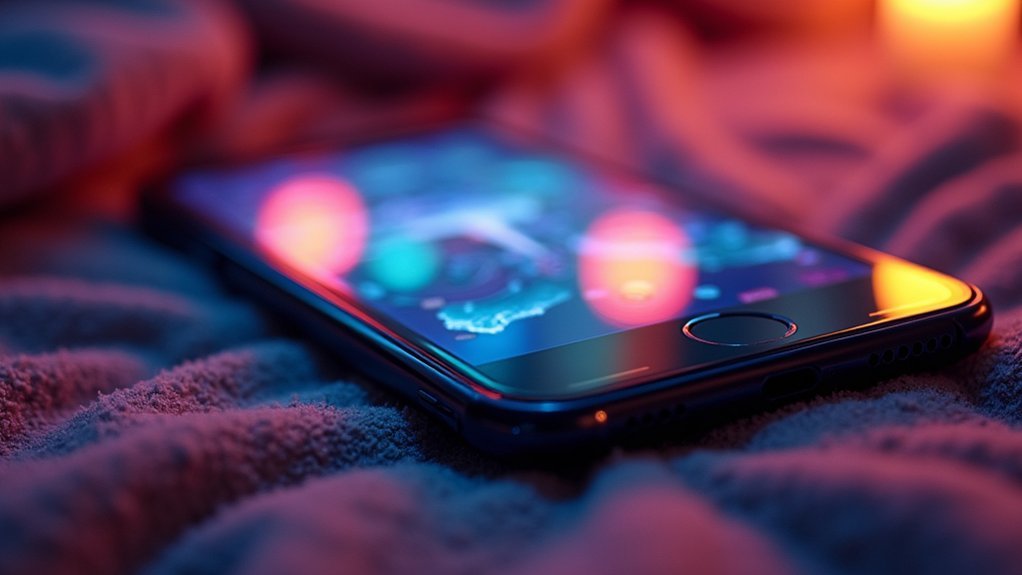
Your smartphone’s advanced OLED displays with 90-120Hz refresh rates and HDR capabilities create vibrant, smooth visuals that rival dedicated gaming systems. Powerful octa-core processors and GPUs deliver real-time rendering with sub-20ms latency, preventing motion sickness while motion sensors track your movements precisely. Spatial audio technologies and Dolby Atmos create three-dimensional soundscapes, while 5G connectivity enables wireless VR streaming. These technologies transform your device into an immersive portal where augmented reality overlays blend seamlessly with reality, revealing deeper interactive possibilities.
Advanced Display Technology Creates Stunning Visual Experiences

When you’re scrolling through social media or diving into a mobile game, your smartphone’s advanced display technology transforms ordinary content into enchanting visual experiences.
OLED and AMOLED screens deliver deeper blacks and vibrant colors that greatly boost visual immersion. You’ll notice how these displays make every image pop with lifelike clarity.
Higher refresh rates between 90Hz and 120Hz create smoother motion rendering, making your gaming sessions and video playback incredibly responsive.
HDR capabilities further enhance your viewing experience by providing greater contrast and color accuracy, capturing intricate details in both bright and dark scenes.
Edge-to-edge displays with minimal bezels maximize screen real estate, drawing you deeper into content.
Advanced touch responsiveness and haptic feedback technologies add a tactile dimension that complements stunning visuals, creating truly immersive smartphone experiences.
Powerful Processing Units Enable Seamless VR Performance
Behind those stunning visuals lies the computational powerhouse that makes mobile VR truly possible. Your smartphone’s octa-core CPU handles complex graphics and renders high-resolution environments in real-time, delivering powerful processing units that rival gaming consoles. Advanced GPUs work alongside these processors to eliminate lag and maintain smooth frame rates during immersive experiences.
| Component | VR Capability | Performance Benefit |
|---|---|---|
| Octa-Core CPU | Real-time rendering | Seamless graphics processing |
| Advanced GPU | High frame rates | Lag-free visualization |
| AI Optimization | Dynamic adjustment | Personalized performance |
Your device’s AI capabilities dynamically optimize virtual reality performance based on your interactions and environmental conditions. This intelligent processing guarantees you’ll experience high-quality VR applications without expensive dedicated hardware, making immersive mobile experiences accessible to everyone through efficient smartphone technology.
Motion Sensors Provide Precise Movement Tracking

Your phone’s motion sensors transform how you interact with mobile content through sophisticated accelerometer gaming applications that respond instantly to your physical movements.
These gyroscope navigation systems track your device’s orientation with remarkable precision, enabling seamless control in VR environments and augmented reality experiences.
You’ll experience real-time position detection that captures even subtle gestures, creating truly immersive mobile interactions that blur the line between digital and physical worlds.
Accelerometer Gaming Applications
As you tilt your smartphone to steer through digital racetracks or shake it to reload weapons in action games, accelerometers transform your physical movements into precise in-game actions.
These accelerometer gaming applications detect various orientations and accelerations, creating intuitive controls that enhance gameplay dynamics across racing and augmented reality genres.
When you physically interact with your device through tilting, shaking, or rotating motions, you’ll experience increased engagement that traditional touch controls can’t match.
Research shows these motion-based inputs improve user satisfaction and retention by offering unique gameplay experiences.
Modern smartphones’ advanced accelerometers achieve high sensitivity and accuracy, enabling developers to create sophisticated applications.
This technology opens doors for immersive learning experiences, making mobile learning more interactive and engaging through physical device manipulation.
Gyroscope Navigation Systems
While accelerometers capture linear movements and tilting motions for gaming interactions, gyroscope navigation systems take motion tracking several steps further by measuring rotational movements with exceptional precision.
These sophisticated motion sensors detect your device’s orientation and angular velocity, enabling accurate tracking of how you’re moving in three-dimensional space.
You’ll experience enhanced mobile immersion through seamless augmented reality (AR) applications that respond instantly to your movements. When you rotate your smartphone, gyroscope navigation systems adjust the digital environment in real-time, creating believable AR experiences.
Your gaming sessions become more engaging as you control gameplay through physical movements rather than just screen touches. Navigation apps benefit greatly too, providing accurate directional data that improves map usage and location-based services for precise positioning.
Real-Time Position Detection
Real-time position detection transforms how you interact with your smartphone by combining multiple motion sensors into a thorough tracking system that monitors your exact location and movement patterns throughout space. Advanced accelerometers and gyroscopes work together to capture every subtle movement with remarkable precision, enabling instant responses to orientation changes.
| Traditional Navigation | Real-Time Position Detection |
|---|---|
| Static screen interactions | Dynamic spatial awareness |
| Limited user engagement | Immersive movement-based control |
| Basic touch responses | Intuitive gesture recognition |
| Delayed feedback loops | Instantaneous position updates |
This technology revolutionizes augmented reality (AR) experiences, making virtual objects appear naturally integrated with your physical environment. Interactive educational content becomes more engaging as you can manipulate 3D models through natural hand movements, creating deeper learning connections that weren’t possible with traditional touchscreen interactions.
High-Quality Audio Systems Deliver Spatial Sound
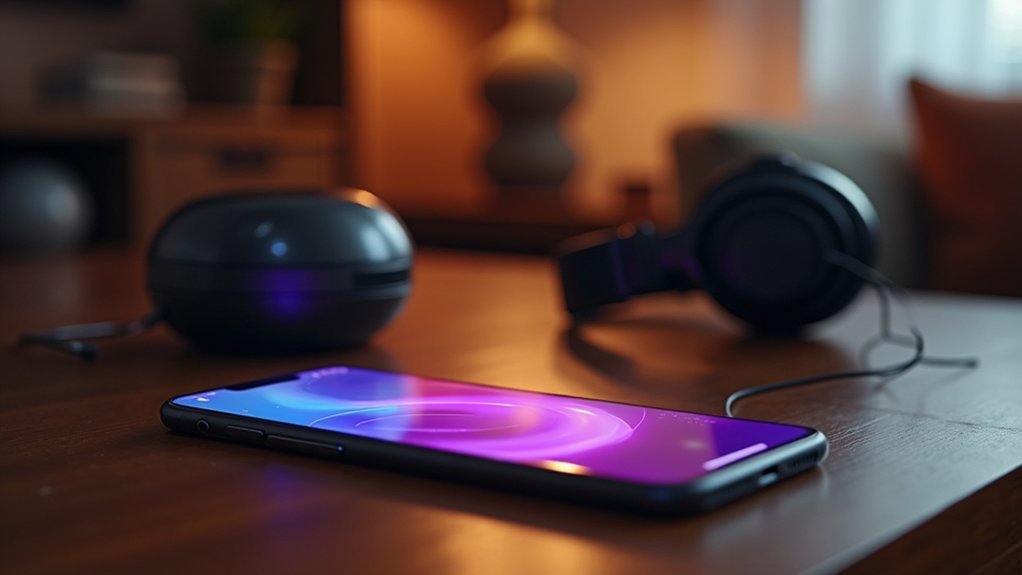
When you’re gaming on your smartphone or streaming your favorite series, high-quality audio systems transform flat, two-dimensional sound into immersive three-dimensional experiences that pull you deeper into the action.
Modern smartphones feature stereo speakers that deliver enhanced clarity and depth, creating richer soundscapes for your entertainment. Advanced spatial audio technologies simulate realistic three-dimensional environments around you.
High-fidelity DACs minimize distortion while providing clearer audio playback for music and multimedia content. Premium features like Dolby Atmos and DTS:X bring surround sound effects directly to your device, greatly enhancing gaming and movie experiences.
Research confirms that immersive sound dramatically improves user engagement, with quality audio boosting focus and retention during educational activities by creating more compelling listening environments.
VR Headset Compatibility Transforms Smartphones Into Immersive Devices
Since your smartphone already packs a high-resolution display and powerful processor, pairing it with a VR headset instantly transforms it into an immersive virtual reality portal.
You’ll experience stunning visual quality when your iPhone or Android device powers these immersive environments through compatible headsets.
VR headsets open interactive educational simulations that make learning science and history incredibly engaging.
VR transforms education by bringing historical events and scientific concepts to life through captivating interactive simulations.
You can explore ancient civilizations or plunge into molecular structures with unprecedented accessibility.
Budget-friendly options like Google Cardboard let you test VR waters without expensive equipment, democratizing this cutting-edge technology.
Your mobile devices become gateways to immersive storytelling and interactive gaming experiences.
As developers create more VR apps specifically designed for smartphones, you’ll discover expanding opportunities for entertainment, education, and professional applications that leverage your phone’s existing capabilities.
External Controllers Add Tactile Interaction Elements
While your smartphone’s touchscreen provides basic interaction, external controllers elevate mobile immersion by delivering precise tactile feedback that makes every tap, swipe, and gesture feel remarkably realistic.
These controllers simulate vibrations and resistance, creating engaging experiences that keep you invested in games and educational apps longer. Research confirms that haptic feedback greatly boosts user satisfaction and retention rates.
You’ll find most external controllers work across multiple devices and platforms, expanding your options considerably. They enable developers to craft complex simulations and virtual reality applications requiring nuanced input.
Whether you’re maneuvering through educational apps or playing intensive games, these controllers transform simple mobile interactions into sophisticated, responsive experiences. This tactile enhancement bridges the gap between basic touchscreen functionality and true mobile immersion.
Augmented Reality Features Blend Digital and Physical Worlds
Your smartphone’s AR capabilities transform learning by overlaying digital content onto real environments, making abstract concepts tangible and interactive.
You can explore 3D anatomical models floating in your living room or walk through historical reconstructions that appear right before your eyes.
These immersive educational experiences aren’t just engaging—they’re proven to improve comprehension and retention compared to traditional learning methods.
AR Educational Tool Integration
When you integrate AR educational tools into your smartphone, you’re accessing technology that transforms abstract concepts into tangible, interactive experiences. Your device becomes a powerful learning platform where digital content overlays the physical world, making complex subjects more understandable and engaging.
Through smartphone use with AR capabilities, you can simulate real-world scenarios safely, practicing skills and applying theoretical knowledge without risk. Studies show you’ll likely score higher on assessments compared to traditional methods, as AR considerably improves retention rates.
Your smartphone’s portability means you can access interactive educational content anywhere, bridging classroom learning with practical application.
With the global AR education market projected to reach $5.3 billion by 2023, you’re part of a revolutionary shift in learning methodologies.
Enhanced Learning Through Immersion
As AR technology advances on smartphones, you’re witnessing the emergence of truly immersive educational environments that seamlessly blend digital content with your physical surroundings.
Mobile phones now transform abstract concepts into tangible, interactive experiences you can manipulate in real-time. When studying anatomy, you’ll see 3D organs floating before you, rotating and dissecting them with simple gestures. Physics becomes visual as you observe molecular structures responding to your touch.
These Augmented Reality (AR) capabilities enhance the learning experience by accommodating your unique learning style and preferences. You’ll take virtual field trips to ancient civilizations or explore microscopic worlds without leaving your classroom.
Research consistently shows that this immersive approach increases your engagement levels and improves retention rates compared to traditional textbook methods, making complex subjects more accessible and memorable.
Low Latency Technology Prevents Motion Sickness
Motion sickness can quickly ruin your mobile immersive experience, but low latency technology offers a powerful solution by dramatically reducing the delay between your input and visual feedback.
When latency drops below 20 milliseconds, it aligns with your natural reflexes and expectations, preventing the disorienting disconnect that triggers nausea.
You’ll notice the difference immediately when your device responds instantly to head movements or touch gestures. This seamless synchronization between perceived and actual movement eliminates the sensory conflicts that cause motion sickness.
High-fidelity haptic feedback enhances this effect by providing immediate tactile responses that perfectly match visual cues.
Advanced solutions like TouchSense mobile software optimize these responses in mobile applications, ensuring you stay comfortable during extended immersive sessions while maintaining complete engagement with your content.
Wireless Connectivity Enables Untethered Virtual Experiences
You’ll experience true freedom when wireless connectivity eliminates the tangle of cables that once restricted your movement in virtual environments.
Your smartphone can now stream high-quality VR content in real-time, maintaining smooth performance without the lag that breaks immersion.
This wireless foundation lets you seamlessly connect multiple devices—from headsets to controllers to sensors—creating a unified ecosystem that responds instantly to your movements.
Freedom From Physical Cables
Nearly every smartphone user has experienced the frustration of tangled cables disrupting their immersive experience. Wireless connectivity eliminates these physical barriers, allowing you to move freely during augmented reality (AR) sessions and virtual interactions. When you’re not constrained by cables, you’ll find yourself more naturally engaged with digital content.
| Aspect | Wired Experience | Wireless Experience | Impact |
|---|---|---|---|
| Movement | Limited range | Full mobility | Enhanced presence |
| Setup | Cable management | Instant connection | Faster engagement |
| Safety | Trip hazards | Clear pathways | Reduced accidents |
| Flexibility | Fixed positions | Dynamic positioning | Natural interactions |
This freedom transforms how you interact with immersive experiences. You’re able to explore virtual environments naturally, respond to haptic feedback without restriction, and maintain the illusion that captivates you in digital worlds.
Real-Time Data Streaming
Beyond the physical freedom of movement, wireless connectivity opens up the real-time data streaming that powers truly immersive virtual experiences.
You’ll access vast cloud-based content instantly, transforming your smartphone into a gateway for live gaming, virtual events, and collaborative learning environments. With 5G technology boosting data transfer speeds, you’re getting high-quality AR and VR content with minimal latency that’s essential for seamless immersion.
Real-time data streaming means you’re no longer limited by your device’s storage capacity. You can tap into massive databases and processing power remotely, enabling complex virtual interactions that would’ve been impossible with standalone hardware.
This wireless connectivity guarantees your immersive experiences remain fluid and responsive, adapting dynamically to your movements and choices without interruption.
Seamless Device Integration
While traditional VR setups tether you to bulky computers with tangled cables, seamless device integration transforms your smartphone into a wireless hub that effortlessly connects with VR headsets, AR glasses, and haptic controllers. Through Bluetooth and Wi-Fi protocols, your phone communicates with gadgets in real-time, eliminating physical limitations that restrict movement during immersive experiences.
| Technology | Benefit | Application |
|---|---|---|
| Bluetooth | Low-power connectivity | Haptic controllers, audio devices |
| Wi-Fi | High-bandwidth data transfer | VR headsets, AR glasses |
| 5G | Ultra-low latency streaming | Cloud-based VR content |
This wireless connectivity liberates your phone’s processing power while you move freely through virtual environments. As mobile hardware advances, seamless device integration enables sophisticated visual rendering and haptic feedback without compromising mobility, creating truly untethered immersive experiences.
Battery Optimization Extends Extended Reality Sessions
As extended reality applications demand increasingly more power from your smartphone, battery optimization becomes the critical factor that determines whether you’ll enjoy uninterrupted immersive sessions or face constant charging breaks.
Advanced management systems intelligently allocate power to XR applications, enhancing performance while maintaining longer durations.
Modern smartphones employ sophisticated techniques to maximize your extended reality experience:
- Adaptive brightness control – automatically adjusts screen intensity based on content and ambient lighting
- Background process management – suspends unnecessary apps to preserve power for XR applications
- Lithium-silicon battery technology – delivers higher energy density compared to traditional lithium-ion batteries
- Intelligent power allocation – prioritizes XR performance while optimizing overall energy consumption
These optimizations support longer-duration interactive content across education, gaming, and professional training applications, ensuring you won’t miss critical moments due to battery depletion.
Frequently Asked Questions
How Can Phones Be Used to Enhance Learning?
You can use phones to access educational resources instantly, experience immersive AR/VR learning, collaborate with classmates in real-time, follow personalized learning paths, and record lectures for later review.
What Are the Positive Effects of Smartphones?
You’ll gain instant access to information, communicate effectively with others, personalize your learning experience, participate in virtual discussions, and access digital resources anywhere, making your daily life more connected and educational.
How Do Smartphones Impact the Environment?
Your smartphone’s production releases 55-95 kg of CO2 emissions while mining destroys habitats. When you dispose of phones improperly, toxic materials contaminate ecosystems. You’re contributing to 50 million tons of annual e-waste.
Why Have Smartphones Been Able to Impact Photography?
You’ve gained access to professional-quality cameras in your pocket, with multiple lenses, advanced sensors, and computational photography features that rival traditional cameras while offering instant editing and sharing capabilities.

Leave a Reply