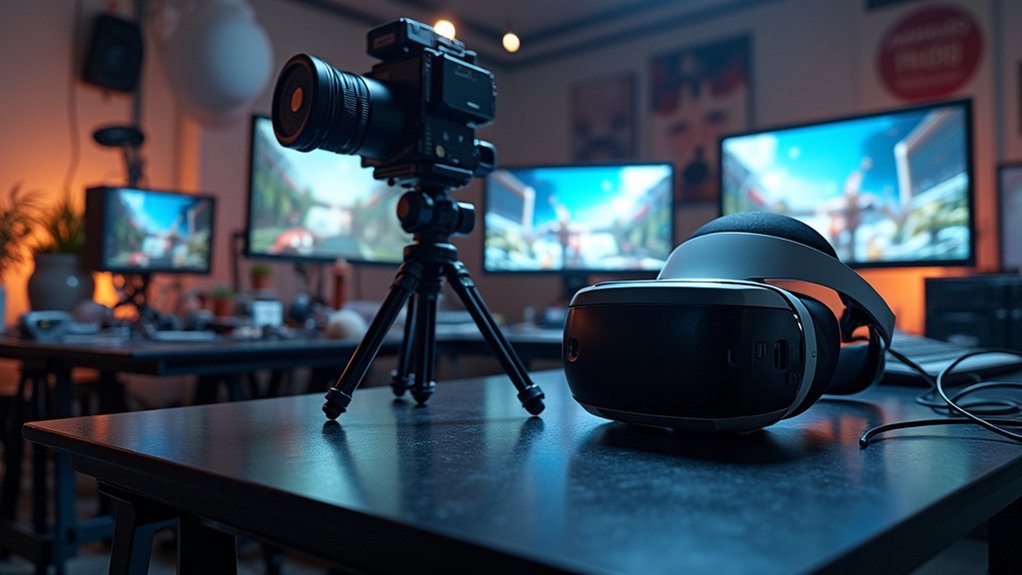
You’ll need specialized 360-degree cameras like the Insta360 Pro 2, which use multiple fisheye lenses to capture immersive footage at 8K resolution or higher. Professional VR filmmaking also requires stereoscopic 3D camera rigs for depth perception, spatial audio equipment including ambisonic microphones for 360-degree soundscapes, and gimbal stabilization systems to eliminate camera shake. High-performance workstations with powerful GPUs and 32GB+ RAM handle the massive data volumes during post-production, while VR headsets let you review your content’s performance across different platforms.
360-Degree Cameras and Multi-Lens Recording Systems
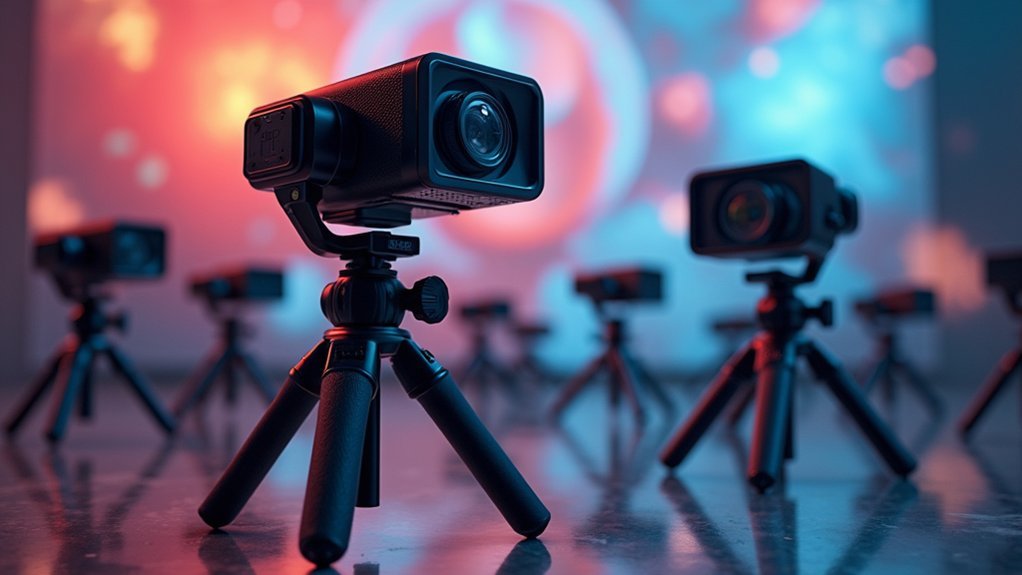
When creating professional VR content, you’ll need specialized cameras that capture footage in all directions simultaneously. 360-degree cameras are essential for producing immersive video that lets viewers explore every angle of your scene.
Multi-lens recording systems like the Insta360 Pro 2 use overlapping fisheye lenses to create high-quality VR experiences with depth perception. These advanced systems target 8K resolution or higher, ensuring crisp playback on VR headsets.
Multi-lens systems with overlapping fisheye cameras deliver professional-grade 8K VR content with enhanced depth perception for premium headset experiences.
Professional 3D-180 cameras offer another approach, using side-by-side fisheye lenses for stereoscopic video that’s perfect for narrative storytelling. However, stitching footage from multiple lenses requires substantial investment, with high-end rigs costing $5,000 to $30,000.
The complexity comes from seamlessly blending multiple camera feeds into cohesive 360-degree content.
Stereoscopic 3D Camera Rigs for Immersive Depth Capture
While 360-degree cameras capture immersive footage, stereoscopic 3D camera rigs take VR filmmaking to the next level by adding realistic depth perception.
These sophisticated camera rigs utilize side-by-side fisheye lenses to create immersive depth that makes viewers feel truly present in virtual environments.
Professional stereoscopic setups like the Insta360 Pro 2 feature six or more lenses, enabling high-resolution 3D-360 video at 8K or greater.
You’ll need advanced computing resources since these systems generate massive data volumes during capture and post-production.
Proper calibration and lens alignment are absolutely critical for your success.
Without precise setup, you’ll encounter visual discrepancies that break immersion.
When properly configured, these rigs deliver a cohesive 3D effect that creates premium viewing experiences for your audience.
Professional Audio Equipment and Spatial Sound Recording

Beyond capturing stunning visuals, you’ll need professional audio equipment that records spatial sound to create truly immersive VR experiences. Binaural microphones are essential, mimicking human hearing patterns to deliver realistic audio that enhances viewer presence.
You’ll also want ambisonic microphones for capturing 360-degree soundscapes, allowing audio to move naturally within the virtual environment from all directions.
Spatial sound recording becomes vital when you’re crafting VR films that demand emotional engagement. Your captured audio won’t reach its full potential without proper editing.
Audio post-production tools like Reaper and Logic Pro X enable you to mix and edit spatial audio effectively, ensuring sound design seamlessly complements your visual elements and creates compelling VR narratives that truly resonate with audiences.
Stabilization Equipment and Specialized VR Mounting Systems
You’ll need robust stabilization equipment to prevent the motion sickness that plagues VR viewers when footage becomes shaky or jittery.
Gimbal stabilization systems provide the smooth, fluid movements essential for comfortable viewing experiences, while specialized VR rig mounting guarantees your 360-degree cameras maintain proper positioning throughout shoots.
These mounting systems accommodate multiple lenses and create the precise camera arrangements necessary for seamless stitching in post-production.
Gimbal Stabilization Systems
Three critical factors make gimbal stabilization systems indispensable for VR filmmaking: they eliminate camera shake, guarantee smooth footage, and prevent viewer motion sickness that can ruin the immersive experience.
You’ll need professional gimbals like the DJI Ronin-S or Moza Air 2, which offer three-axis stabilization and payload capacities that accommodate various VR camera setups.
Specialized equipment such as the Freefly Movi and Insta360 ONE X2’s mounting accessories are specifically designed for 360-degree cameras, maintaining perfect balance during dynamic shots.
These systems integrate advanced features like follow-focus and remote control capabilities, letting you achieve precise movements and angles.
Since sudden movements cause viewer discomfort in VR, investing in quality gimbal stabilization systems isn’t optional—it’s essential for professional results.
VR Rig Mounting
Professional VR rig mounting systems serve as the foundation for achieving broadcast-quality 360-degree footage, providing the structural stability that separates amateur content from cinematic productions. You’ll need specialized mounts that accommodate multi-camera rigs while maintaining precise lens alignment for seamless stitching. These mounting solutions eliminate motion artifacts that can ruin immersive environments.
| Mount Type | Best Use Case | Key Advantage |
|---|---|---|
| Gimbal Systems | Dynamic Movement | Active Stabilization |
| Custom Tripods | Static Shots | Height Flexibility |
| Steadicam Rigs | Walking Sequences | Smooth Motion |
Advanced VR rig mounting incorporates sensors and stabilization technologies specifically designed for 360-degree cameras. You’ll find that professional-grade mounts offer adjustable arms and flexible positioning, enabling creative angles while maintaining the structural integrity essential for high-quality VR content production.
High-Resolution Sensors and Frame Rate Considerations
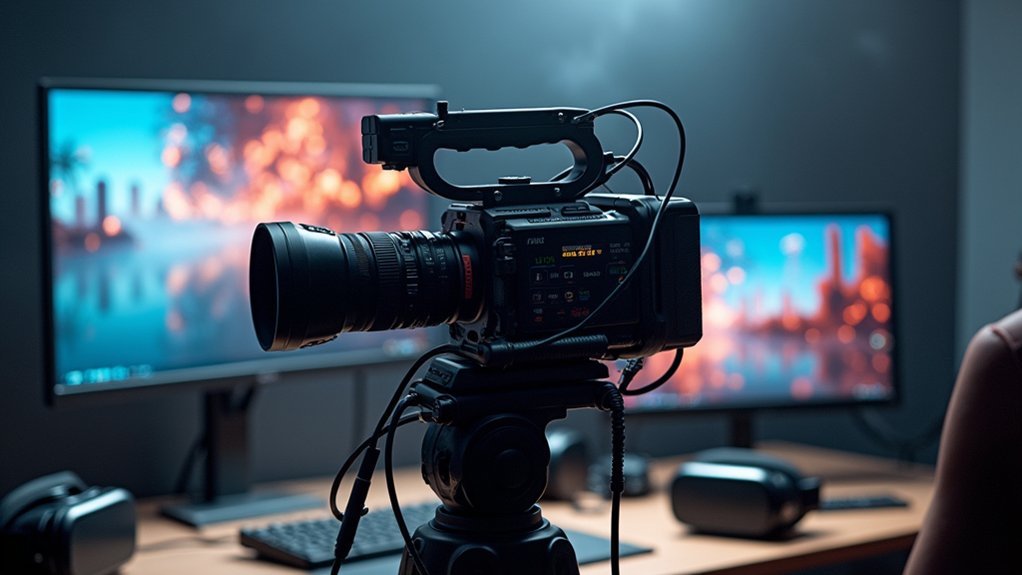
When capturing VR content, your camera’s sensor resolution directly impacts the viewer’s immersion level, with 8K or higher becoming the industry standard for professional 3D-360 productions.
High-resolution sensors are essential since 3D-360 video requires twice the resolution of monoscopic formats to maintain detail and depth perception.
You’ll need to balance frame rate considerations carefully. While 30fps meets minimum requirements, 60fps delivers smoother playback and reduces motion judder during fast movements.
However, higher frame rates create larger file sizes that’ll strain your post-production workflows and demand more processing power.
Don’t overlook sensor size when selecting equipment.
Larger sensors provide superior low-light performance, vital for maintaining quality in dim environments where VR productions often occur.
Stitching Software and Real-Time Preview Solutions
After capturing your multi-camera VR footage, you’ll need powerful stitching software to seamlessly blend those overlapping images into a cohesive 360-degree experience.
Professional options like Adobe Premiere Pro, Kolor Autopano Video, and Mistika VR offer specialized tools for correcting lens distortions and aligning footage from multiple angles.
Professional VR stitching software provides essential lens correction and multi-angle alignment tools for seamless 360-degree video production.
Real-time preview capabilities in software like Mistika VR let you assess stitching quality during production, preventing costly post-production surprises.
Modern stitching software handles high-resolution 360 video processing, with some applications supporting 8K and beyond for exceptional visual fidelity.
Advanced programs integrate spatial audio features, ensuring sound aligns perfectly with your visual environment.
This synchronization creates a truly immersive experience where viewers feel completely transported into your virtual world.
Storage Solutions and Data Management for Large VR Files
One hour of professional VR footage can generate hundreds of gigabytes of data, making storage solutions a critical component of your production pipeline.
You’ll need high-speed SSDs for storing large VR files, as they deliver faster read/write speeds that dramatically reduce loading and processing times during post-production.
Consider implementing RAID configurations to enhance data reliability and performance. These setups combine multiple drives to protect against data loss while improving access speeds for your massive files.
Cloud storage offers scalable solutions that facilitate team collaboration and provide essential off-site backups for data security.
Effective data management requires clear naming conventions and organized folder structures, especially when working with multi-camera setups and extensive footage libraries.
Lighting Equipment Designed for 360-Degree Environments
Since traditional lighting setups create visible shadows and equipment reflections that break VR immersion, you’ll need specialized 360-degree lighting equipment that illuminates every angle seamlessly.
Omnidirectional lights and strategically positioned softboxes provide even illumination across your entire field of view, eliminating harsh shadows that disrupt the viewer’s experience.
LED lighting systems work best for 360-degree environments because they generate minimal heat while offering adjustable color temperature control. You can fine-tune lighting conditions without overheating your equipment or talent.
Light diffusion materials like umbrellas and softboxes create softer illumination, reducing glare and enhancing footage quality.
Position your lights carefully to prevent reflections on camera lenses, which destroy immersion.
Strategic placement guarantees consistent lighting throughout your scene while keeping equipment invisible to viewers exploring your virtual environment.
Post-Production Hardware and Rendering Workstations
Once you’ve captured your 360-degree footage with proper lighting, you’ll need powerful post-production hardware to transform raw VR content into polished experiences.
High-performance rendering workstations equipped with Intel i9 or AMD Ryzen 9 CPUs and NVIDIA RTX 30 series GPUs handle massive data volumes from specialized cameras efficiently.
You’ll require minimum 32GB RAM for smooth VR video editing, especially with 8K resolution content. Dedicated SSD storage with 500+ MB/s speeds prevents bottlenecks when accessing large files.
Multi-monitor setups enhance your workflow by displaying timelines, effects, and previews simultaneously.
Professional editing software like Adobe Premiere Pro and After Effects manages complex post-production tasks including stitching, spatial audio integration, and special effects rendering.
VR Headsets for Professional Content Review and Testing
Multiple professional-grade VR headsets serve as essential tools for reviewing and testing your 360-degree content before final distribution.
Each device offers unique features that enhance your ability to evaluate immersive experience quality and guarantee professional content meets industry standards.
Key VR headsets for professional testing include:
- Meta Quest Pro – Features advanced eye-tracking and face-tracking technology for enhanced user engagement analysis.
- Valve Index VR Kit – Delivers high-quality tracking with precision finger-tracking controllers for serious developers.
- Sony PlayStation VR2 – Provides 2,000 by 2,040 pixels per eye with sharp OLED displays for PlayStation ecosystem testing.
- HTC Vive Pro 2 – Offers exceptional visual fidelity with 2,448 by 2,448 pixels per eye for detailed evaluation.
These headsets enable you to thoroughly assess your VR content’s performance across different platforms and hardware configurations.
Drone Technology and Aerial VR Capture Equipment
You’ll need sophisticated drone camera integration systems to capture stunning aerial VR footage that immerses viewers in expansive, three-dimensional environments.
Your drone setup should include 360-degree camera mounts, like those compatible with the DJI Mavic Air 2, which enable extensive spherical recording from unique aerial perspectives.
Advanced aerial stabilization technology, such as the DJI Ronin-S system, becomes essential for maintaining smooth footage that won’t trigger motion sickness in your VR audience.
Drone Camera Integration Systems
When you’re capturing VR footage from the sky, drone camera integration systems revolutionize your filmmaking capabilities by providing breathtaking aerial perspectives that ground-based equipment simply can’t achieve.
These systems combine drones with 360-degree video cameras to create immersive content that enhances your VR narratives with unprecedented scale and depth.
Professional drone camera setups require several critical components:
- High-quality cameras like the Z Cam S1 paired with advanced drones such as the DJI Inspire 2
- Stabilization technologies including gimbals to eliminate motion blur and maintain smooth footage
- Pre-flight planning to guarantee ideal shot composition and safety compliance
- Regulatory adherence to local aviation laws governing aerial filmmaking operations
These integration systems transform ordinary scenes into visually compelling experiences that captivate viewers through dynamic aerial storytelling.
Aerial Stabilization Technology
Professional aerial stabilization technology forms the backbone of successful VR filmmaking, ensuring your footage maintains the smooth, immersive quality that viewers expect from premium virtual reality content.
You’ll want drones like the DJI Mavic 3 or Skydio 2, which feature advanced gimbal systems and high-resolution cameras capable of 4K recording.
For extensive aerial VR capture, mount 360-degree cameras such as the Insta360 ONE X2 to capture expansive vistas from every angle.
Plan your flight paths carefully using drone software to pre-program routes that avoid sudden movements.
This strategic approach creates immersive VR experiences perfect for real estate showcases, tourism marketing, and adventure storytelling while maintaining professional-grade stability throughout your aerial sequences.
Frequently Asked Questions
What Equipment Is Used for Virtual Reality?
You’ll need 360-degree cameras, stereoscopic equipment, binaural microphones, editing software, sturdy tripods, and drones. These tools capture immersive visuals and spatial audio, creating realistic virtual reality experiences that transport viewers into completely different environments.
What Do You Need to Make VR Videos?
You’ll need 360-degree cameras for capturing immersive footage, sturdy tripods for stability, binaural microphones for spatial audio, post-production software like Adobe Premiere Pro for stitching, and VR headsets for testing your final content.
How Are VR Movies Made?
You’ll create VR movies by capturing footage with 360-degree cameras, planning scenes for immersive viewing, stitching multiple angles together during post-production, and integrating spatial audio to deliver seamless, engaging experiences for viewers.
What Technology Is Used to Create Virtual Reality?
You’ll use specialized 360-degree cameras, stereoscopic rigs, binaural microphones for spatial audio, and advanced editing software like Adobe Premiere Pro to stitch footage and create immersive virtual reality experiences.

Leave a Reply