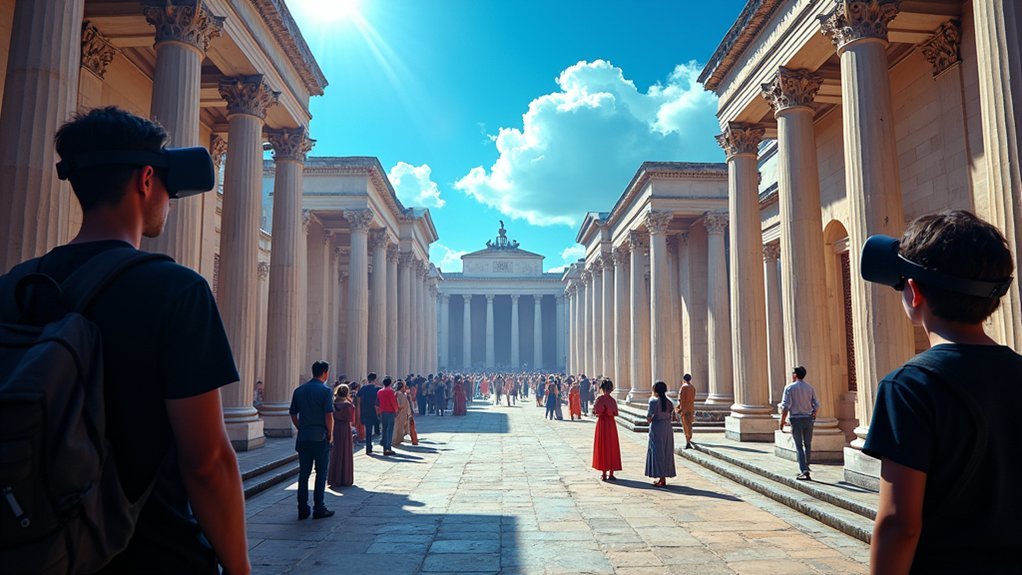
You’ll find exceptional historical reconstruction through Timelooper VR’s George Washington inauguration experience, Lithodomos Virtual Rome’s ancient temple recreations, and Google’s Open Heritage Project covering 26 global sites. Spike Island AR reconstructs 6th-century monasteries, while Monto District Dublin revives Victorian neighborhoods. Don’t miss National Geographic’s Viking cultural immersion, Avebury’s prehistoric stone circles, and Waterford’s shop overlays. These projects transform passive learning into engaging time travel experiences that make history tangible and accessible through cutting-edge technology that’ll transport you across centuries.
Timelooper VR: Experiencing George Washington’s Inauguration and Historical Moments
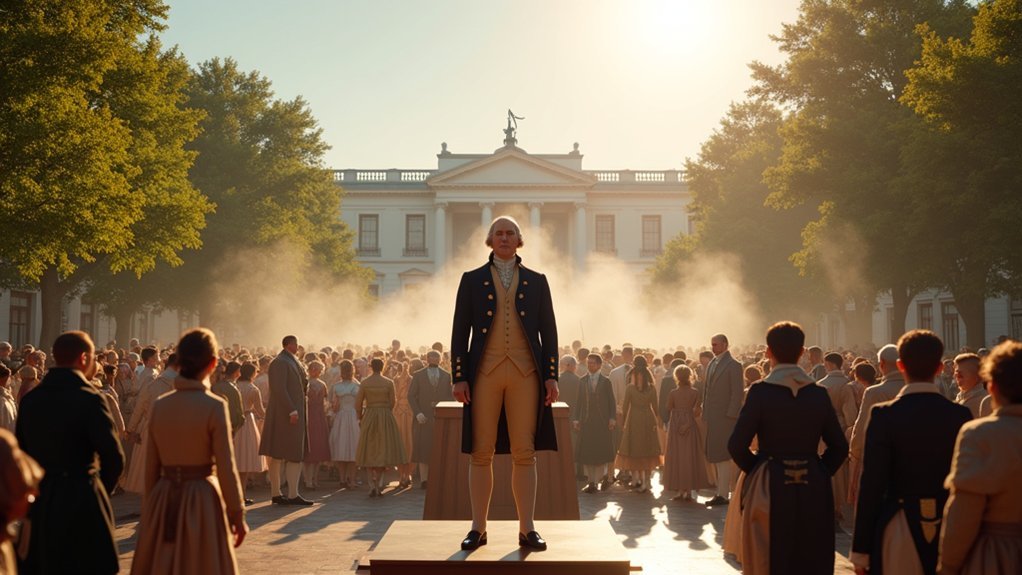
When you step into Timelooper VR, you’re transported directly to Federal Hall in 1789 to witness George Washington taking his oath as America’s first president. You’ll experience this pivotal moment through immersive virtual reality that makes history tangible and engaging.
Step into 1789 and witness George Washington’s presidential oath at Federal Hall through immersive virtual reality that makes history tangible.
Timelooper doesn’t stop at presidential inaugurations. You can explore remastered 360-degree visuals of the John Lennon Memorial in 1980 or witness the Pearl Harbor attacks through cultural VR content from TIME magazine.
These experiences bridge the gap between traditional augmented reality (AR) and full immersion, creating interactive historical encounters.
The app transforms how you consume historical content by letting you witness and interact with significant events. Timelooper’s technology makes pivotal moments accessible to modern audiences, turning passive learning into enthralling experiences that transport you across centuries.
Lithodomos Virtual Rome: Immersive Recreations of Ancient Roman Architecture
You’ll find Lithodomos VR’s reconstructions of iconic sites like the Temple of Venus and Rome showcase impressive temple reconstruction accuracy through meticulous research and expert collaboration.
Their advanced 360-degree VR technology transports you directly into ancient Roman architecture, creating an immersive experience that goes beyond traditional visual learning.
However, you should consider the archaeological fidelity concerns raised by experts who question whether these digital recreations can truly capture the authentic historical reality of these ancient structures.
Temple Reconstruction Accuracy
Although reconstructing ancient temples presents immense technical challenges, Lithodomos VR has established itself as a leader in creating historically accurate virtual representations of Roman architecture. You’ll discover their temple reconstruction accuracy relies heavily on archaeological research and expert consultation, ensuring authentic portrayals of structures like the Temple of Venus and Rome. Their AR experiences transport you back in time through advanced 360-degree technology.
| Accuracy Factor | Lithodomos Approach | Result |
|---|---|---|
| Archaeological Research | Expert collaboration with historians | Authentic structural details |
| Digital Artistry | Continuous refinement processes | Visually stunning recreations |
| Public Access | Broad audience engagement | Enhanced historical understanding |
You’ll find these immersive experiences bridge knowledge gaps about ancient Roman architecture while maintaining rigorous historical standards through ongoing collaboration between archaeologists and digital artists.
360-Degree VR Technology
Lithodomos VR’s 360-degree technology transforms how you experience ancient Roman architecture by creating fully immersive digital environments that capture every architectural detail.
You’ll find yourself standing within meticulously reconstructed spaces like the Temple of Venus and Rome, where advanced 3D modeling reveals the original grandeur of these iconic structures.
This virtual reality platform doesn’t just show you ruins—it transports you to witness these monuments in their historical prime.
You’re experiencing cutting-edge technology that collaborates with archaeologists to guarantee historical accuracy in every reconstruction.
The detailed modeling captures architectural elements you’d never see in today’s deteriorated ruins, making ancient Roman sites accessible regardless of your physical location.
You’re fundamentally traveling through time using digital craftsmanship.
Archaeological Fidelity Concerns
While this immersive technology offers unprecedented access to ancient Rome, serious questions emerge about how accurately these digital reconstructions represent historical reality.
You’ll find that archaeologists express legitimate archaeological fidelity concerns about VR representations, emphasizing that maintaining educational value requires unwavering commitment to authenticity. When you explore these virtual environments, you’re experiencing interpretations that may not fully capture the complexities and nuances of ancient Roman architecture and culture.
However, you should know that Lithodomos actively addresses these archaeological fidelity concerns by collaborating directly with historians and archaeologists.
They’re constantly updating their reconstructions based on the latest research and archaeological findings. You’re witnessing an ongoing effort to balance artistic interpretation with historical accuracy, though the technology’s limitations in reconstructing the past remain a valid consideration for educational applications.
Google’s Open Heritage Project: 3D Models of Global Cultural Sites
When you explore Google’s Open Heritage Project, you’re accessing one of the most ambitious digital preservation initiatives ever undertaken. This collaboration between Google and CyArk transforms how you experience cultural heritage through advanced 3D modeling technology.
You’ll discover 26 heritage sites across 18 countries, from Pompeii’s ancient streets to Native American cliff dwellings, all rendered in stunning detail.
The project excels at digital storytelling, allowing you to virtually walk through sites you might never visit physically. You’re witnessing democratized access to global heritage, where immersive digital representations preserve these treasures for future generations.
Each freely available 3D model bridges geographical barriers, fostering worldwide appreciation for diverse histories while ensuring these irreplaceable sites remain accessible regardless of physical limitations or global circumstances.
Spike Island AR: Reconstructing 6th-Century Monasteries and Children’s Prisons
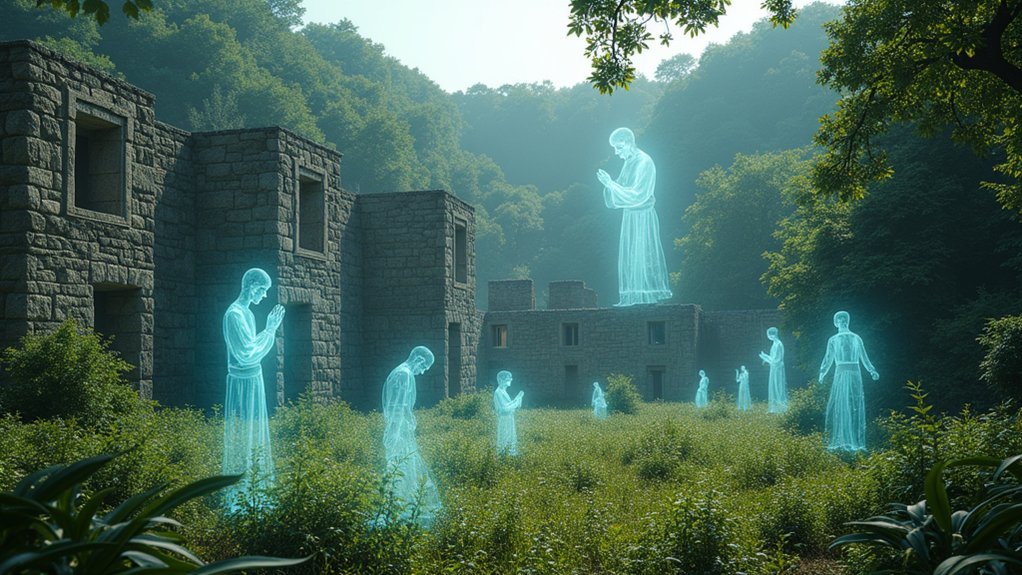
Building on this foundation of digital heritage preservation, Spike Island AR demonstrates how augmented reality can reconstruct multiple historical periods within a single location. You’ll experience immersive overlays that bring the 6th-century monastery to life, visualizing ancient architecture and daily monastic routines. The technology also recreates the harsh realities of the Children’s Prison, providing historical context through detailed reconstructions.
| Historical Period | AR Experience | Visitor Engagement Feature |
|---|---|---|
| 6th Century | Monastery reconstruction | Interactive daily life scenarios |
| Victorian Era | Children’s Prison recreation | Personal inmate stories |
| Multiple Periods | Layered historical overlays | Emotional storytelling elements |
You’ll engage with personal narratives of past inhabitants, creating deeper emotional connections to history. This project exemplifies how AR bridges historical facts with human experiences, making centuries-old stories accessible and compelling for modern audiences.
Monto District Dublin: AR Recreation of Lost Victorian-Era Neighborhoods
Imvizar’s groundbreaking AR technology transforms Dublin’s former Monto district into a window to Victorian-era street life, reconstructing neighborhoods that vanished decades ago.
You’ll walk through digitally recreated streets where bustling shops and diverse establishments once thrived, experiencing the vibrant social dynamics that defined this historic area.
The AR recreations let you interact with historical figures from the past, bringing Victorian Dublin’s cultural complexity to life through immersive experiences.
You’re not just observing history—you’re stepping into it. This innovative approach preserves historical memory while serving as a powerful educational tool for locals and tourists alike.
This technology bridges past and present, transforming historical education into an immersive journey that engages both residents and visitors.
The project demonstrates how cutting-edge technology can revive lost urban landscapes, offering unprecedented insights into Dublin’s rich social history through visually compelling, interactive storytelling.
Chambers Building Sydney: Virtual Resurrection of Demolished Architectural Heritage

You’ll discover how Sydney’s lost Chambers Building has been brought back to life through cutting-edge AR technology that recreates its Victorian-era grandeur for modern audiences.
The project demonstrates sophisticated reconstruction methods that capture intricate architectural details from the demolished 19th-century commercial landmark.
You can now experience this vanished piece of Sydney’s heritage through mobile devices, creating new opportunities for heritage tourism and historical education.
Original Building’s Historical Significance
Standing as a symbol of Victorian grandeur, the Chambers Building represented one of Sydney’s most striking examples of 19th-century commercial architecture before its unfortunate demolition in 1971.
You’ll discover that this remarkable structure served as more than just another commercial building—it embodied the ambitious spirit of Sydney’s rapid urban development during the late Victorian era.
The building’s significance extends beyond its ornate façade and elaborate cornices.
You’re witnessing architectural craftsmanship that defined an entire generation of Sydney’s commercial landscape.
Among historical sites, the Chambers Building stood out for housing diverse businesses that shaped the city’s economic growth.
Its intricate design elements reflected the prosperity and artistic sensibilities of the 1890s, making it an irreplaceable piece of Sydney’s architectural heritage that AR technology now helps preserve.
AR Reconstruction Technology Methods
While traditional reconstruction methods rely on physical materials and lengthy construction processes, AR technology transforms historical documentation into immersive digital experiences within minutes.
You’ll discover how detailed 3D modeling forms the foundation of the Chambers Building’s virtual resurrection. Developers meticulously analyzed historical records and photographs to create accurate visual representations of the structure’s architectural features.
The augmented reality system employs geospatial anchoring techniques that position virtual elements precisely within the original site location. You can interact with AR overlays that reveal the building’s historical context and cultural significance.
This sophisticated approach combines historical accuracy with cutting-edge technology, creating an immersive experience that brings demolished heritage back to life. The project demonstrates how digital preservation methods can effectively maintain architectural legacy for future generations.
Heritage Tourism Impact
The Chambers Building’s AR reconstruction has fundamentally transformed Sydney’s heritage tourism landscape by creating an entirely new category of visitor experience.
You’ll discover that this innovative approach attracts both traditional history enthusiasts and tech-savvy tourists seeking cutting-edge digital experiences.
The heritage tourism impact extends beyond simple sightseeing, as you can now explore detailed architectural elements and historical contexts that would’ve been lost forever.
Through augmented reality, you’re experiencing a resurrection of lost social spaces that foster deeper cultural connections.
This technology bridges past and present, allowing you to engage with Sydney’s architectural heritage in ways previously impossible.
You’ll find that this virtual reconstruction enhances the area’s tourism appeal while preserving historical narratives for future generations.
Waterford’s Anastasia Fleming Shop: AR Overlay on Partial Historical Remains
When you visit the remnants of Anastasia Fleming’s shop in Waterford, augmented reality transforms scattered stones and partial walls into a vivid window to the past. You’ll witness how AR technology overlays historical details onto existing structures, breathing life into fragments that might otherwise seem unremarkable.
| AR Feature | Historical Impact |
|---|---|
| Visual reconstruction | Reveals original craftsmanship |
| Interactive timeline | Shows shop’s evolution |
| Audio narratives | Connects personal stories |
| 3D modeling | Displays missing architecture |
| Cultural context | Explains local significance |
Through this immersive experience, you’ll appreciate Waterford’s heritage in ways traditional tours can’t offer. The project demonstrates how augmented reality bridges past and present, ensuring forgotten stories don’t disappear. You’re not just observing history—you’re experiencing it firsthand, fostering deeper connections with local culture.
National Geographic VR: Viking Fighting Pits and Ancient Cultural Experiences
As you step into National Geographic’s Viking fighting pits through VR, you’re transported directly into the heart of ancient Norse culture where warriors once clashed in brutal combat.
The 360-degree visuals immerse you in authentic historical atmospheres, letting you witness the raw intensity and complex social dynamics of Viking warfare firsthand.
You’ll experience advanced VR technology that makes historical education both accessible and engaging, especially if you can’t physically visit these ancient sites.
The interactive storytelling approach delivers exceptional entertainment value while fostering genuine appreciation for cultural heritage.
Interactive storytelling transforms entertainment into meaningful cultural education, creating lasting appreciation for our shared historical heritage.
This initiative exemplifies how virtual reality bridges gaps in historical knowledge, encouraging deeper exploration of ancient civilizations through visceral, immersive experiences that traditional learning methods simply can’t match.
Avebury Neolithic Settlement: 3D Modeling of Prehistoric Archaeological Sites
You’ll experience one of Europe’s most ambitious prehistoric reconstruction projects through Liz Falconer’s 3D modeling work at the Avebury Neolithic settlement, where cutting-edge digital documentation captures 4,600-year-old stone circles in stunning detail.
The interactive virtual environment lets you explore the UNESCO World Heritage site’s massive monuments and settlement structures, revealing how advanced archaeological excavation techniques translate ancient discoveries into immersive digital experiences.
You can navigate through reconstructed Neolithic landscapes that showcase prehistoric community organization, ritual spaces, and the sophisticated planning behind these monumental stone arrangements.
Archaeological Excavation Digital Documentation
While traditional archaeological excavation methods rely on physical documentation through drawings and photographs, the Avebury Neolithic settlement project revolutionizes this approach by employing cutting-edge 3D modeling techniques to capture every detail of prehistoric archaeological sites.
You’ll discover how advanced photogrammetry and laser scanning create thorough digital records that preserve archaeological context with unprecedented accuracy.
Using AR enhances your documentation process by allowing real-time visualization of buried structures and artifact positions. This collaborative effort between archaeologists, artists, and technologists guarantees authentic representation of findings.
Key benefits include:
- Detailed digital preservation of megalithic structures and landscape features
- Virtual exploration capabilities for researchers and public engagement
- Enhanced research potential through accurate 3D reconstructions
- Model framework for future prehistoric cultural heritage projects
Neolithic Settlement Virtual Reconstruction
Something extraordinary happens when you step into the Avebury Neolithic Settlement’s virtual reconstruction—advanced 3D modeling brings a 5,000-year-old world to life with stunning archaeological accuracy.
You’ll explore prehistoric structures through high-resolution scans and photogrammetry that create precise digital replicas of artifacts and architectural elements. This powerful tool transforms how you understand Neolithic daily life and community organization.
You can interact with the site virtually, discovering social and cultural practices of ancient inhabitants while researchers maintain strict archaeological fidelity.
Every digital element aligns with historical findings from actual excavations. This project demonstrates technology’s ability to bridge gaps in historical understanding, setting a standard for future reconstructions that’ll enhance public engagement with heritage sites worldwide.
Interactive Prehistoric Site Exploration
How does cutting-edge 3D modeling transform your exploration of one of Britain’s most significant prehistoric monuments?
At Avebury, you’ll experience an unprecedented journey through time that brings Neolithic life into stunning reality.
Liz Falconer’s innovative approach combines archaeological precision with advanced digital reconstruction, allowing you to walk among ancient megaliths and earthworks as they appeared millennia ago.
This immersive experience offers you:
- Detailed megalith visualization – Explore towering stone circles in their original configurations
- Interactive earthwork exploration – Navigate complex prehistoric landscapes and ceremonial spaces
- Cultural practice insights – Witness daily rituals and social activities of Neolithic inhabitants
- Educational time-travel – Bridge thousands of years through cutting-edge mixed reality technology
You’ll gain deeper appreciation for this UNESCO World Heritage site’s archaeological significance while experiencing prehistoric architecture firsthand.
Salesforce Dublin Tower: Internal Reconstruction of the Old Railway Hotel
Innovation meets preservation at Dublin’s Salesforce Tower, where you’ll discover a remarkable AR experience that brings the vanished Old Railway Hotel back to life.
You’ll step into a meticulously crafted virtual reconstruction that captures every architectural detail and social atmosphere of this historically significant site. Through immersive augmented reality, you can interact with elements that recreate the hotel’s original environment, offering deep insights into its cultural context.
This groundbreaking project demonstrates how AR technology bridges modern spaces with their historical narratives. You’re not just observing history—you’re experiencing it firsthand.
The reconstruction preserves emotional connections to the past while making historical knowledge accessible to everyone. Whether you’re sharing your experience on a YouTube channel or simply exploring, you’ll appreciate how technology transforms learning into an unforgettable journey through time.
Frequently Asked Questions
How Can VR Be Used in History?
You can use VR to experience historical events firsthand, explore ancient sites virtually, interact with historical objects, and engage in immersive learning that transforms traditional history education into compelling experiences.
What Is Mixed Reality in Construction?
You’ll use mixed reality in construction to overlay digital 3D models onto real-world job sites, letting you visualize designs, collaborate with remote teams, and make real-time adjustments to reduce errors.
What Are the Three Types of Augmented Reality?
You’ll encounter three main AR types: marker-based AR using QR codes or images as triggers, markerless AR relying on GPS and sensors, and projection-based AR projecting digital content onto physical surfaces.
What Countries Are Using Augmented Reality?
You’ll find many countries using augmented reality, including the United States, China, Japan, Germany, and South Korea. They’re implementing AR across industries like healthcare, education, retail, manufacturing, and entertainment for various applications.

Leave a Reply