
You’ll find exceptional inside-out tracking with the VIVE Ultimate Tracker 3+1 Kit’s 6DoF movement capture, Meta Quest Pro’s precise hand and eye tracking, and Varjo Aero’s sophisticated computer vision technology. The Pico 4 Enterprise offers advanced SLAM mapping, while HTC VIVE XR Elite provides lightweight dual-camera arrays. Microsoft HoloLens 2 delivers holographic processing, Magic Leap 2 creates spatial anchors, and Lynx R1 features open-source flexibility with Ultraleap hand tracking. Each system eliminates external sensors while maintaining professional-grade accuracy for your specific virtual reality needs.
VIVE Ultimate Tracker 3+1 Kit – Full-Body Precision Without Base Stations
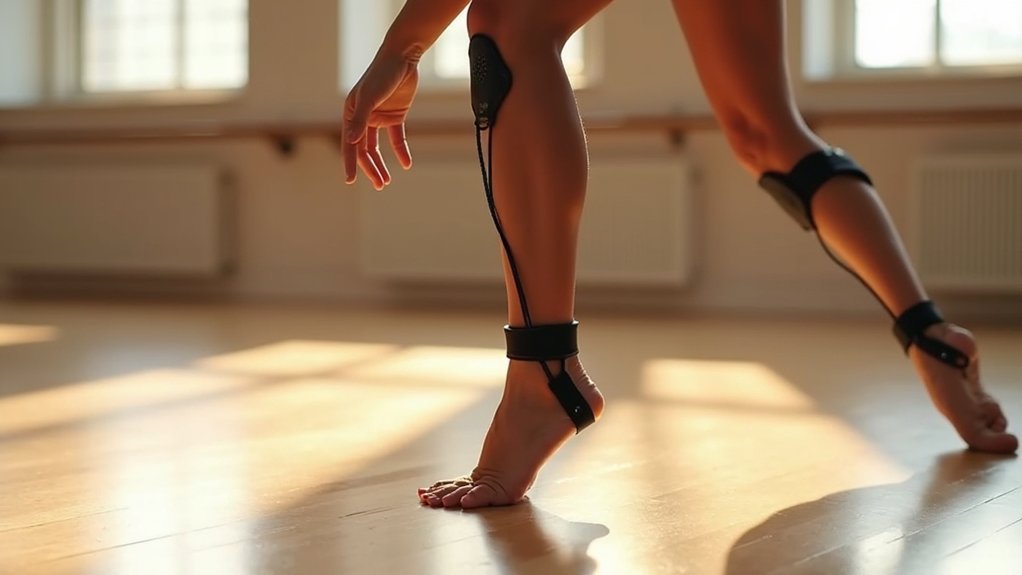
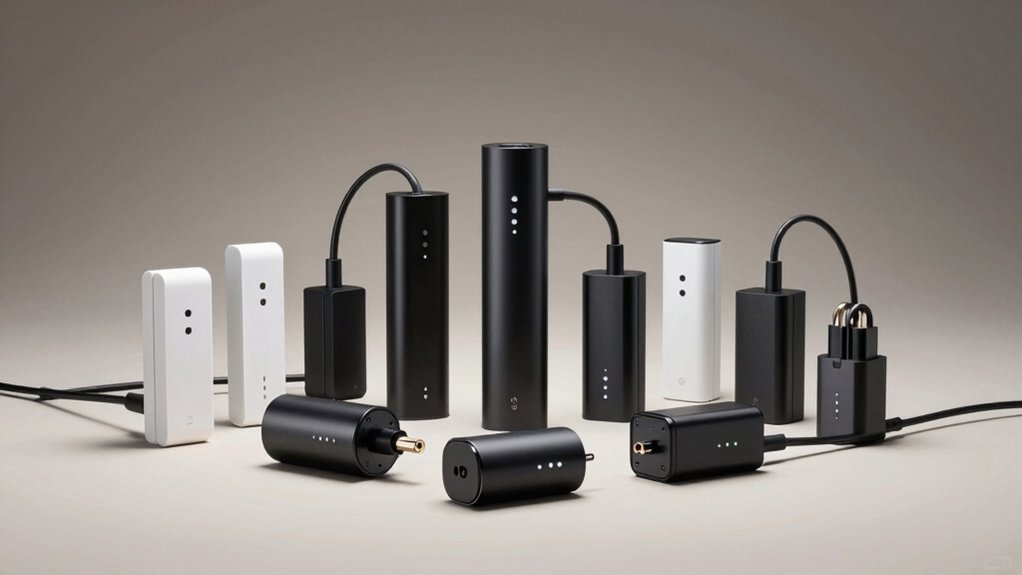
Freedom from bulky base stations transforms how you experience full-body tracking with the VIVE Ultimate Tracker 3+1 Kit.
You’ll get three trackers and one wireless dongle that deliver precise movement capture without external setup requirements.
The system uses 6DoF inside-out tracking to monitor your head, hands, waist, and feet in real-time.
Two wide-FOV cameras provide instant spatial recognition while advanced computer vision technology synchronizes your virtual and physical movements seamlessly.
Advanced computer vision algorithms instantly map your environment while dual wide-angle cameras ensure your every movement translates perfectly into virtual reality.
You’ll appreciate the compact, balanced design that prioritizes comfort and functionality.
The quick-release mechanism lets you attach trackers to various objects effortlessly.
With 7-hour battery life and 2.2-hour charging using Qualcomm Quick Charge 3.0, you’ll spend more time moving and less time waiting.
Meta Quest Pro – Enterprise-Grade Hand and Eye Tracking
You’ll find the Meta Quest Pro’s hand tracking capabilities represent a significant leap forward in enterprise VR applications, utilizing embedded sensors to capture precise finger movements and gestures without external hardware.
The system’s eye tracking precision enables natural interaction through gaze-based navigation and foveated rendering, reducing computational load while enhancing visual quality where you’re looking.
These advanced tracking features work together seamlessly, allowing you to manipulate virtual objects with natural hand movements while the headset accurately follows your eye movements for intuitive control.
Advanced Hand Tracking Features
While traditional VR systems rely heavily on handheld controllers, the Meta Quest Pro revolutionizes enterprise interactions through its sophisticated hand and eye tracking capabilities.
You’ll experience precise hand tracking powered by high-resolution cameras and machine learning algorithms that capture your movements in real-time. The system’s depth sensors and infrared technology guarantee reliable performance across varying lighting conditions and complex backgrounds.
You can navigate virtual environments through intuitive gestures and subtle eye movements, greatly reducing your dependence on physical controllers.
This seamless integration creates more natural interactions in virtual meetings and collaborative workspaces. The advanced tracking technology enhances your productivity and engagement, making enterprise-grade applications more accessible and immersive than ever before.
Eye Tracking Precision
When it comes to eye tracking precision, the Meta Quest Pro delivers unprecedented accuracy with gaze detection within less than 1 degree of your actual focus point.
You’ll experience enterprise-grade technology that captures even subtle eye movements and translates them into virtual actions seamlessly. The advanced algorithms provide real-time feedback, letting you control applications and interfaces intuitively through natural gaze patterns.
This precise eye tracking considerably enhances foveated rendering performance by optimizing graphics processing. The system reduces rendering workload in your peripheral vision areas while maintaining sharp detail where you’re looking.
You’ll find these capabilities particularly valuable in professional applications like design workflows, training simulations, and remote collaboration sessions, where natural eye-based interactions create more immersive and efficient virtual experiences.
Varjo Aero – Professional Mixed Reality With Computer Vision
You’ll find the Varjo Aero takes professional mixed reality to the next level through its sophisticated computer vision technology that eliminates external tracking hardware.
The headset’s embedded sensors work together to create precise spatial mapping and movement detection, giving you freedom to operate in various environments without complex setup requirements.
This computer vision approach delivers the low-latency, high-stability tracking performance you need for professional applications like training simulations and design workflows.
Computer Vision Technology
As computer vision technology advances in professional mixed reality applications, the Varjo Aero headset demonstrates how sophisticated tracking systems can transform virtual movement experiences. You’ll benefit from dual 12 MP cameras that work with high-quality optics to create accurate spatial mapping and environment recognition. The headset’s low-latency algorithms minimize occlusion issues, ensuring stable performance in dynamic environments.
| Feature | Capability |
|---|---|
| Camera System | Dual 12 MP cameras with advanced optics |
| Tracking Performance | Low-latency with minimal occlusion issues |
| Professional Applications | Full-body tracking for training simulations |
You can integrate this computer vision technology seamlessly with Unity and Unreal Engine through Varjo’s proprietary software. This compatibility enables easy content creation while supporting full-body tracking for professional training simulations and interactive gaming applications.
Professional Mixed Reality
Professional mixed reality applications demand more than just advanced computer vision—they require headsets that can handle complex workflows while maintaining visual excellence.
The Varjo Aero delivers precisely this combination through its sophisticated inside-out tracking system, eliminating external sensors while providing exceptional spatial awareness.
You’ll experience seamless blending of physical and virtual environments thanks to dual mini-LED displays that produce vivid colors and sharp details across a wide field of view.
The lightweight, ergonomic design guarantees comfort during extended professional sessions, whether you’re conducting design reviews, training simulations, or complex visualizations.
What sets the Aero apart is its compatibility with existing VR and mixed reality software, allowing you to integrate it into established workflows across industries without disrupting your current tools and processes.
Pico 4 Enterprise – Advanced SLAM Technology for Business Applications
While most VR headsets struggle with complex business environments, the Pico 4 Enterprise sets itself apart through its advanced SLAM (Simultaneous Localization and Mapping) technology that delivers precise real-time tracking and environmental mapping.
You’ll experience smooth virtual movement with its inside-out tracking system that eliminates external sensors, making setup effortless across different business locations.
The headset’s 2160 x 2160 per eye resolution and 90 Hz refresh rate guarantee crystal-clear visuals during extended professional use.
You’ll appreciate the ergonomic design that prevents discomfort during lengthy training sessions or simulations.
Whether you’re conducting virtual training, running collaborative workspaces, or performing complex simulations, the Pico 4 Enterprise’s stable tracking technology enhances productivity and engagement in demanding business applications.
HTC VIVE XR Elite – Lightweight Design With Dual Camera Arrays
The HTC VIVE XR Elite takes inside-out tracking to new heights with its exceptionally lightweight 785-gram design and sophisticated dual camera arrays.
You’ll experience enhanced comfort during extended VR sessions while benefiting from advanced spatial recognition technology that eliminates external sensor requirements.
The headset’s inside-out tracking system delivers precise 6DoF movement detection, allowing seamless interaction within virtual environments.
You can move freely through gaming experiences and training simulations with consistent accuracy.
The dual cameras function effectively across various lighting conditions, ensuring reliable performance regardless of your environment’s complexity.
Setup becomes effortless with the XR Elite’s compact, integrated sensor design.
You’ll shift quickly into immersive experiences without complicated installations, making it ideal for both entertainment and professional applications where mobility and convenience matter most.
Apple Vision Pro – Spatial Computing With Real-Time Environment Mapping
You’ll find the Apple Vision Pro takes inside-out tracking to new heights with its real-time environment mapping that continuously scans and understands your physical space.
The device’s spatial computing capabilities let you interact naturally with digital content that’s precisely anchored to your real-world surroundings.
This advanced mapping system updates dynamically as you move, ensuring virtual objects remain perfectly positioned relative to your environment.
Real-Time Environment Mapping
When you put on the Apple Vision Pro, advanced computer vision algorithms immediately begin mapping your environment in real time, creating a foundation for seamless spatial computing experiences.
The device combines high-resolution cameras and sensors to construct detailed 3D maps of your surroundings, ensuring accurate tracking and spatial awareness throughout your session.
You’ll notice how the Vision Pro’s spatial computing capabilities detect and respond to physical objects instantly, enhancing your interaction with virtual elements.
The system leverages SLAM technology to maintain precise tracking even when lighting conditions change around you.
This real-time environment mapping enables immersive augmented reality applications by overlaying digital content onto your mapped physical space, delivering a cohesive mixed reality experience that feels natural and responsive.
Spatial Computing Capabilities
Building upon this environmental awareness, Apple Vision Pro’s spatial computing capabilities transform how you interact with digital content in three-dimensional space. The device’s inside-out tracking technology enables seamless blending of virtual and physical objects, creating unprecedented interaction possibilities.
| Feature | Capability | Benefit |
|---|---|---|
| Surface Recognition | Detects walls, floors, furniture | Accurate object placement |
| Obstacle Detection | Maps environmental barriers | Safe navigation |
| Multi-user Tracking | Recognizes other users | Shared experiences |
Your Vision Pro’s computer vision algorithms maintain tracking stability in complex environments, minimizing occlusion issues that typically plague mixed reality systems. This precision supports diverse applications from augmented reality experiences to advanced gaming, where accurate spatial understanding becomes essential for immersive interactions with both digital content and real-world surfaces.
Microsoft HoloLens 2 – Holographic Processing for Industrial Training
Although industrial training has traditionally relied on static documentation and classroom instruction, Microsoft’s HoloLens 2 revolutionizes this approach through its advanced holographic processing capabilities that transform how workers learn complex procedures.
You’ll experience immersive mixed reality training that leverages inside-out tracking technology, eliminating external sensors while providing precise spatial mapping and environmental understanding.
The device’s high-resolution displays and 90-degree field of view let you visualize 3D holograms with exceptional clarity in your real workspace.
You’ll interact naturally through integrated hand and eye tracking, making training simulations more intuitive.
The HoloLens 2 supports remote assistance, step-by-step guidance, and collaborative workflows, greatly improving your learning outcomes and operational efficiency in industrial environments.
Magic Leap 2 – Spatial Anchors and Persistent Digital Content
Magic Leap 2 takes mixed reality experiences beyond the training applications of HoloLens 2 by introducing sophisticated spatial anchoring technology that creates permanent digital landmarks in your physical environment. You’ll experience persistent virtual content that remembers exactly where you placed it, even after powering down the device.
| Feature | Specification |
|---|---|
| Field of View | Wide-angle coverage |
| Sensor Quality | High-resolution, low-latency |
| Lighting Adaptation | All conditions supported |
| Content Persistence | Full spatial memory |
| Tracking Accuracy | Real-time precision |
The advanced VR tracking system utilizes inside-out sensors that continuously map your surroundings, creating spatial anchors that lock digital objects to specific physical locations. You can return to previously marked spaces and interact with the same virtual elements exactly where you left them, maintaining seamless continuity across sessions.
Lynx R1 – Open Source Mixed Reality With Ultraleap Hand Tracking
While most mixed reality headsets lock you into proprietary ecosystems, the Lynx R1 breaks this mold by delivering an open-source platform that puts development freedom directly in your hands.
Unlike competitors that trap users in closed systems, the Lynx R1 empowers developers with complete creative control through its open-source architecture.
You’ll experience precise interactions through advanced inside-out tracking combined with Ultraleap hand tracking technology, eliminating the need for controllers while enabling natural gesture recognition.
The dual 4K displays deliver crisp visuals across a wide field of view, while integrated spatial audio responds dynamically to your movements.
You can wear the lightweight, ergonomic headset comfortably during extended sessions without fatigue.
What sets the Lynx R1 apart is its open-source foundation, which empowers you and the developer community to create custom applications and push the boundaries of mixed reality experiences beyond traditional limitations.
ByteDance Pico 4 – AI-Powered Movement Recognition for Social VR
ByteDance takes a different approach with the Pico 4, focusing specifically on AI-powered movement recognition that transforms how you interact with others in social VR environments.
This lightweight 295-gram headset delivers impressive 2160 x 2160 pixel per eye resolution, ensuring crystal-clear visuals during virtual gatherings.
The Pico 4’s standout feature lies in its advanced AI-powered movement recognition technology, which creates more intuitive and natural interactions with other users.
You’ll appreciate the seamless 6DoF inside-out tracking that eliminates external sensor requirements, making setup effortless across different locations.
Supporting multiple social VR platforms, you can connect with diverse user communities in shared virtual spaces.
The comfortable design enables extended social sessions without fatigue, while the sophisticated tracking system captures your movements with remarkable precision for authentic virtual presence.
Frequently Asked Questions
How Do You Perform Inside-Out Tracking in VR?
You’ll use onboard cameras and sensors in your VR headset to scan your surroundings. Computer vision algorithms process this visual data, creating a map of your environment and tracking your head and controller movements in real-time.
What VR Headsets Have Inside-Out Tracking?
You’ll find inside-out tracking on several popular headsets including the Oculus Quest 2, Microsoft HoloLens 2, VIVE Focus 3, HP Reverb G2, and Pico G2 4K, each offering freedom from external sensors.
What’s the Best VR System on the Market?
You’ll find the Meta Quest 3 currently leads the market, offering excellent inside-out tracking, wireless freedom, and strong game library. It balances performance, price, and ease-of-use better than competitors.
Is Lighthouse Tracking Inside-Out?
No, lighthouse tracking isn’t inside-out tracking. You’ll find lighthouse uses external base stations that emit infrared lasers to track your headset’s position, while inside-out tracking relies on cameras built into your headset.

Leave a Reply