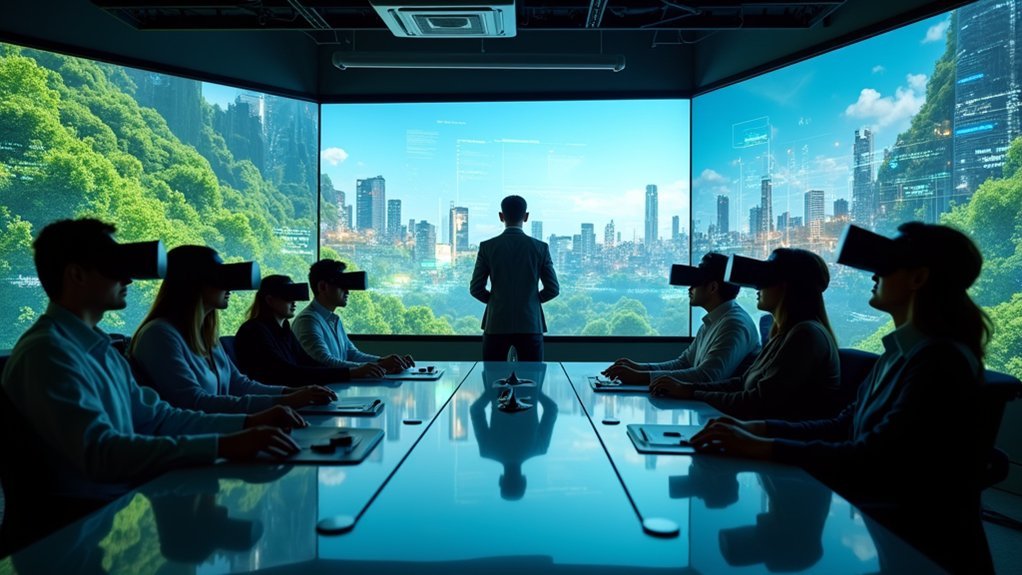
You’ll discover enterprise VR assessment solutions that are revolutionizing employee evaluation through immersive simulations and real-time analytics. These platforms offer multi-device compatibility, AI-driven personalization, and seamless LMS integration while reducing training costs by up to 50% and boosting knowledge retention by 75%. Leading solutions provide photorealistic environments, advanced performance metrics, and industry-specific scenarios across healthcare, manufacturing, and education sectors. Explore how these cutting-edge technologies can transform your organization’s training effectiveness and workforce development strategies.
Market Overview of Enterprise VR Assessment Technology

The enterprise VR assessment technology market is experiencing unprecedented growth, with projections showing the global VR market expanding from under $5 billion in 2021 to over $12 billion by 2024.
This surge reflects increasing demand for enterprise VR solutions across healthcare, education, and manufacturing sectors. You’ll find that VR assessment technologies are revolutionizing how organizations approach immersive training by delivering realistic simulations that enhance skill development and retention.
These platforms integrate seamlessly with learning management systems, providing robust analytics for tracking performance and engagement.
VR platforms deliver comprehensive analytics integration, enabling organizations to monitor learner progress and engagement metrics through existing management systems.
Companies are adopting cost-effective training solutions that reduce traditional expenses while improving training effectiveness. The technology’s ability to measure skills accurately in controlled virtual environments makes it an attractive investment for forward-thinking organizations seeking competitive advantages.
Key Features of Professional VR Assessment Platforms
When you’re evaluating professional VR assessment platforms, you’ll find that real-time performance analytics form the backbone of effective measurement systems, providing instant feedback on user competencies and skill progression.
You’ll also need multi-device compatibility support to guarantee your assessment tools work seamlessly across different VR headsets and enterprise hardware configurations.
Advanced simulation capabilities enable you to create complex, interactive scenarios that mirror real-world challenges while maintaining the controlled environment necessary for accurate performance evaluation.
Real-Time Performance Analytics
As organizations increasingly adopt VR training solutions, real-time performance analytics emerge as a critical differentiator that transforms how you measure and improve workforce development.
Professional VR assessment platforms deliver immediate feedback during training sessions, enhancing your learning experience through actionable insights. You’ll access advanced metrics including user engagement levels, task completion rates, and skill proficiency scores that evaluate individual performance effectively.
Many platforms integrate seamlessly with Learning Management Systems, enabling thorough progress tracking.
AI-driven analytics personalize learning paths based on your performance data, optimizing training outcomes and efficiency. These real-time capabilities support organizational decision-making by providing detailed workforce competency reports, identifying skill gaps, and suggesting targeted interventions for maximum impact.
Multi-Device Compatibility Support
Professional VR assessment platforms break down hardware barriers by supporting multiple device types, ensuring your training programs reach every team member regardless of their available technology.
You’ll find that modern VR assessment platforms deliver seamless cross-platform functionality, allowing users to engage with immersive technologies through VR headsets, tablets, or desktop computers without compromising performance quality.
Cloud integration enables real-time data synchronization across all devices, maintaining consistent progress tracking and assessment results.
Your organization benefits from responsive design principles that optimize user experience across different screen sizes and resolutions, accommodating both immersive and non-immersive contexts.
This multi-device compatibility maximizes your training solutions investment while enhancing accessibility for remote teams, ensuring thorough coverage regardless of hardware preferences or geographic distribution.
Advanced Simulation Capabilities
Beyond device compatibility, the true power of enterprise VR assessment platforms lies in their advanced simulation capabilities that create photorealistic training environments. You’ll experience high-fidelity graphics and physics engines that make scenarios feel authentically real, dramatically improving engagement and skill acquisition.
| Feature | Capability | Business Impact |
|---|---|---|
| Adaptive Learning | Performance-based adjustments | Personalized development |
| Data Analytics | Real-time metrics tracking | Measurable ROI |
| Multi-User Support | Collaborative assessments | Enhanced teamwork |
| Scenario Variety | Industry-specific simulations | Targeted skill building |
These immersive training environments adapt to your team’s performance through adaptive learning technologies, providing targeted feedback that accelerates development. You can leverage multi-user environments for collaborative assessments, enabling teams to practice communication and coordination skills together while generating valuable performance data for continuous improvement.
Leading VR Assessment Solution Providers
While numerous companies have entered the VR assessment market, several providers have distinguished themselves through innovative platforms and proven results across industries.
These enterprise VR leaders offer extensive training platforms that deliver measurable skill improvements:
- Osso VR – Provides immersive surgical training with extensive simulation libraries for healthcare professionals seeking enhanced skill transfer.
- Oxford Medical Simulation – Pioneers virtual reality (VR) healthcare education by merging clinical competency with immersive learning experiences.
- MAI – Specializes in medical VR solutions featuring BodyMap and AcuMap tools for extensive healthcare education.
- Immersive Technologies – Creates advanced simulation technologies replicating real-world scenarios across multiple industries.
- Gemba – Delivers integrated software, content, and services for training distributed workforces in global enterprises.
You’ll find these providers consistently demonstrate ROI through improved performance metrics and reduced training costs.
Industry-Specific VR Assessment Applications
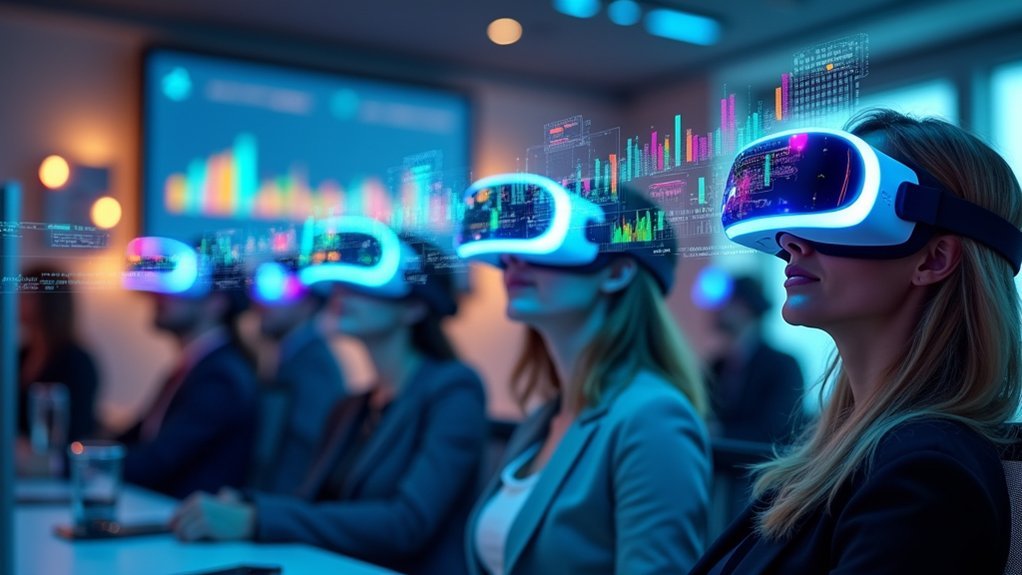
These established VR assessment providers have developed specialized solutions that address unique challenges across distinct industries.
In healthcare, you’ll find platforms like Osso VR delivering surgical training assessments that enhance skill measurement while improving patient outcomes.
Osso VR transforms surgical training through immersive assessments that measurably improve both skill development and patient safety outcomes.
The education sector leverages immersive experiences through solutions like Axon Park, achieving 20% increases in knowledge acquisition for engineering and medical subjects through interactive simulations.
Manufacturing companies utilize VR training solutions that replicate real-world processes, boosting safety and efficiency while cutting traditional training costs.
Military sectors employ realistic training simulations for strategic planning and decision-making in safe environments.
Companies like MAI create specialized medical solutions combining Western and Eastern knowledge, fostering improved skill retention and competency for healthcare professionals through enhanced immersive learning experiences.
Benefits of Implementing VR-Based Employee Evaluations
You’ll discover that VR-based employee evaluations transform how you measure performance by providing immersive scenarios that capture thorough data beyond traditional methods.
Your organization can achieve up to 50% cost reduction in training expenses while simultaneously boosting employee engagement by 30% through realistic simulation experiences.
These enhanced performance metrics and cost-effective solutions position VR assessments as a strategic advantage for modern workforce development.
Enhanced Performance Metrics
When organizations implement VR-based employee evaluations, they’re gaining access to performance metrics that far exceed traditional assessment methods in both accuracy and depth.
VR assessments capture granular data points that simply aren’t available through conventional evaluation techniques, giving you unprecedented visibility into employee capabilities.
These immersive environments generate rich performance metrics through real-time tracking of:
- Eye movement patterns revealing attention focus and decision-making processes
- Hand gesture precision measuring technical skill execution and dexterity
- Response time analytics identifying problem-solving speed and cognitive agility
- Stress response indicators monitoring performance under pressure scenarios
- Collaboration dynamics tracking teamwork effectiveness in virtual scenarios
You’ll reduce training costs while boosting employee engagement through data-driven insights that enable personalized development pathways tailored to each individual’s specific strengths and improvement areas.
Cost-Effective Training Solutions
Beyond collecting superior performance data, VR-based employee evaluations deliver considerable financial advantages that make them an attractive investment for forward-thinking organizations.
You’ll reduce training costs by up to 50% when implementing these cost-effective solutions compared to traditional methods. VR training considerably boosts knowledge retention rates by 75%, ensuring your investment delivers lasting results.
These immersive experiences create realistic scenarios where employees demonstrate skills safely, leading to more accurate assessments.
You’ll see operational efficiency improve as your teams engage 30% more effectively during evaluations. The rapidly expanding VR training market, projected to exceed $12 billion by 2024, demonstrates widespread enterprise adoption.
When you implement VR-based employee evaluations, you’re not just upgrading assessment methods—you’re positioning your organization for sustainable growth while maximizing training ROI.
Technical Requirements for Enterprise VR Assessment Systems
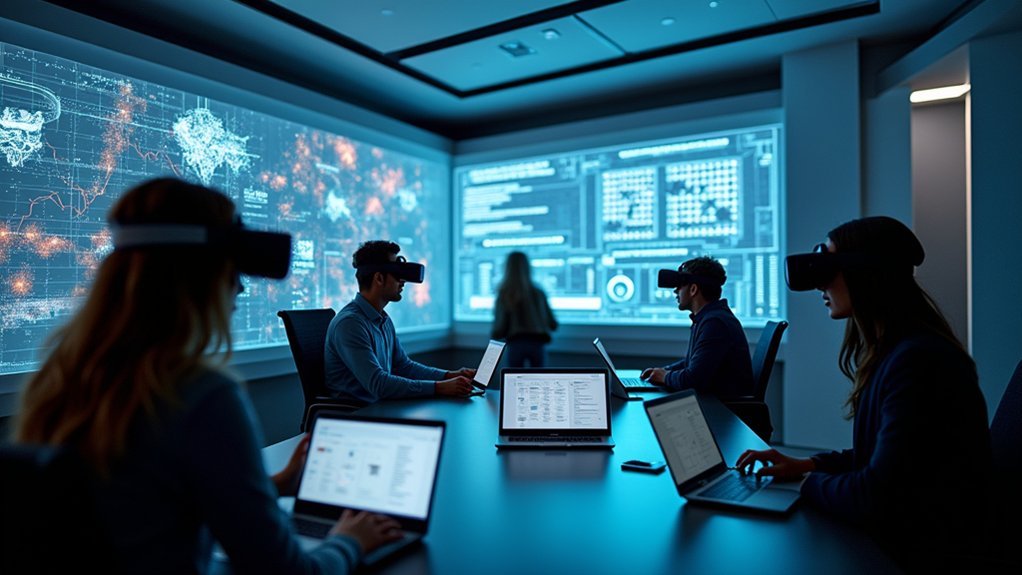
Although deploying enterprise VR assessment systems might seem straightforward, you’ll need to meet specific technical requirements that directly impact user experience and system effectiveness.
Your VR technology foundation demands high-performance hardware with headsets supporting minimum 90Hz refresh rates and powerful GPUs for seamless immersion. Software compatibility becomes vital when integrating Unity and Unreal Engine development platforms for customized assessment applications.
Essential technical specifications include:
- Data security protocols guaranteeing GDPR and HIPAA compliance for sensitive information protection
- Integration capabilities connecting existing LMS and analytics tools for progress tracking
- User interface design providing intuitive navigation for learners and assessors
- Hardware performance standards maintaining consistent frame rates and visual quality
- Cross-platform compatibility supporting various devices and operating systems
Meeting these requirements guarantees your VR assessment platform delivers reliable, secure, and engaging experiences while seamlessly fitting into existing enterprise infrastructure.
Cost Analysis and ROI of VR Assessment Solutions
While VR assessment technology requires substantial upfront investment, you’ll discover that thorough cost analysis reveals compelling ROI potential that’s transforming how enterprises approach training budgets.
VR assessment solutions deliver up to 75% reduction in traditional training costs while boosting learning retention rates by 80%. Your immersive learning programs can increase productivity by 30% and reduce error rates by 50%, creating substantial operational savings.
The market’s explosive growth from under $5 billion in 2021 to over $12 billion by 2024 demonstrates proven value. You’ll achieve faster employee training completion, reduced onboarding time, and enhanced performance metrics.
When calculating ROI, consider decreased error-related costs, improved efficiency, and accelerated skill development. These quantifiable benefits consistently outweigh initial technology investments, making VR assessment solutions financially attractive for forward-thinking enterprises.
Integration Strategies for Existing Training Programs
Having established the financial benefits of VR assessment solutions, successful implementation depends on strategic integration with your current training infrastructure.
You’ll need extensive integration strategies that seamlessly blend immersive and interactive VR technology with your existing enterprise training systems.
Start by conducting thorough needs assessments to identify specific training gaps where VR applications can deliver maximum impact.
Identify training gaps through comprehensive needs assessments to maximize VR implementation impact and effectiveness.
Consider these essential integration approaches:
- Partner with experienced VR development companies for customized solutions
- Implement phased rollouts alongside traditional training methods
- Guarantee seamless connectivity with your current Learning Management Systems
- Leverage analytics from VR sessions to refine training content continuously
- Tailor immersive experiences to address identified skill development needs
This strategic approach guarantees your workforce adapts smoothly while maximizing the 75% potential increase in learning effectiveness that VR training delivers.
Future Trends in Virtual Reality Assessment Technology
As VR assessment technology rapidly evolves, you’ll witness transformative changes that reshape how enterprises evaluate and develop talent across industries.
AI-powered adaptive testing will personalize your training experiences, automatically adjusting difficulty levels based on individual performance patterns. You’ll see increasingly realistic simulations that mirror real-world scenarios, particularly in healthcare and military sectors where safe practice environments are essential.
Biometric data integration will revolutionize how you measure engagement and competence, providing deeper insights than traditional assessment methods.
Remote work trends will drive sophisticated virtual collaboration tools, enabling seamless evaluation regardless of geographical constraints.
These advancements will create extensive virtual reality (VR) ecosystems where performance analytics merge with immersive experiences, delivering data-driven insights that transform enterprise training into precise, measurable outcomes.
Frequently Asked Questions
What Company Is Leading in Virtual Reality?
You’ll find Program-Ace leading VR development since 1992, while Osso VR dominates surgical training and Varjo Technologies creates the world’s only human-eye resolution VR devices for complex industries.
What Is a VR Assessment?
You’ll experience an immersive evaluation using virtual reality technology that simulates real-world scenarios to test your skills and knowledge in a controlled, engaging environment that’s more effective than traditional assessments.
What Is the Best Software for VR?
You’ll find Unity and Unreal Engine are top choices for VR development, offering millions of users extensive real-time 3D capabilities. Autodesk’s Maya also excels for detailed environment creation in immersive applications.
Who Is the Leader in VR Technology?
You’ll find Varjo Technologies leading VR innovation with their VR-1’s human-eye resolution. They’re specifically targeting industries requiring exceptional visual fidelity, setting them apart from competitors in the enterprise VR market.

Leave a Reply