
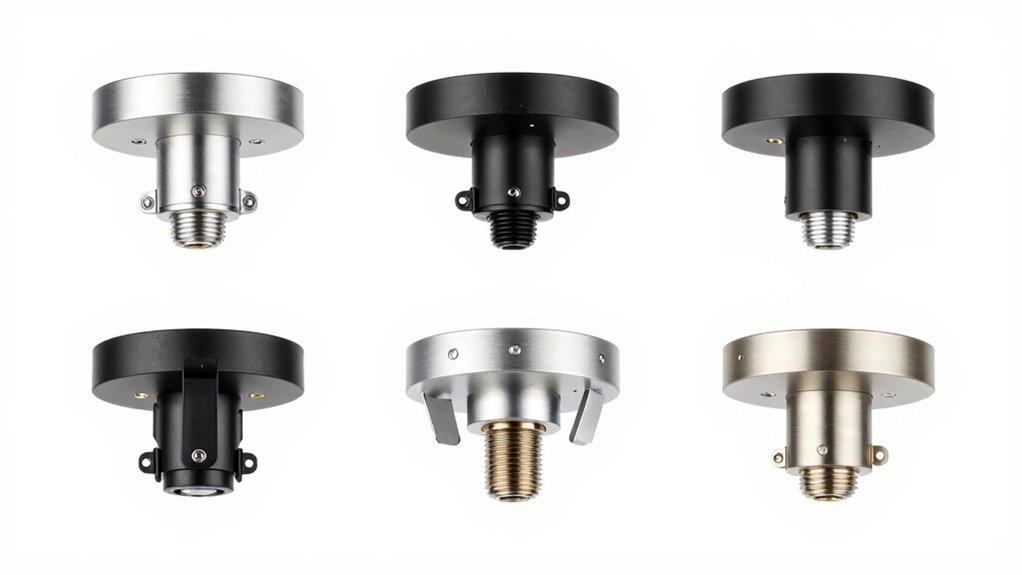
You’re probably wondering how to automate your lighting without complicated wiring or costly renovations. Ceiling-mount motion sensors offer a straightforward solution, but with so many options available, you’ll need to know what distinguishes the top performers. We’ve identified five models that combine reliable detection with hassle-free installation—and there’s more to contemplate before you decide.
| Maxxima Ceiling Mount 360 Degree PIR Occupancy Sensor |  | Best Overall | Detection Range: 360-degree, up to 15 feet high | Time Delay Adjustment: 15 seconds to 30 minutes | Light Sensitivity Control: Adjustable light level sensing | CHECK ON AMAZON | Read More |
| Leviton Ceiling-Mount Occupancy Sensor and Switching Relay |  | Professional Grade | Detection Range: 360-degree, ~530 sq. ft. at 8 ft mounting | Time Delay Adjustment: 20 seconds to 15 minutes | Light Sensitivity Control: Not specified | CHECK ON AMAZON | Read More |
| RAYZEEK Ceiling Sensor Light Switch 360 Degree Motion |  | Most Versatile | Detection Range: 360-degree, adjustable high/low | Time Delay Adjustment: 15 seconds to 30 minutes | Light Sensitivity Control: Adjustable (Off/15/25/35 Lux) | CHECK ON AMAZON | Read More |
| YCA1050 PIR Motion Sensor Light Switch |  | Sleekest Design | Detection Range: 360-degree, 50 ft detection range | Time Delay Adjustment: Not specified | Light Sensitivity Control: Built-in photocell with adjustable sensitivity | CHECK ON AMAZON | Read More |
| ENERLITES MPC-50V PIR Ceiling Occupancy Sensor |  | Largest Coverage | Detection Range: 360-degree, up to 1200 sq. ft. coverage | Time Delay Adjustment: 15 seconds to 30 minutes | Light Sensitivity Control: Adjustable with dip switch (50% or 100%) | CHECK ON AMAZON | Read More |
More Details on Our Top Picks
Maxxima Ceiling Mount 360 Degree PIR Occupancy Sensor
If you’re looking for a versatile motion sensor that works with virtually any lighting type, the Maxxima Ceiling Mount 360 Degree PIR Occupancy Sensor delivers reliable automatic control for both commercial and residential spaces. This hard-wired unit handles LED, incandescent, fluorescent, and low-voltage systems seamlessly. You’ll appreciate its 360-degree detection range at heights up to 15 feet, along with adjustable time delays from 15 seconds to 30 minutes. The sensor operates on 120–277V AC and supports loads up to 1200W at 277V, requiring no minimum load. Adjustable sensitivity and light-level sensing let you customize performance to your space, while its UL listing and one-year warranty ensure quality and peace of mind.
- Detection Range:360-degree, up to 15 feet high
- Time Delay Adjustment:15 seconds to 30 minutes
- Light Sensitivity Control:Adjustable light level sensing
- Voltage Rating:120V–277V AC
- Lamp Compatibility:LED, incandescent, fluorescent, CFL, MLV, ELV
- Certifications & Warranty:UL Listed, 1-year warranty
- Additional Feature:High wattage capacity (1200W)
- Additional Feature:Mounts up to 15 feet
- Additional Feature:No minimum load required
Leviton Ceiling-Mount Occupancy Sensor and Switching Relay
Looking for a sensor that covers expansive spaces with minimal installation hassle? The Leviton ODC0S-I1W delivers impressive performance with its 360° field of view and segmented Fresnel lens featuring 79 segments for optimum detection. You’ll get coverage up to 530 square feet at 8-foot mounting heights, perfect for larger rooms or open areas. The 1000-Watt, 120-Volt switching relay handles substantial lighting loads effortlessly. You can adjust the delayed OFF time from 20 seconds to 15 minutes based on your needs, and the LED indicator flashes to verify power and function. It’s designed for indoor use with an operating temperature range of 32–122°F.
- Detection Range:360-degree, ~530 sq. ft. at 8 ft mounting
- Time Delay Adjustment:20 seconds to 15 minutes
- Light Sensitivity Control:Not specified
- Voltage Rating:120V
- Lamp Compatibility:Works with passive infrared, ultrasonic, multi-sensing
- Certifications & Warranty:Not specified
- Additional Feature:530 sq. ft. coverage area
- Additional Feature:79-segment Fresnel lens
- Additional Feature:LED motion detection indicator
RAYZEEK Ceiling Sensor Light Switch 360 Degree Motion
Need hands-free lighting that adapts to your space’s natural light? The RAYZEEK Ceiling Sensor Light Switch offers 360-degree motion detection with dual-mode operation. You’ll appreciate its smart light-sensing feature that turns lights on only when it’s dark and motion’s detected, saving energy during daylight hours. Setup’s straightforward—just verify your neutral wire before installation. You can customize time delay (15 seconds to 30 minutes), sensitivity levels, and detection range. With a 10A capacity handling up to 1000W incandescent or 500W LED, it’s ideal for entryways, garages, and storage rooms. No complicated programming required.
- Detection Range:360-degree, adjustable high/low
- Time Delay Adjustment:15 seconds to 30 minutes
- Light Sensitivity Control:Adjustable (Off/15/25/35 Lux)
- Voltage Rating:120V
- Lamp Compatibility:Compatible with all bulbs
- Certifications & Warranty:Not specified
- Additional Feature:Dual-mode operation (light+occupancy)
- Additional Feature:Works with ceiling fans
- Additional Feature:One-touch quick setup
YCA1050 PIR Motion Sensor Light Switch
Want hands-free lighting that won’t clutter your ceiling? The YCA1050 PIR Motion Sensor Light Switch delivers exactly that with its ultra-slim 1-inch profile. This 85-265V AC ceiling mount uses passive infrared technology to detect movement across 360 degrees, covering up to 50 feet with clear line of sight. You’ll appreciate the built-in photocell that activates lights only when needed, reducing energy waste. Its IP22 rating makes it ideal for indoor spaces like laundry rooms, hallways, and garages. Installation’s straightforward—mount it 6 feet from your light fixture for optimal performance. At just 0.1W standby power, it’s efficient, unobtrusive, and reliable.
- Detection Range:360-degree, 50 ft detection range
- Time Delay Adjustment:Not specified
- Light Sensitivity Control:Built-in photocell with adjustable sensitivity
- Voltage Rating:85-265V AC
- Lamp Compatibility:Compatible with all bulbs
- Certifications & Warranty:IP22 rated
- Additional Feature:Ultra-slim 1-inch profile
- Additional Feature:50 ft detection range
- Additional Feature:Home alarm integration capability
ENERLITES MPC-50V PIR Ceiling Occupancy Sensor
The ENERLITES MPC-50V PIR Ceiling Occupancy Sensor delivers thorough motion detection across large commercial spaces—but why settle for basic coverage when you can get 360° sensing that monitors up to 1,200 square feet? You’ll appreciate its adjustable sensitivity settings and customizable time delays ranging from 15 seconds to 30 minutes, allowing precise control over your lighting needs. The multi-level Fresnel lens technology ensures reliable detection in warehouses, hallways, bathrooms, and offices. It’s compatible with LED, CFL, and incandescent bulbs, making retrofitting effortless. Installation is straightforward—just mount it in your ceiling junction box. Plus, it’s California Title 24 compliant and UL listed, giving you peace of mind with commercial-grade reliability.
- Detection Range:360-degree, up to 1200 sq. ft. coverage
- Time Delay Adjustment:15 seconds to 30 minutes
- Light Sensitivity Control:Adjustable with dip switch (50% or 100%)
- Voltage Rating:120V AC @ 60Hz
- Lamp Compatibility:LED, CFL, incandescent
- Certifications & Warranty:UL Listed, California Title 24 compliant, 1-year warranty
- Additional Feature:1200 sq. ft. coverage
- Additional Feature:California Title 24 compliant
- Additional Feature:Surveillance camera support
Factors to Consider When Choosing Ceiling Mounts for Sensors
When you’re selecting a ceiling mount for your sensor, you’ll want to verify the voltage and power requirements match your existing system to avoid compatibility issues. You should also consider the coverage area and detection range needed for your space, along with installation height specifications that’ll ensure optimal sensor performance. Finally, you’ll benefit from models offering adjustable sensitivity settings and multiple lighting compatibility options, giving you flexibility to customize the system to your specific environment.
Voltage and Power Requirements
How do you know if your ceiling-mount sensor will work with your building’s electrical system? You’ll need to verify voltage compatibility first. Most sensors require 120–277V AC, though some models operate at only one voltage. Check your building’s available voltage—typically 120V or 277V—and match it to your sensor’s rating.
Next, consider power requirements. Maximum load ratings vary significantly; for example, certain units handle 800W at 120V but 1200W at 277V. You’ll need to confirm your lighting fixtures don’t exceed these limits. Additionally, verify compatibility with your lighting type—LED, incandescent, CFL, or ballast-equipped systems—since not all sensors support every type.
Finally, determine whether your sensor requires a neutral wire or operates line-only, as this affects installation wiring and electrical code compliance.
Coverage Area and Detection Range
Coverage area and detection range are critical because they determine whether your sensor will actually detect motion throughout your space. Most 360° sensors cover around 530 square feet when mounted at 8 feet high, though some reach up to 1,200 square feet in larger installations.
Your mounting height directly affects performance—ensure it matches the manufacturer’s specifications to avoid blind spots. Lens design matters too; segmented Fresnel lenses with multiple segments enhance detection accuracy.
Remember that walls, furniture, and obstructions reduce effective coverage. For seamless monitoring in larger spaces, you’ll likely need multiple units rather than relying on a single sensor. Always verify that your chosen mount height aligns with your room’s dimensions and layout before purchasing.
Installation Height Specifications
Since your ceiling height directly impacts sensor performance, you’ll want to carefully match your mounting height to the product’s specifications. Most ceiling-mounted occupancy sensors operate effectively between 8 and 15 feet, though some models perform optimally at lower heights around 8 feet to minimize false triggers and maximize detection accuracy.
If you’re installing at higher ceilings—12 to 15 feet—look for sensors featuring wider Fresnel lenses or multi-sensing technology to maintain full 360° coverage. Always consult the manufacturer’s documentation before purchasing, as different models have different height requirements. Matching your ceiling height to the sensor’s rated specifications ensures reliable occupancy detection and prevents coverage gaps that could compromise your system’s effectiveness.
Adjustable Sensitivity Settings
What makes one ceiling mount sensor trigger reliably while another struggles in the same space? Adjustable sensitivity settings. You’ll find that many models offer dedicated sensitivity controls, allowing you to fine-tune detection strength beyond simple on/off functionality. This matters because higher sensitivity can trigger false positives from small animals or cross-room movement in high-traffic areas, while lower sensitivity may miss legitimate activity in larger spaces.
You should calibrate sensitivity to match your room’s typical movement profile and ambient conditions. Pair these adjustments with time delays and light-level sensors for optimal performance. Remember that recalibration becomes necessary when you change sensitivity levels, ensuring your 360° coverage maintains consistent detection across varying installation heights and environmental factors.
Lighting Compatibility Options
Not every ceiling-mount sensor works with every bulb type in your fixture. You’ll need to verify compatibility with your specific lamps—whether you’re using LED, incandescent, CFL, or fluorescent options with electronic ballasts.
Check the maximum load ratings listed in your sensor’s specifications, typically ranging from 800W at 120V to 1200W at 277V. Exceeding these limits can damage your system or create safety hazards.
Some models require a neutral wire, which affects compatibility with certain LED drivers and dimming circuitry. Others feature photocell technology that prevents activation when ambient light reaches a set threshold, making them ideal for daylighted spaces.
Finally, confirm whether your sensor specifies ballast types like EBF or MLV, or if it works with all bulbs universally.
Time Delay Functionality
How long should your lights stay on after motion stops? That’s where time delay functionality comes in. Most ceiling-mount sensors offer adjustable delays ranging from 15 seconds to 30 minutes, letting you customize the perfect timeframe for your space.
For high-traffic areas like hallways or bathrooms, shorter delays—around 20 seconds—maximize energy savings by turning lights off quickly. Longer delays work better in low-traffic zones, reducing annoying flickering and re-triggering that wastes energy and frustrates users.
You’ll find that pairing adjustable time delays with sensitivity and light level settings optimizes your sensor’s performance. This combination ensures your lighting responds exactly how you need it to, balancing comfort with efficiency for your specific environment.
Environmental Rating Standards
Where you install your ceiling-mount sensor matters just as much as which one you choose. Environmental rating standards dictate where your sensor can reliably operate. You’ll want to verify IP ratings—such as IP22—that protect against moisture intrusion suitable for your space type. Check the operating temperature range, typically 32–122°F, ensuring your environment won’t compromise performance.
Look for UL listing or equivalent safety certifications confirming electrical and fire-safety compliance. Some sensors specify indoor-only use or dry-space requirements, guiding proper placement decisions. Temperature and humidity specs directly influence sensitivity and detection range; extreme conditions can degrade performance.
If you’re installing in commercial spaces, you’ll need to comply with regional codes like California Title 24, which mandate energy-efficiency standards. Understanding these requirements prevents costly installation mistakes.
Mounting Hardware Included
What’s inside the box matters just as much as what’s mounted on your ceiling. Different models include varying hardware—some provide wire nuts and screws for straightforward ceiling installation, while others require additional components you’ll need to source separately.
Before purchasing, check what’s included and verify it matches your ceiling type and height requirements. Most quality sensors accommodate mounting up to 15 feet, though you’ll want hardware suited to your specific installation height.
Consider the mounting profile too. Slim designs need minimal hardware for that clean, unobtrusive look. Additionally, ensure any included hardware supports secure mounting for proper 360° detection coverage. Always verify environmental ratings—IP ratings and indoor-only specifications affect whether hardware suits your space’s conditions.
Frequently Asked Questions
How Long Do Ceiling Mount Sensor Batteries Typically Last Before Replacement?
You’ll typically get 2-5 years of battery life from ceiling mount sensors, depending on the model and usage frequency. You should check your device’s manual for specific estimates, and you’ll want to replace batteries when you notice low-battery warnings.
Can Ceiling Occupancy Sensors Be Used in Outdoor or Wet Environments?
You’ll find that most ceiling occupancy sensors aren’t designed for outdoor or wet environments. They’re built for indoor use, as moisture damages their electronics. You should choose weatherproof outdoor sensors instead for exterior applications.
What Is the Average Cost Difference Between Wired and Wireless Ceiling Mounts?
You’ll typically find wireless ceiling mounts cost $50-$200 more than wired options. The price difference depends on brand, features, and installation complexity. Wireless units justify their premium through easier setup and flexibility, while wired mounts offer reliability.
Do Ceiling Sensors Work With Smart Home Systems Like Alexa or Google?
You can integrate most ceiling sensors with Alexa or Google Home through compatible smart home hubs or bridges. You’ll need to check your sensor’s compatibility first, as not all models support these platforms directly.
How Often Should Ceiling Mount Sensors Be Cleaned for Optimal Performance?
You should clean your ceiling mount sensors every three to six months. Dust and debris accumulate over time, blocking their detection capabilities. Regular cleaning ensures you’ll maintain optimal performance and accuracy from your sensors.

Leave a Reply