You’re navigating a crowded GPU market where choosing the right RTX card can make or break your 2026 gaming setup. With so many options boasting similar specs, you’ll want to understand what truly separates the high performers from the rest. The real question isn’t just which card’s fastest—it’s which one’s right for your specific needs.
| ASUS Dual NVIDIA GeForce RTX 3050 6GB Graphics Card | Best Compact Design | GPU Architecture: NVIDIA Ampere | Memory Configuration: 6GB GDDR6 | PCIe Interface: PCIe 4.0 | CHECK ON AMAZON | Read Our Analysis | |
| PNY NVIDIA GeForce RTX 5060 Graphics Card (8GB) |  | Best Value Entry | GPU Architecture: NVIDIA Blackwell | Memory Configuration: 8GB GDDR7 | PCIe Interface: PCIe 5.0 | CHECK ON AMAZON | Read Our Analysis |
| PNY NVIDIA GeForce RTX 5060 Ti Graphics Card | Best All-Around Performance | GPU Architecture: NVIDIA Blackwell | Memory Configuration: 8GB GDDR7 | PCIe Interface: PCIe 5.0 | CHECK ON AMAZON | Read Our Analysis | |
| PNY NVIDIA GeForce RTX 5060 Ti Graphics Card |  | Best Dual-Fan Option | GPU Architecture: NVIDIA Blackwell | Memory Configuration: 8GB GDDR7 | PCIe Interface: PCIe 5.0 | CHECK ON AMAZON | Read Our Analysis |
| PNY NVIDIA GeForce RTX 5050 Graphics Card (8GB) | 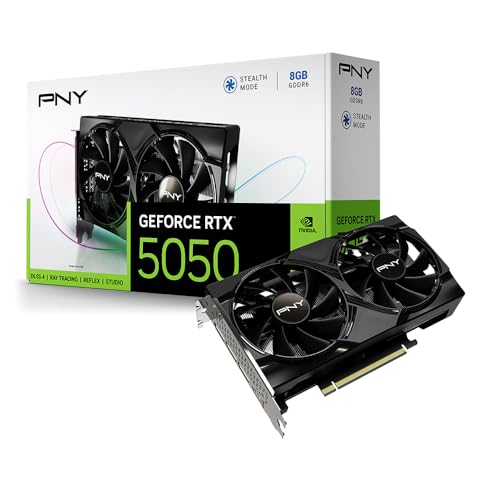 | Best Budget Gaming | GPU Architecture: NVIDIA Blackwell | Memory Configuration: 8GB GDDR6 | PCIe Interface: PCIe 5.0 | CHECK ON AMAZON | Read Our Analysis |
| ASUS Dual GeForce RTX 5060 Ti 8GB Graphics Card |  | Best Overall Performance | GPU Architecture: NVIDIA Blackwell | Memory Configuration: 8GB GDDR7 | PCIe Interface: PCIe 5.0 | CHECK ON AMAZON | Read Our Analysis |
More Details on Our Top Picks
ASUS Dual NVIDIA GeForce RTX 3050 6GB Graphics Card
If you’re building a compact gaming rig without sacrificing RTX performance, the ASUS Dual RTX 3050 is your answer. This 6GB card leverages Ampere architecture with 2nd-gen RT Cores and 3rd-gen Tensor Cores for enhanced ray-tracing and AI capabilities. You’ll enjoy solid 1080p–1440p gaming with RTX features enabled. The Axial-tech fan design and 2-slot form factor maximize cooling efficiency while fitting snugly in smaller chassis. PCIe 4.0 support, HDMI 2.1, and DisplayPort 1.4a connectivity round out a versatile package. With 0dB technology and a steel bracket, you’re getting a reliable, quiet performer that doesn’t demand excessive power.
- GPU Architecture:NVIDIA Ampere
- Memory Configuration:6GB GDDR6
- PCIe Interface:PCIe 4.0
- Display Outputs:HDMI 2.1 / DisplayPort 1.4a
- Form Factor:2-Slot compact design
- AI & DLSS Support:3rd Gen Tensor Cores
- Additional Feature:Ampere architecture ray-tracing
- Additional Feature:0dB silent cooling technology
- Additional Feature:Compact 2-slot design
PNY NVIDIA GeForce RTX 5060 Graphics Card (8GB)
Looking for a compact graphics card that doesn’t compromise on power? The PNY NVIDIA GeForce RTX 5060 delivers impressive performance in a space-efficient 2-slot design. You’ll get 8GB of GDDR7 memory paired with NVIDIA’s Blackwell architecture, enabling DLSS 4 for boosted frame rates and enhanced visuals. The card’s Fifth-Gen Tensor Cores and Fourth-Gen Ray Tracing Cores handle demanding games and creative work seamlessly. With PCIe 5.0 support and dual HDMI/DP 2.1 outputs, you’re future-proofed for next-gen displays. Reflex technology sharpens your competitive edge through faster target acquisition. Whether you’re gaming, creating, or developing, this SFF-ready card punches above its weight.
- GPU Architecture:NVIDIA Blackwell
- Memory Configuration:8GB GDDR7
- PCIe Interface:PCIe 5.0
- Display Outputs:HDMI 2.1 / DisplayPort 2.1
- Form Factor:2-Slot SFF-Ready
- AI & DLSS Support:DLSS 4 / 5th Gen Tensor Cores
- Additional Feature:Fifth-Gen Tensor Cores
- Additional Feature:Reflex competitive gaming tech
- Additional Feature:Built-in AI processors
PNY NVIDIA GeForce RTX 5060 Ti Graphics Card
The PNY NVIDIA GeForce RTX 5060 Ti Epic-X ARGB OC is your ideal choice if you’re building a compact gaming rig or SFF system without sacrificing performance. This card packs 8GB of GDDR7 memory and reaches 2692 MHz boost speeds, delivering smooth gameplay in demanding titles. You’ll benefit from DLSS 4’s AI-powered neural rendering, which amplifies your FPS while maintaining visual fidelity. The fifth-gen Tensor Cores and fourth-gen Ray Tracing Cores handle modern workloads effortlessly. With PCIe 5.0 support, HDMI 2.1, and DisplayPort 2.1 connectivity, you’re future-proofed. The dual-slot design fits tight builds, while ARGB lighting customization adds aesthetic appeal for enthusiasts prioritizing both power and compactness.
- GPU Architecture:NVIDIA Blackwell
- Memory Configuration:8GB GDDR7
- PCIe Interface:PCIe 5.0
- Display Outputs:HDMI 2.1 / DisplayPort 2.1
- Form Factor:2-Slot SFF-Ready
- AI & DLSS Support:DLSS 4 / 5th Gen Tensor Cores
- Additional Feature:2692 MHz boost speed
- Additional Feature:ARGB RGB customization features
- Additional Feature:SFF-Ready small form factor
PNY NVIDIA GeForce RTX 5060 Ti Graphics Card
Want a compact GPU that doesn’t compromise on performance? The PNY NVIDIA GeForce RTX 5060 Ti OC Dual Fan delivers serious power in a 2-slot, SFF-ready form factor. You’ll get 8GB GDDR7 memory and a 2692 MHz boost speed that handles demanding games and creative applications effortlessly. Its Blackwell architecture features fifth-gen Tensor Cores and fourth-gen Ray Tracing Cores, while DLSS 4 neural rendering boosts your FPS and image quality simultaneously. The card supports PCIe 5.0 and includes HDMI/DP 2.1 connectivity. Whether you’re gaming, creating, or developing, this GPU’s AI-assisted workflows and Reflex technologies ensure peak performance and precision.
- GPU Architecture:NVIDIA Blackwell
- Memory Configuration:8GB GDDR7
- PCIe Interface:PCIe 5.0
- Display Outputs:HDMI 2.1 / DisplayPort 2.1
- Form Factor:2-Slot SFF-Ready
- AI & DLSS Support:DLSS 4 / 5th Gen Tensor Cores
- Additional Feature:New Streaming Multiprocessors
- Additional Feature:Dual Fan cooling design
- Additional Feature:Studio driver optimization support
PNY NVIDIA GeForce RTX 5050 Graphics Card (8GB)
If you’re building a compact gaming PC without sacrificing performance, PNY’s RTX 5050 delivers impressive power in a space-conscious package. You’ll get 8GB GDDR6 memory paired with Blackwell architecture and DLSS 4 for exceptional frame rates. The dual-fan cooling keeps temperatures manageable, while PCIe 5.0 and DisplayPort 2.1 ensure future-proof connectivity. Its 2-slot design fits small-form-factor cases perfectly. Fifth-gen Tensor Cores and fourth-gen ray tracing accelerate both gaming and creative workloads. NVIDIA Reflex optimizes responsiveness for competitive titles, enhancing your reaction times and aim precision significantly.
- GPU Architecture:NVIDIA Blackwell
- Memory Configuration:8GB GDDR6
- PCIe Interface:PCIe 5.0
- Display Outputs:HDMI 2.1 / DisplayPort 2.1
- Form Factor:2-Slot SFF-Ready
- AI & DLSS Support:DLSS 4 / 5th Gen Tensor Cores
- Additional Feature:GDDR6 memory configuration
- Additional Feature:Graphics pipeline optimization tech
- Additional Feature:Exclusive AI workflow tools
ASUS Dual GeForce RTX 5060 Ti 8GB Graphics Card
Looking for a compact powerhouse that doesn’t compromise on performance? The ASUS Dual GeForce RTX 5060 Ti 8GB delivers. You’ll get NVIDIA’s Blackwell architecture paired with 8GB GDDR7 memory and PCIe 5.0 support. The card’s 2.5-slot design makes it SFF-ready, perfect if you’re working with limited space. Its Axial-tech fan system keeps temperatures in check while 0dB technology keeps things whisper-quiet during idle periods. With DLSS 4 and 767 AI TOPS, you’re equipped for both traditional gaming and AI-enhanced experiences. Clock speeds reach 2632 MHz in OC mode, ensuring solid performance for 1440p gaming.
- GPU Architecture:NVIDIA Blackwell
- Memory Configuration:8GB GDDR7
- PCIe Interface:PCIe 5.0
- Display Outputs:HDMI 2.1b / DisplayPort 2.1b
- Form Factor:2.5-Slot SFF-Ready
- AI & DLSS Support:DLSS 4 / 767 AI TOPS
- Additional Feature:767 AI TOPS performance
- Additional Feature:Axial-tech barrier ring design
- Additional Feature:2.5-slot form factor
Factors to Consider When Choosing Graphics Cards (RTX Series)
When you’re selecting an RTX graphics card, you’ll need to balance performance requirements with your specific gaming goals and resolution targets. You should evaluate memory capacity, bandwidth, power consumption, and cooling capabilities to ensure the card fits your system and maintains optimal thermals under load. Finally, verify the form factor and compatibility with your motherboard and case before making your purchase decision.
Performance Requirements and Gaming
How do you know which RTX card will actually deliver the gaming experience you want? Your gaming goals determine which specs matter most. If you’re targeting 1440p at high settings with ray tracing, you’ll need robust RT Cores and sufficient VRAM—at least 8GB. For 4K gaming, bump that to 12GB or higher with faster memory bandwidth.
DLSS via Tensor Cores becomes essential when you’re pushing high resolutions or frame rates. Newer generational improvements—like 4th-gen RT Cores and 5th-gen Tensor Cores—significantly boost ray tracing throughput and AI performance, directly impacting your FPS gains.
Consider your monitor’s refresh rate too. A 360Hz display demands different GPU power than a 144Hz one. Match your card’s capabilities to your actual gaming targets for optimal value.
Memory Capacity and Bandwidth
You’ll find that memory capacity and bandwidth work together to determine whether your RTX card can handle your gaming ambitions. Most RTX cards offer 6GB to 8GB of VRAM, which directly impacts texture detail and performance at higher resolutions. Memory bandwidth—measured in GB/s—reveals how efficiently your GPU feeds data to its cores. GDDR6 and GDDR7 memory types affect this bandwidth, with newer generations delivering superior data transfer rates. A 128-bit memory bus width combines with memory speed to establish peak bandwidth. Larger capacity reduces texture streaming demands, maintaining frame rates in VR and open-world games with expansive asset libraries. When comparing cards, evaluate both metrics together; they’re equally crucial for sustained performance at your target resolution and settings.
Power Efficiency and Consumption
Why does your electricity bill matter when choosing an RTX card? Power efficiency directly impacts your long-term costs and environmental footprint. Newer architectures like Ada and Blackwell deliver substantially higher FPS per watt, reducing energy consumption during gaming sessions.
You’ll also benefit from 0dB silent idle technology, which minimizes power draw during low-usage periods. PCIe 5.0 support enables better power management, optimizing performance-per-watt in modern GPUs. Memory choices matter too—GDDR7 operates at different frequencies than GDDR6, affecting cooling requirements and overall power demands.
Finally, consider cooling design. Dual- or multi-fan configurations in compact form factors optimize thermal performance, preventing throttling that wastes energy. By prioritizing efficiency, you’re investing in lower electricity bills and sustained peak gaming performance.
Cooling Solutions and Thermals
What separates a GPU that maintains peak performance from one that throttles under sustained load? Your cooling solution.
You’ll want to consider multi-fan configurations that deliver higher static pressure and more effective heat dissipation for demanding workloads. Axial-tech fan designs use longer blades and smaller hubs to maximize airflow while keeping cards compact—crucial for your space constraints.
Barrier rings around fans increase downward air pressure, enhancing cooling under load when you need it most. If you’re building in tight spaces, SFF-Ready cards employ compact cooling without sacrificing thermals.
0dB Technology matters too. You’ll appreciate silent operation during light gaming, with fans staying dormant until temperatures trigger engagement.
These thermal innovations ensure your RTX card won’t throttle during peak gaming sessions.
Form Factor and Compatibility
Form factor determines whether your RTX card fits your case and motherboard. You’ll encounter 2-slot, 2.5-slot, and SFF-Ready designs, each affecting compatibility differently. A 2-slot card occupies standard spacing, while 2.5-slot variants require additional clearance. SFF-Ready GPUs suit compact builds and mini-ITX systems with tighter constraints.
Your motherboard’s PCIe slot placement matters too. Larger cards may obstruct neighboring slots or RAM, limiting upgrade flexibility. Consider your case dimensions carefully—mid-tower systems sometimes struggle with bulkier designs.
PCIe 4.0 versus PCIe 5.0 interfaces also influence compatibility with your motherboard generation. Verify your system supports the card’s interface to maximize bandwidth potential. Finally, ensure adequate airflow around your chosen form factor. Proper spacing prevents thermal throttling and maintains cooling efficiency with axial-tech fans and barrier ring designs.
Ray Tracing and AI Capabilities
Since you’re investing in an RTX card for 2026, you’ll want to understand how ray tracing and AI features directly impact your gaming experience. Dedicated RT Cores accelerate real-time ray tracing, delivering superior performance compared to non-RT architectures. Meanwhile, advanced Tensor Cores enable AI-driven technologies like DLSS, which upscales images intelligently and boosts frame rates while maintaining visual quality during ray-traced scenes. Newer architectures like Ampere and Blackwell enhance concurrent RT shading and efficiency, allowing you to enjoy more complex ray-traced environments at higher resolutions. Additionally, Reflex technology reduces input-to-frame latency, sharpening your responsiveness in competitive gaming. Together, these capabilities create smoother, more immersive gameplay with enhanced performance and visual fidelity.
Display Connections and Support
How you’ll connect your monitor to your RTX card matters just as much as the GPU’s raw power. Modern RTX graphics cards typically feature HDMI 2.1 and DisplayPort 1.4a or 2.1 outputs, enabling you to drive high refresh rates and resolutions simultaneously. These newer display standards support 4K and 8K gaming while handling advanced features like DLSS and ray tracing workflows effectively.
The number of physical connectors determines how many monitors you can connect without daisy-chaining. If you’re building a multi-monitor setup, you’ll want cards offering multiple display outputs. Additionally, some cards advertise SFF-Ready compatibility, meaning you can fit multiple display connections even in compact builds. Consider your current and future display needs when selecting your RTX card.
Budget and Value Proposition
Your RTX card’s price tag shouldn’t just reflect raw performance—it’s an investment in longevity and feature richness. When evaluating value, you’ll want to weigh VRAM capacity (6GB versus 8GB) against core performance to ensure your card sustains demanding workloads at your target resolution. Higher-priced models typically offer broader memory interfaces and superior cooling solutions, enabling quieter operation and reducing future upgrade pressure.
Consider DLSS generation support, too. Newer DLSS 4 implementations boost frame rates and image quality, stretching your card’s effective lifespan. PCIe 5.0 compatibility provides bandwidth headroom for emerging systems, protecting your investment against technological obsolescence.
Ultimately, you’re balancing upfront cost against sustained performance, thermal efficiency, and feature access across multiple years of gaming.
Frequently Asked Questions
What Is the Difference Between RTX 5060 and RTX 5060 Ti Performance Metrics?
You’ll find the RTX 5060 Ti delivers higher VRAM, increased CUDA cores, and better memory bandwidth than the standard 5060. You’re getting superior frame rates, improved ray tracing performance, and enhanced AI capabilities with the Ti variant.
How Much Power Consumption Do RTX Graphics Cards Require for Optimal Gaming?
You’ll need between 300-450 watts for optimal RTX gaming, depending on your card’s tier. Higher-end models like the RTX 5080 demand 320-450W, while mid-range cards require 250-320W. You should pair adequate PSU capacity accordingly.
Are Older RTX 3000 Series Cards Still Viable for 2026 Gaming Needs?
You’ll find RTX 3000 series cards still capable for 2026 gaming, though they’re struggling with demanding titles at high settings. You’re better served upgrading to newer architectures for best performance and ray tracing capabilities.
What Cooling Solutions Work Best With High-End RTX Graphics Cards?
You’ll want liquid cooling systems for optimal performance with high-end RTX cards. They’re superior to air cooling, offering better heat dissipation and lower temperatures. Consider AIOs or custom loops depending on your budget and technical comfort level.
How Do RTX Card Prices Compare to Competing AMD Radeon Alternatives?
You’ll find RTX cards typically cost more upfront than competing Radeon alternatives, but you’re often paying for superior DLSS technology and better ray-tracing performance. You should compare specific models for true value assessments.