
You can now step into ancient Rome’s bustling forums or witness the signing of historical treaties through immersive VR technology that’s revolutionizing historical education. These virtual experiences replace static textbooks with interactive environments where you’ll explore authentic reconstructions of historical sites, practice ancient languages with virtual characters, and develop deeper emotional connections to past events. With 87% of students showing increased engagement, VR creates personalized learning pathways that’ll transform your understanding of history forever.
Virtual Reality Technology Transforming Historical Learning
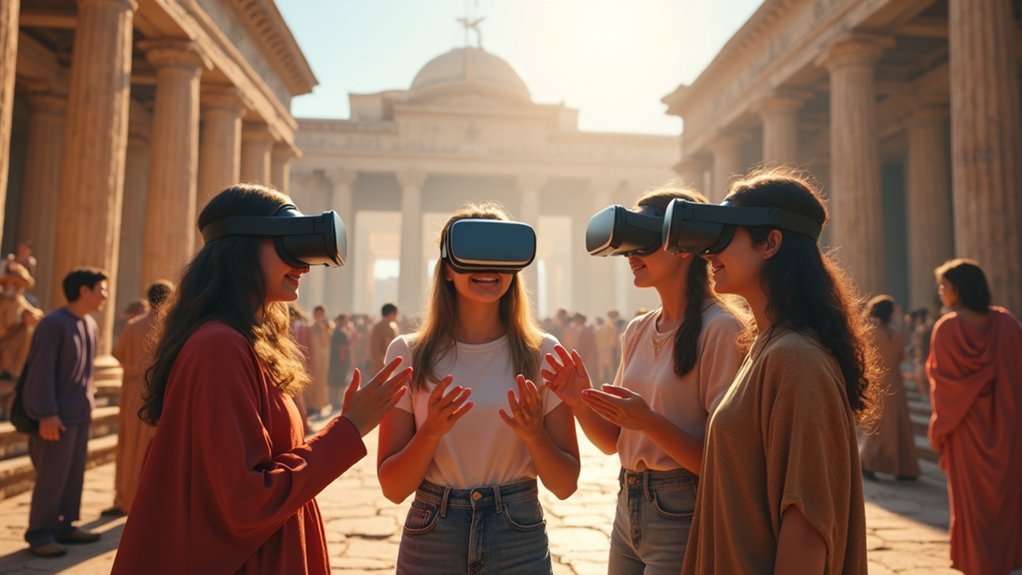
While traditional textbooks and documentaries have long served as the backbone of historical education, virtual reality technology now transports you directly into the past through immersive experiences that make history tangible and immediate.
You can walk through accurate reconstructions of ancient Rome’s bustling streets or explore the Anne Frank House, experiencing these locations as they truly existed.
VR replaces static images with interactive environments where you’ll encounter authentic architectural details, period clothing, and historical dialects. These engaging experiences considerably boost your memory retention and understanding compared to conventional learning methods.
As haptic feedback and sensory elements advance, you’re witnessing the transformation of historical education into enthralling journeys that motivate deeper exploration of our past.
Authenticity and Accuracy in Time-Traveling VR Experiences
The transformative power of these VR historical experiences depends entirely on their commitment to authenticity and accuracy.
When you step into time-traveling VR, you’ll encounter meticulously researched environments where developers collaborate directly with historians to guarantee precise representations of historical events.
You’ll notice architectural details based on concrete historical evidence, allowing you to explore spaces that mirror their real-life counterparts from centuries past.
The clothing, mannerisms, and dialects you encounter reflect careful attention to cultural and social context.
Authentic cultural details in VR transport users beyond surface-level history into lived experiences of past societies.
Examples like “Rome Reborn” and “Anne Frank House VR” demonstrate how authenticity fosters genuine empathy and understanding.
When historical details are accurate, you’ll find yourself more engaged and develop deeper comprehension of complex historical narratives that textbooks simply can’t provide.
Notable VR Applications for Historical Education
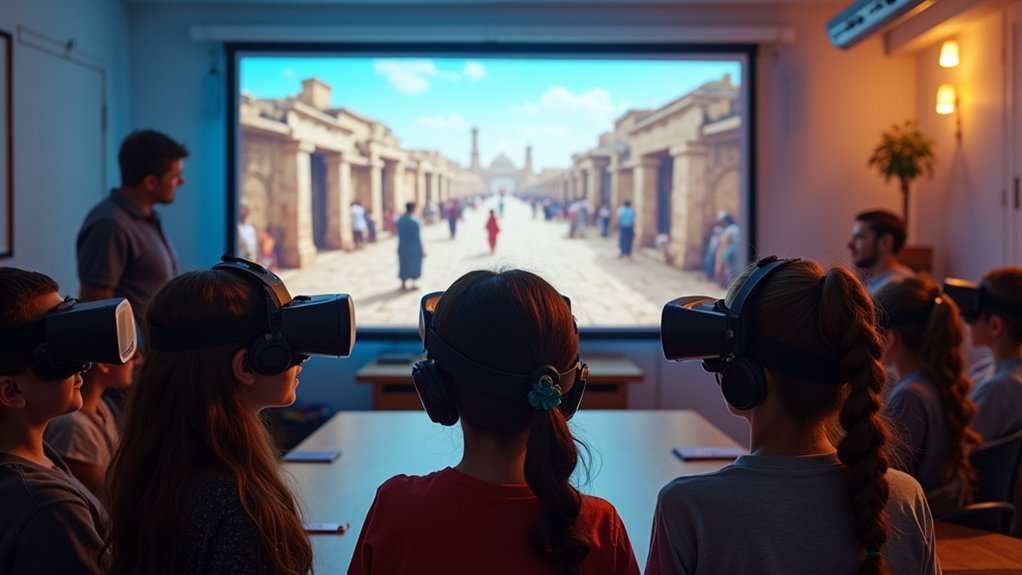
You can explore ancient Rome’s grandeur through “Rome Reborn’s” 3D reconstruction or journey into Egypt’s pyramids with immersive tomb experiences.
Holocaust education takes on profound meaning through “Anne Frank House VR,” which creates empathetic connections to this dark period in history.
Space exploration comes alive when you experience the Apollo 11 moon landing firsthand, feeling the weight of humanity’s greatest achievement.
Ancient Civilizations Explored
Through cutting-edge VR applications, you can now walk through ancient Rome’s bustling streets, explore pharaohs’ tombs, and witness pivotal moments that shaped human civilization.
“Rome Reborn” transforms historical study by letting you experience a meticulously crafted 3D reconstruction of the eternal city, complete with the Colosseum’s grandeur and the Roman Forum’s political significance.
Virtual Reality enhances Learning through “360° Ancient Egypt,” transporting you to significant archaeological sites where you’ll engage directly with pharaonic culture.
“Nefertari Pyramid Tomb” VR guides you through the Egyptian queen’s burial chamber, revealing intricate artistry and ancient burial practices.
“Apollo 11 VR” simulates humanity’s first moon landing, while “Anne Frank House VR” creates profound empathy through interactive exploration of Holocaust experiences.
Holocaust Memorial Experiences
While traditional history textbooks describe Holocaust atrocities through distant words and static images, VR applications like “Anne Frank House VR” create visceral connections that transform how you understand this darkest chapter of human history.
These Holocaust-related technologies place you directly within reconstructed spaces where real people faced unimaginable circumstances. You’ll experience the cramped quarters of the Secret Annex and witness the 1943 Berlin Blitz simulation, creating profound emotional understanding that textbooks can’t achieve.
- Feel the claustrophobic tension of hiding in silence for years
- Experience the terror of air raid sirens echoing through wartime Berlin
- Walk through authentic recreations of concentration camp barracks
- Witness survivor testimonies in immersive 3D environments
- Connect emotionally with individual stories of loss and resilience
This unique learning approach guarantees Holocaust education remains vivid and meaningful for future generations.
Space Exploration Simulations
When Apollo 11’s lunar module touched down on the moon’s surface in 1969, millions watched grainy footage on television screens.
But VR applications like “Apollo 11 VR” now let you experience Neil Armstrong’s perspective as you descend toward the Sea of Tranquility.
You’ll feel the tension of those critical moments, understanding space exploration’s complexity through immersive simulation.
These historical learning experiences transform abstract concepts into visceral understanding.
You can pilot a Lancaster bomber during the 1943 Berlin Blitz, experiencing WWII aerial combat strategies firsthand.
VR technology places you directly into pivotal moments, fostering empathy by putting you in historical figures’ shoes.
Space exploration simulations engage learners in ways traditional education can’t replicate, making scientific and historical contexts more relatable and memorable for students.
Enhancing Student Engagement Through Immersive History
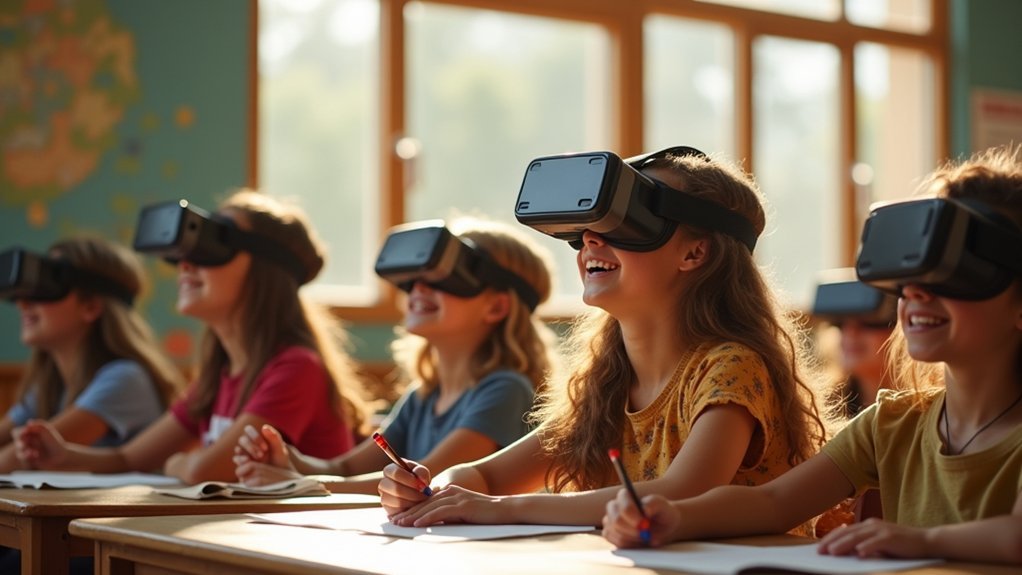
How can educators transform dusty textbooks and static timelines into enchanting adventures that make students feel like they’re living through history itself?
When you integrate VR experiences like “Rome Reborn” and “Anne Frank House VR” into your classroom, you’re creating immersive time-traveling journeys that make history feel relevant and relatable.
Your students won’t just read about ancient civilizations—they’ll walk through them. Research shows 87% of students are more likely to attend class when technology enhances their learning.
Through interactive simulations, you’ll foster deeper understanding and retention while encouraging active participation.
VR’s personalized learning capabilities let students explore at their own pace, dramatically increasing engagement and motivation.
- Walking through ancient Rome’s bustling streets
- Standing beside Anne Frank in her hidden sanctuary
- Witnessing pivotal historical moments unfold
- Exploring civilizations thought lost forever
- Experiencing history through personal, emotional connections
Accessibility and Inclusion in Virtual Historical Experiences
Because traditional field trips and museum visits aren’t accessible to every student, VR technology breaks down the barriers that have long excluded learners from experiencing history firsthand.
You’ll find that virtual reality promotes accessibility by eliminating physical, financial, and geographical constraints that prevent many students from engaging with historical sites.
When you implement VR in your classroom, you’re ensuring inclusion for students with mobility challenges or disabilities who can now interact with history in previously impossible ways.
You can provide experiences like the Anne Frank House VR or Apollo 11 simulations to every student, regardless of their circumstances.
This technology guarantees that all learners connect with historical events through immersive experiences, fostering understanding and creating equitable educational opportunities for diverse demographics.
Language Learning Through Historical VR Simulations
You can now practice ancient languages like Latin and Greek through immersive VR experiences that transport you directly into historical civilizations.
These simulations let you engage in authentic conversations with virtual characters while exploring ancient Rome’s forums or Athens’ agora, making language learning feel natural and contextual.
You’ll find yourself retaining vocabulary and grammar more effectively when you’re actively using the language to navigate real historical scenarios rather than memorizing from textbooks.
Ancient Language Immersion Experiences
When you step into a virtual Roman forum and need to negotiate the price of olive oil in fluent Latin, you’re experiencing one of education’s most groundbreaking innovations. Ancient languages come alive through VR technology, transforming dusty textbooks into vibrant, interactive experiences.
Applications like Linguae Vitae place you directly into historical scenarios where you’ll practice nearly extinct languages in realistic settings. You’ll interact with virtual characters and artifacts, deepening your understanding of ancient cultures while building conversational skills through immediate application.
Research confirms that immersive language learning through VR remarkably improves memory retention, making these experiences powerful educational tools.
- Feel the excitement of speaking Latin in ancient Rome’s bustling marketplace
- Experience the pride of mastering conversations with historical figures
- Discover the thrill of understanding ancient texts through cultural immersion
- Witness languages transform from academic subjects to living communication
- Connect emotionally with civilizations across millennia
Historical Context Language Practice
These immersive ancient language experiences gain even greater educational power when placed within broader historical contexts that transform how students understand both language and culture.
When you practice Latin while negotiating trade agreements in ancient Rome or speak Classical Greek during philosophical debates in Athens, you’re not just memorizing vocabulary—you’re experiencing language as it lived and breathed within its historical context.
This contextual language practice helps you grasp nuances, dialects, and cultural significance that textbooks can’t convey. You’ll develop critical thinking skills while understanding why certain phrases emerged and how historical events shaped linguistic evolution.
VR simulations create authentic scenarios where your language practice becomes meaningful, relevant, and deeply connected to the rich tapestry of human civilization.
Classroom Implementation Challenges and Solutions
Although VR technology promises to revolutionize historical education, you’ll face significant hurdles when implementing it in your classroom. The high costs of VR equipment and ongoing maintenance can strain your school’s budget, requiring strategic partnerships for funding solutions.
You’ll need technical expertise to operate and troubleshoot the technology effectively, while resistance to change among colleagues may slow adoption rates.
However, as technology continues advancing, solutions emerge:
- Advocate passionately for VR integration to transform your students’ learning experience
- Seek collaborative partnerships with tech companies for affordable educational tools
- Embrace professional development opportunities to master VR implementation
- Build school-wide support by demonstrating VR’s educational impact
- Secure sustainable funding through grants and strategic institutional partnerships
These classroom implementation challenges require proactive solutions and commitment.
Personalized Learning Pathways in Historical VR
While traditional history lessons confine you to textbooks and lectures, personalized learning pathways in historical VR transform you into an active participant who shapes your own educational journey.
You’ll explore specific historical events, figures, or cultures that align with your interests and learning style, enhancing motivation and retention at your own pace.
Machine learning analyzes your performance, creating customized experiences that address your unique challenges and needs.
VR offers immersive environments where you’ll practice ancient languages, witness pivotal moments, and engage with historical scenarios that foster deeper connections to content.
Through collaborative efforts between educators and developers, these personalized learning pathways become accessible to diverse student demographics, ensuring effective historical education reaches every learner.
Cost Considerations and Institutional Adoption
Despite the promising potential of personalized VR learning pathways, you’ll face substantial financial barriers when considering institutional adoption of this technology. Hardware, software, and ongoing maintenance costs create significant budget challenges for educational institutions. Limited school funding often prevents widespread classroom implementation, leaving many students without access to these immersive experiences.
Cost considerations extend beyond initial setup expenses. You’ll need sustainable funding strategies, including:
- Seeking collaborative partnerships with tech companies to reduce implementation costs
- Pursuing grant opportunities specifically designed for educational technology advancement
- Exploring cost-sharing arrangements between multiple districts or institutions
- Budgeting for long-term maintenance and system updates beyond initial investment
- Prioritizing strategic implementation in select programs before full institutional adoption
Strategic planning guarantees successful VR integration without compromising educational quality.
Future Developments in Educational Time-Travel Technology
Forward-looking developments in educational time-travel technology will transform how you experience historical learning through enhanced sensory integration and intelligent personalization. You’ll feel cobblestones beneath your feet while walking through ancient Rome or smell smoke from medieval forges as haptic feedback creates unprecedented realism.
| Technology Feature | Educational Impact |
|---|---|
| Haptic Feedback | Physical sensations enhance immersion |
| Machine Learning | Personalized historical experiences |
| Affordable VR Tools | Wider accessibility for learners |
| Sensory Elements | Multi-dimensional learning environments |
Virtual reality (VR) is revolutionizing how educational institutions approach historical instruction. Collaborations between schools and developers are creating cost-effective solutions that’ll make immersive experiences standard curriculum components. You’ll develop a deeper understanding of historical events through personalized journeys tailored to your interests and learning preferences.
Frequently Asked Questions
How Do Teachers Receive Training for Immersive Historical Education Programs?
You’ll attend specialized workshops where you practice using virtual reality equipment, learn interactive teaching methods, and develop skills for guiding students through simulated historical environments and role-playing scenarios effectively.
What Age Groups Benefit Most From Time Travel Historical Experiences?
You’ll find middle schoolers aged 11-14 benefit most from historical experiences. They’re developmentally ready for complex narratives, can distinguish past from present, yet remain imaginatively engaged enough to fully immerse themselves in different time periods.
Can Immersive History Programs Replace Traditional Textbook-Based Learning Entirely?
You shouldn’t replace textbooks entirely with immersive programs. You’ll need both approaches since textbooks provide thorough knowledge foundations while immersive experiences offer emotional connections and deeper understanding that textbooks can’t deliver.
How Do Schools Measure Learning Outcomes From Virtual Historical Experiences?
You’ll find schools track student performance through pre and post-experience assessments, peer discussions, project portfolios, and behavioral observations. They’re measuring critical thinking skills, historical knowledge retention, and engagement levels effectively.
What Safety Protocols Exist for Students Using VR Historical Simulations?
You’ll find extensive safety protocols including motion sickness prevention, content warnings for sensitive historical events, supervised sessions, emergency stop buttons, equipment sanitization, and age-appropriate filtering to protect students during VR experiences.