You’ll experience breakthrough anxiety relief through virtual reality therapy, where controlled digital environments let you confront fears safely from a therapist’s office. VRT combines immersive technology with proven cognitive-behavioral techniques, systematically exposing you to anxiety triggers while building coping mechanisms. Research shows up to 75% symptom reduction across phobias and social anxiety disorders, outperforming traditional imagination-based methods through standardized, repeatable exposure sessions that therapists can customize to your specific needs and monitor your progress in real-time.
Understanding Virtual Reality Therapy and Its Applications
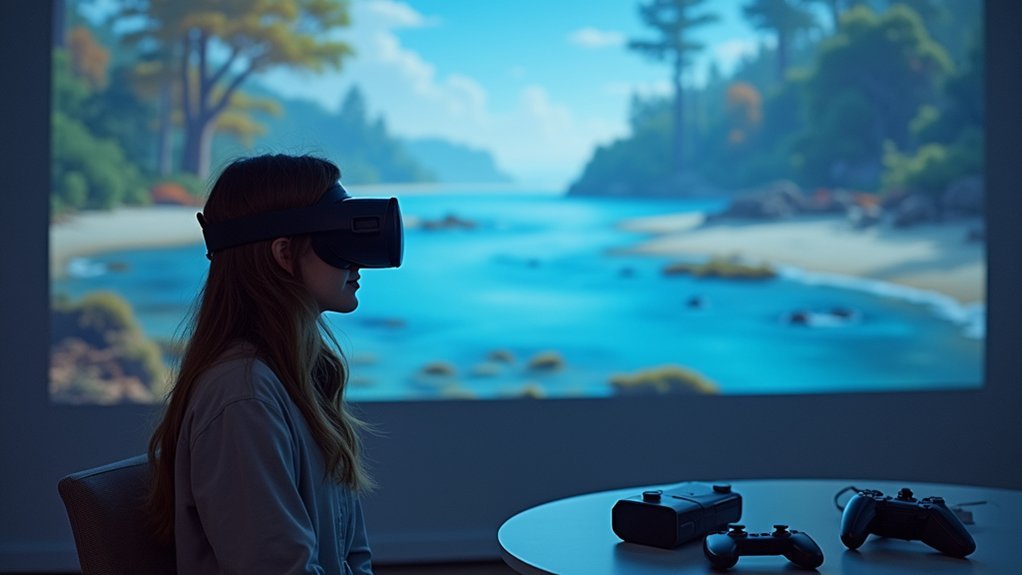
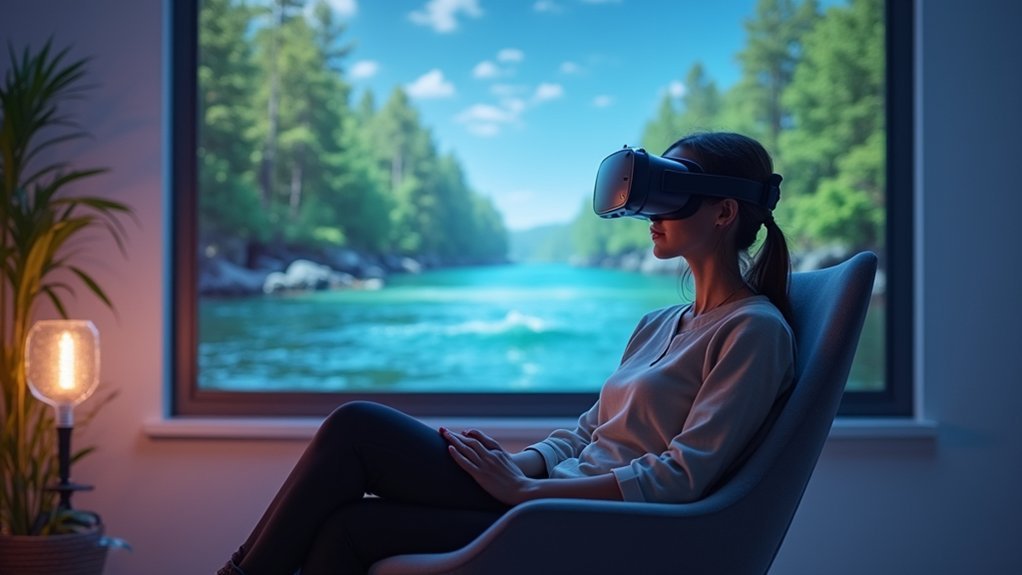
While traditional therapy requires you to imagine anxiety-provoking scenarios, Virtual Reality Therapy (VRT) plunges you directly into controlled digital environments where you can confront your fears safely.
Through VR therapy, you’ll experience immersive scenarios designed specifically for your anxiety triggers, whether you’re dealing with specific phobias or social anxiety.
Your treatment begins with relaxation techniques before gradually exposing you to virtual situations that increase in complexity. This progressive approach helps you build effective coping mechanisms while reducing your anxiety levels systematically.
The interactive nature of VR therapy enhances your engagement and motivation throughout the process.
Research shows that VR therapy delivers results comparable to traditional exposure therapies, with significant improvements in anxiety symptoms.
The technology allows therapists to tailor experiences precisely to your individual needs.
The Science Behind VR Exposure Treatment
Although VR exposure therapy might seem like futuristic technology, it’s grounded in decades of established psychological research on exposure therapy principles.
When you undergo VR exposure therapy (VRET), you’re experiencing a scientifically-backed treatment that combines immersive technology with proven cognitive-behavioral therapy techniques.
The science works by gradually exposing you to anxiety-triggering situations in controlled virtual environments. This allows your brain to process and adapt to feared stimuli without real-world risks.
Research demonstrates that VRET produces measurable neurological changes, helping you develop coping mechanisms and reducing anxiety responses over time.
Meta-analyses show impressive results, with some patients experiencing up to 75% symptom reduction in phobia cases.
The technology’s ability to create tailored, interactive scenarios enhances your engagement while maintaining the therapeutic effectiveness of traditional exposure methods.
How VR Creates Controlled Therapeutic Environments
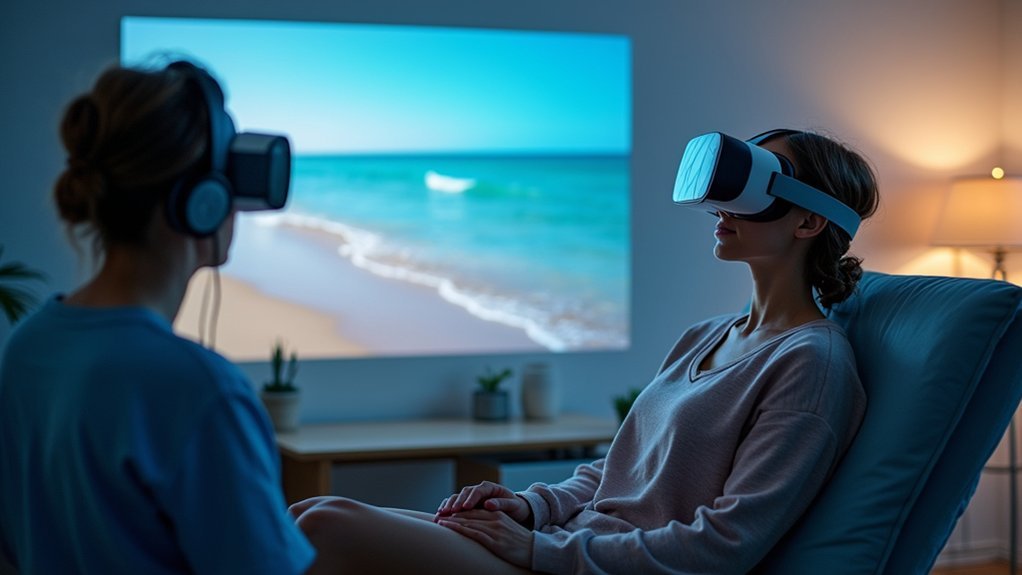
Understanding the science behind VRET naturally leads to examining how virtual environments create ideal therapeutic conditions. When you’re receiving VR exposure therapy (VRET), you’re immersed in controlled therapeutic environments that eliminate unpredictable real-world variables.
These standardized scenarios allow your therapist to monitor your responses precisely while gradually exposing you to anxiety-inducing situations without actual risks. Your therapist can customize each VR scenario to match your specific fears and anxiety levels, ensuring appropriate exposure intensity.
The technology enables real-time measurement of your anxiety responses, allowing immediate adjustments to your treatment plan. You’ll experience consistent, repeatable conditions that traditional therapy can’t replicate.
This controlled approach means you’re getting exposure that’s both safe and therapeutically effective, creating superior conditions for overcoming your anxiety disorders.
Comparing VR to Traditional Imagination-Based Therapies
When you’re considering anxiety treatment options, the contrast between VR exposure therapy and traditional imagination-based approaches becomes immediately apparent.
VR exposure therapy provides standardized scenarios that eliminate the unpredictability of imagination-based methods, giving you consistent therapeutic experiences. You’ll find VR environments induce anxiety levels comparable to personalized imagination while offering superior control over variables.
Unlike subjective imagination techniques, VR delivers structured, gradual exposure in safe settings. You’ll experience higher engagement and satisfaction since immersive technology captures your attention more effectively than mental visualization alone.
This enhanced focus translates to better treatment outcomes for anxiety disorders.
VR’s standardized approach makes measuring progress easier, allowing therapists to adjust your treatment plan precisely. You get reliable, repeatable exposure sessions rather than relying on imagination’s variable intensity.
Clinical Research Supporting VR Effectiveness

You’ll find compelling evidence for VR’s therapeutic potential when examining thorough research data across multiple studies.
Meta-analyses consistently demonstrate that VR treatments produce outcomes comparable to traditional exposure therapies, while randomized controlled trials show significant symptom reduction for conditions ranging from specific phobias to PTSD.
These clinical findings aren’t just promising short-term results—long-term efficacy studies reveal that VR’s therapeutic benefits persist well beyond the initial treatment period.
Meta-Analysis Treatment Outcomes
Although traditional exposure therapy has long been the gold standard for anxiety treatment, meta-analyses now reveal that Virtual Reality Therapy (VRT) delivers comparable—and sometimes superior—results across multiple anxiety disorders.
When you examine VRET treatment outcomes, you’ll find compelling evidence: patients with specific phobias experience up to 75% symptom reduction, while veterans with PTSD show marked improvement through virtual prolonged exposure therapy.
You’ll discover that systematic reviews consistently demonstrate VRT’s effectiveness across over 30 randomized control trials.
These quantitative analyses reveal significant anxiety level decreases, validating VRT as a personalized treatment option.
The data shows you’re not just getting alternative therapy—you’re accessing evidence-based intervention that matches traditional methods while offering unique advantages like controlled environments and repeatable scenarios.
Controlled Trial Results
Clinical research demonstrates VR therapy’s effectiveness through rigorously controlled studies that measure actual physiological and psychological responses.
You’ll find compelling evidence in randomized control trials where VR exposure therapy (VRET) consistently outperforms traditional methods. In one significant study, 145 workers’ compensation patients experienced a 33% reduction in pain and 46% decrease in anxiety after 14 weeks of Vx® Therapy.
When researchers compared standardized VR scenarios to personalized imagination techniques for treating anxiety disorders, both methods successfully increased anxiety levels during exposure sessions, proving VR’s capability to trigger therapeutic responses.
Over 30 randomized control trials now support VRET’s efficacy, with some studies documenting up to 75% symptom reduction in phobia patients, establishing VR as a scientifically validated treatment option.
Long-Term Efficacy Studies
Beyond immediate treatment outcomes, researchers have tracked VR therapy’s lasting impact through extended follow-up studies that reveal its enduring benefits. When you consider VR therapy for your mental health needs, you’ll find compelling evidence supporting its long-term efficacy:
- Sustained anxiety reduction – Follow-up assessments demonstrate improvements maintained for up to six months post-treatment.
- Comparable effectiveness – Meta-analytic results show VR’s effects match traditional CBT for specific phobias.
- Persistent symptom relief – Over 70% of participants maintain significant anxiety reduction during follow-up periods.
- PTSD improvements – Substantial decreases in intrusive thoughts and hyperarousal continue beyond treatment completion.
These studies prove you’re investing in lasting mental health improvements, not just temporary relief. VR therapy’s enduring effects make it a valuable long-term treatment option.
Treating Specific Phobias With Virtual Reality
You can now experience targeted relief from specific phobias through VR exposure therapy, which creates controlled virtual environments for confronting fears like heights, spiders, or public speaking.
This approach lets you gradually adjust the intensity and duration of exposure while maintaining complete safety throughout your treatment sessions.
Research demonstrates that VR phobia treatment achieves a remarkable 75% average symptom reduction, matching traditional exposure therapy’s effectiveness without real-world risks.
VR Exposure Therapy
When you’re trapped by a specific phobia, VR exposure therapy offers a breakthrough approach that lets you confront your fears in a safe, controlled virtual environment.
You’ll experience gradual exposure to phobic stimuli while your therapist provides real-time support throughout the process.
The technology delivers remarkable results through:
- Immersive engagement – You’re more actively involved than with traditional therapy methods.
- Customized treatment – Sessions are tailored to your individual needs and preferences.
- Proven effectiveness – Patients achieve approximately 75% symptom reduction on average.
- Enhanced motivation – You’ll stay more committed to treatment protocols, improving outcomes.
VR exposure therapy performs as effectively as conventional exposure methods while offering a non-invasive alternative.
Whether you’re facing fear of heights, spiders, or other specific phobias, this controlled virtual approach helps reduce anxiety levels considerably.
Phobia Treatment Outcomes
As research continues to validate VR therapy’s effectiveness, the documented outcomes for specific phobia treatment reveal compelling success rates that transform how we approach fear-based disorders.
When you undergo Virtual Reality Exposure Therapy (VRET), you’ll experience a 75% reduction in phobia symptoms through controlled, progressive exposure to your specific fears. Whether you’re confronting spiders, heights, or flying, VRET creates a safe environment where you can face these triggers without real-world consequences.
You’ll find that VRET matches traditional exposure therapy’s effectiveness while offering enhanced engagement through immersive technology. Meta-analyses consistently show substantial improvements in your anxiety symptoms during clinical applications.
The interactive nature of VR keeps you actively engaged throughout treatment, making the therapeutic process more effective at reducing your fear responses and achieving lasting phobia recovery.
VR Applications for Social Anxiety Disorders
Virtual reality therapy transforms how clinicians treat social anxiety disorders by creating immersive environments where you can safely confront your fears. This innovative VR approach allows you to practice social interactions without real-world consequences, making therapy more accessible and effective.
VR therapy creates safe, immersive environments for practicing social interactions without real-world consequences, revolutionizing social anxiety treatment.
Key benefits of VR therapy for social anxiety include:
- Controlled exposure scenarios – You’ll experience virtual social gatherings or public speaking situations tailored to your specific triggers.
- Significant symptom reduction – Studies show up to 75% decrease in anxiety levels after treatment sessions.
- Enhanced engagement – Interactive experiences increase your motivation compared to traditional methods.
- Proven effectiveness – Research demonstrates VRT performs as well as conventional exposure therapies.
You’ll develop essential coping strategies while building confidence in a supportive, risk-free environment that accelerates your social functioning improvements.
Post-Traumatic Stress Disorder Treatment Using VR
Beyond social situations, VR therapy proves equally transformative for treating post-traumatic stress disorder, offering a groundbreaking approach to trauma recovery.
VR exposure therapy allows you to confront traumatic memories in a controlled, safe environment where you can process these experiences at your own pace. Studies reveal that veterans participating in this immersive treatment experienced a remarkable 75% reduction in overall symptom severity.
You’ll find VR exposure therapy recreates specific traumatic scenarios, enabling prolonged exposure that gradually diminishes your anxiety responses.
Research shows high patient satisfaction rates with no significant side effects, making this approach both feasible and acceptable. By integrating cutting-edge VR technology with traditional therapeutic methods, you’ll experience enhanced treatment outcomes for posttraumatic stress while engaging with therapy in an innovative, effective way.
Generalized Anxiety Disorder and VR Interventions
When you’re struggling with generalized anxiety disorder, VR interventions offer a revolutionary approach that transforms how you’ll engage with exposure therapy.
Unlike traditional methods, VR exposure therapy (VRET) creates controlled environments where you can safely confront anxiety-inducing stimuli without real-world consequences.
Research shows VR’s remarkable effectiveness for treating generalized anxiety disorder:
- Significant symptom reduction – You’ll experience up to 46% decrease in anxiety levels after therapy sessions.
- Enhanced engagement – VR scenarios maintain your focus better than traditional imaginal exposure.
- Measurable outcomes – Therapists can precisely track your progress and treatment responses.
- Flexible scenarios – Both standardized and personalized VR environments effectively induce therapeutic anxiety levels.
This innovative technology revolutionizes mental healthcare by improving treatment efficacy while boosting your satisfaction throughout the therapeutic process.
Patient Engagement and Compliance Benefits
Since traditional therapy often struggles with patient dropout rates, VR technology transforms your therapeutic experience by creating compelling, interactive sessions that you’ll actually want to attend. VR exposure therapy (VRET) achieves remarkable 75% reduction in phobia symptoms through immersive environments that actively engage you throughout treatment.
| Traditional Therapy | VR Therapy |
|---|---|
| Limited engagement | Interactive immersion |
| High dropout rates | Increased participation |
| Repetitive sessions | Dynamic experiences |
| Patient resistance | High motivation |
| Standard protocols | Flexible treatment |
You’ll find yourself confronting fears within controlled virtual settings, dramatically improving your willingness to participate in exposure sessions. Patient satisfaction soars as you experience technology that’s both engaging and enjoyable. VRET’s flexibility allows repeated exposure without additional risks, promoting better compliance and superior therapeutic outcomes through sustained participation.
Measuring Therapeutic Outcomes in VR Sessions
Although VR therapy creates engaging treatment experiences, you need concrete measurements to validate its effectiveness in reducing your anxiety symptoms. Measuring therapeutic outcomes in VR sessions provides clinicians with quantifiable data to track your progress and optimize treatment plans.
Your therapeutic progress can be evaluated through several key methods:
- Standardized anxiety assessment scales that quantify symptom reduction before and after sessions
- Real-time anxiety monitoring during VR exposure therapy (VRET) sessions for immediate treatment adjustments
- Consistent exposure scenarios that enable reliable comparisons across different patients and settings
- Meta-analytical validation showing VR therapy achieves at least equivalent effectiveness to traditional exposure therapies
Research demonstrates that VRET can reduce your anxiety levels by an average of 46% after completing therapy sessions, providing concrete evidence of treatment success.
Cost-Effectiveness and Accessibility Considerations
Beyond demonstrating clinical effectiveness, VR therapy’s practical implementation depends heavily on its economic viability and patient accessibility.
You’ll find that VRT offers compelling cost-effectiveness advantages over traditional therapy methods. The technology reduces expenses associated with in-person sessions, travel costs, and facility overhead while potentially delivering comparable therapeutic outcomes.
VRT’s accessibility benefits are equally impressive. You can receive treatment from home through teletherapy options, eliminating transportation barriers and scheduling constraints. This approach particularly benefits underserved populations where mental health resources remain limited.
As VR technology becomes more affordable, you’re seeing expanded access to anxiety treatment across diverse demographics.
The projected market growth from $3.11 billion to $25.22 billion by 2030 reflects healthcare’s recognition of VR’s economic potential in delivering effective, accessible mental health solutions.
Training Requirements for Mental Health Practitioners
You’ll need to develop essential VR competencies that go beyond traditional therapeutic skills to effectively implement virtual reality in anxiety treatment.
Certification and standardized training programs guarantee you’re equipped with the technical knowledge and ethical framework required for safe VRT practice.
Ongoing skills development through continuing education keeps you current with rapidly evolving VR technology and evidence-based applications in mental health care.
Essential VR Competencies
The integration of virtual reality into anxiety treatment demands an extensive skill set that extends far beyond basic technological literacy.
As a practitioner implementing virtual reality therapy, you’ll need thorough competencies to effectively treat anxiety disorders and guarantee ideal patient outcomes.
Your essential VR competencies must include:
- Technical proficiency – You’ll operate VR hardware and software systems while troubleshooting technical issues during sessions.
- Psychological expertise – You’ll understand exposure therapy principles and tailor interventions for specific phobias and PTSD.
- Therapeutic techniques – You’ll integrate relaxation and mindfulness strategies to help patients manage anxiety during immersive experiences.
- Assessment skills – You’ll continuously monitor patient responses and anxiety levels to maintain safety and treatment effectiveness throughout sessions.
Certification and Standards
As mental health care evolves to embrace emerging technologies, practitioners must obtain specialized certification before implementing VR therapy in clinical settings.
You’ll need to complete thorough coursework covering VRT’s theoretical foundations, therapeutic techniques, and ethical considerations when using immersive technologies. These certification programs require hands-on experience with VR equipment and software, guaranteeing you can effectively guide patients through virtual exposure scenarios while monitoring their responses.
You can earn continuing education credits through specialized workshops, such as the 2.5 CE credits offered by the APA Office of Continuing Education in Psychology.
Staying current with ongoing VRT research is essential for applying evidence-based approaches. This systematic training guarantees you’re equipped to safely and effectively integrate virtual reality into your anxiety treatment protocols.
Ongoing Skills Development
Building on your foundational certification, continuous professional development keeps your VR therapy skills sharp and current with rapidly advancing technology.
You’ll need ongoing skills development to maintain proficiency in VR exposure therapy techniques.
Specialized workshops offer structured learning opportunities to advance your expertise:
- Earn continuing education credits – Complete 2.5 CE credit workshops focusing on VR integration for anxiety disorders
- Master therapeutic advantages – Learn to identify at least three key benefits of VR exposure therapy over traditional treatment methods
- Expand treatment scope – Develop skills to treat at least two specific anxiety disorders using VR applications
- Apply evidence-based practices – Gain hands-on experience through case examples and research summaries demonstrating VR therapy’s effectiveness
These programs guarantee you’re delivering cutting-edge, research-backed treatments to your clients.
Future Developments in VR Anxiety Treatment
While VR anxiety treatment has shown promising results in current applications, researchers are now directing their efforts toward optimizing protocols that’ll enhance efficacy and address individual patient needs through tailored immersive experiences.
These future developments focus on establishing VR’s long-term effectiveness compared to traditional exposure therapies while investigating cost-effectiveness for broader healthcare implementation.
You’ll see expanded accessibility through VR integration with mobile applications and teletherapy, allowing treatment from home. This evolution will make therapy more convenient and reach patients who previously couldn’t access care.
Researchers are also prioritizing ethical considerations to guarantee safe, informed use of VR technologies. The efficacy of VR will be strengthened through personalized protocols that adapt to your specific anxiety triggers and therapeutic progress.
Frequently Asked Questions
Could Virtual Reality Help Treat Anxiety?
You can benefit from virtual reality therapy for anxiety disorders. VR exposure therapy lets you confront fears safely, reducing phobia symptoms by up to 75% while being as effective as traditional treatments.
What Is the Success Rate of Virtual Reality Exposure Therapy?
You’ll find VRET achieves impressive success rates, with clinical trials showing approximately 75% symptom reduction for specific phobias and significant PTSD improvements in veterans, with lasting results comparable to traditional therapy methods.
Does Insurance Cover VR Therapy?
Insurance coverage for VR therapy varies considerably by provider. You’ll need to check with your specific insurer, as some cover it under behavioral health benefits while others don’t yet recognize it.
Is Virtual Reality One of Many Emerging Treatments for Post Traumatic Stress Disorder?
Yes, you’ll find virtual reality is one of several emerging PTSD treatments alongside therapies like EMDR and neurofeedback. You’re seeing promising research showing VR’s effectiveness in helping veterans process trauma safely.