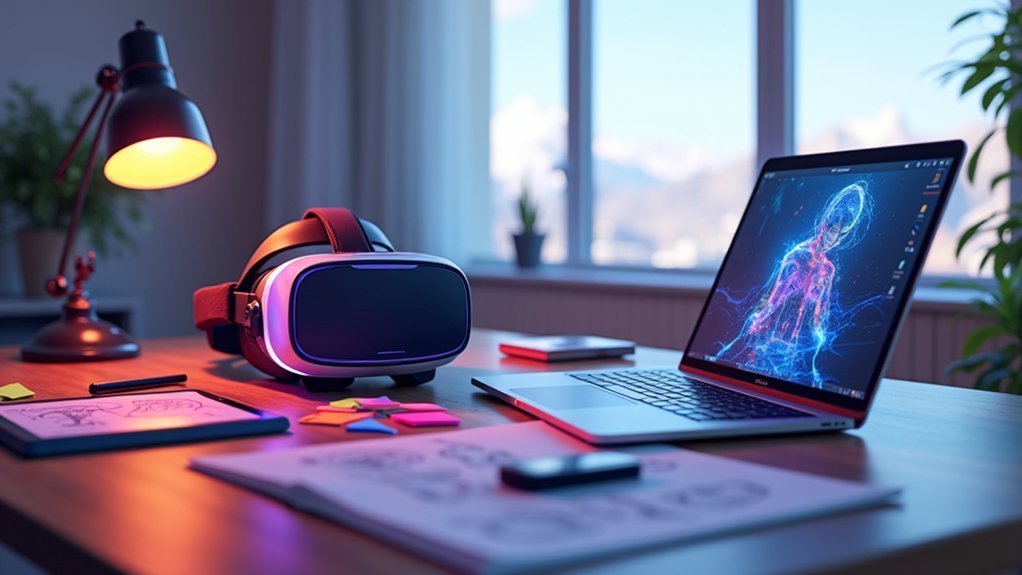
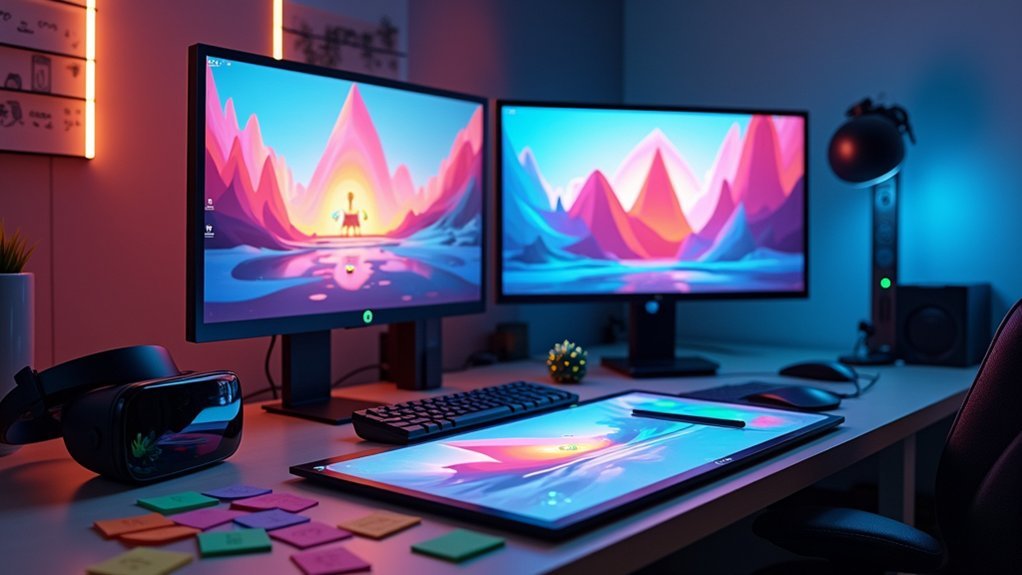
You’ll need three essential components to start VR animation: beginner-friendly software like Ollie VR or Quill that doesn’t require prior experience, compatible hardware including VR goggles (Oculus Rift or HTC Vive) with hand controllers and a powerful computer featuring a dedicated graphics card, plus basic 3D modeling tools like Blender or SketchUp that integrate with VR workflows. These tools allow you to create, manipulate, and export immersive animations effectively. Understanding how these components work together will unleash your creative potential.
Essential VR Animation Software Platforms
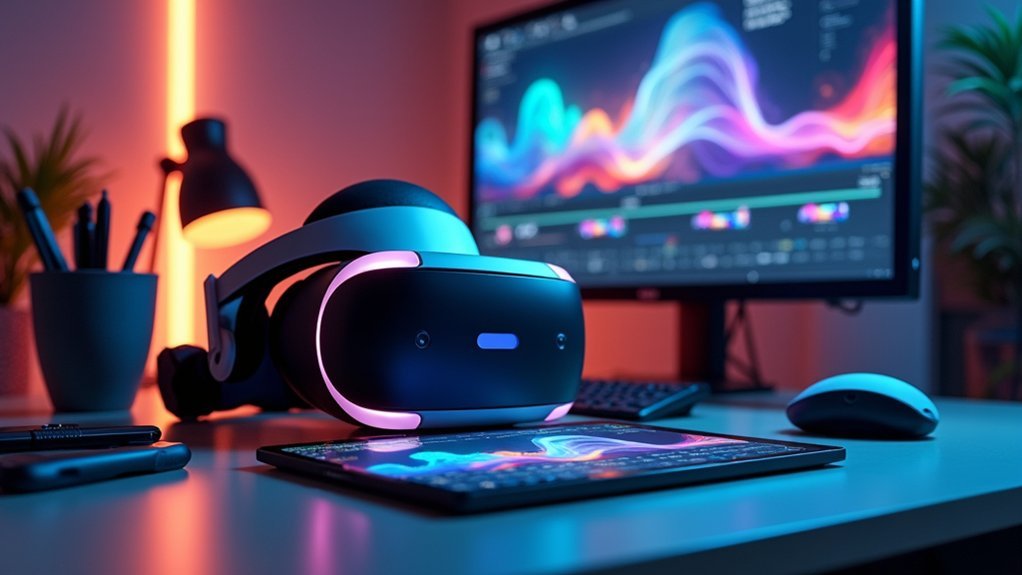
While traditional animation requires expensive software and years of training, VR animation platforms have revolutionized creative expression by making 3D animation accessible to everyone.
Ollie VR stands out as the ideal animation tool for beginners aged 13-18, offering an intuitive interface that eliminates the need for prior experience.
Quill provides a user-friendly painting and animation platform with an infinitely scalable canvas and rich color palette.
Tvori excels at story prototyping with its library of simple shapes and props.
AnimVR combines traditional techniques with digital creation, perfect for building 3D storyboards without complex rigging.
Medium rounds out your toolkit with powerful sculpting capabilities.
These VR animation platforms transform creative barriers into creative possibilities, empowering you to animate confidently.
Hardware Requirements for VR Content Creation
Before you plunge into creating your first VR animation, you’ll need the right hardware setup to bring your creative visions to life.
A solid hardware foundation transforms ambitious creative concepts into immersive virtual reality experiences that captivate audiences.
Your essential equipment includes:
- VR Goggles – Choose between Oculus Rift or HTC Vive for immersive VR experiences that let you visualize animations in real-time 3D space.
- Hand Controllers – These allow you to manipulate objects, navigate keyframes, and interact naturally within your virtual workspace.
- Powerful Computer – You’ll need a dedicated graphics card like NVIDIA GTX 1060 or higher, plus at least 8GB RAM to run VR animation tools smoothly.
- Motion Sensors – Additional tracking devices enhance precision and expand your creative capabilities beyond basic controllers.
Ensure your chosen VR animation tools are compatible with your hardware platform, whether that’s Oculus or Steam-based systems.
3D Modeling Tools Compatible With VR Workflows
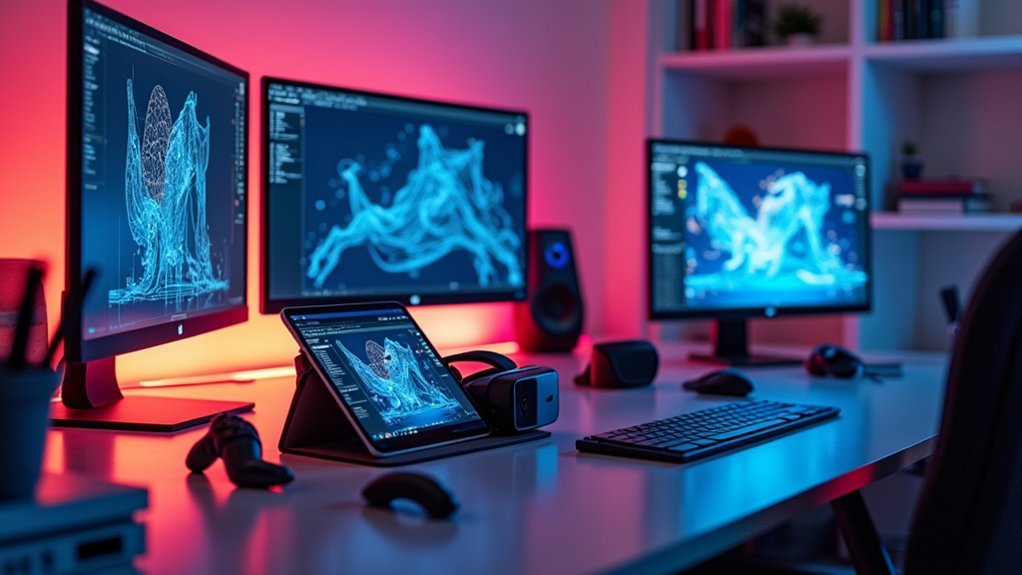
Once you’ve assembled your VR hardware setup, you’ll need 3D modeling software that seamlessly integrates with your virtual reality workflow.
Blender stands out as an excellent starting point since it’s free, open-source, and packed with animation tools perfect for VR applications.
Autodesk Maya offers industry-standard capabilities with VR integration through specialized plugins, while ZBrush excels at high-resolution character sculpting for detailed virtual reality projects.
SketchUp provides a beginner-friendly interface that’s ideal for architectural designs, and its models export easily to VR platforms.
For absolute beginners, Tinkercad offers simplified web-based 3D modeling that removes complexity while still producing VR-compatible content.
Each tool serves different skill levels and project requirements within VR workflows.
Animation Controllers and Timeline Management
After you’ve selected your 3D modeling software, understanding animation controllers becomes your next essential step in creating compelling VR content.
Animation controllers in VR tools like Ollie VR help you manage animation states and shifts for your 3D models, making the process approachable for beginners.
VR animation controllers simplify complex 3D model management, transforming intimidating technical processes into accessible creative tools for newcomers.
The timeline feature provides visual structure for your animated scene, letting you control duration and sequence management effectively.
Here’s what you’ll need to master:
- Set keyframes to record specific model properties and create smooth shifts between movements
- Add animation events to synchronize sound and visual effects at precise timeline moments
- Configure animation states to define different behaviors for your 3D models
- Practice previewing animations regularly in VR to guarantee natural, immersive movements and make necessary adjustments
Video Production and Post-Processing Applications
While animation controllers handle the movement of your VR content, capturing and refining that content requires dedicated video production tools.
You’ll need capture software like OBS or ShadowPlay to record your VR experience in real-time, whether you’re documenting Oculus gameplay or animation workflows. These applications guarantee you’re creating high-quality videos from your immersive content.
For post-processing, video editing software like Premiere Pro or DaVinci Resolve becomes your essential animation tool. You can enhance visual quality, add effects, and apply color grading to your captured footage.
Pay careful attention to export settings when finalizing your work—proper configuration guarantees your VR content maintains high resolution and compatibility across different platforms, delivering a superior viewing experience for your audience.
Free Vs Paid VR Animation Tool Options
Beyond capturing and editing your VR animations, you’ll face an important decision about which tools to use for creating content in the first place.
Free tools like Quill and Tvori offer beginners intuitive interfaces without financial barriers, while paid options such as Tilt Brush ($20) and Gravity Sketch ($30) provide advanced features for your creative toolkit.
Consider these key differences when choosing VR animation tools:
- Cost vs. Capability – Free tools enable experimentation, while paid options deliver robust functionality for professional-quality animations.
- Community Engagement – Free platforms like Medium emphasize shared creations and collaborative learning.
- Support Structure – Paid tools typically offer extensive customer support and regular updates.
- Feature Limitations – Free versions may restrict advanced capabilities that serious creators require.
Your choice depends on whether you’re casually exploring or pursuing professional development.
Frequently Asked Questions
What Animation Software Should I Use for Beginners?
You should start with Ollie VR if you’re 13-18, as it’s designed for complete beginners. Alternatively, try Tvori since it requires no prior 3D knowledge and offers an easy-to-learn interface with simple shapes.
What Equipment Do I Need for Virtual Reality?
You’ll need VR goggles like Oculus Rift or HTC Vive, hand controllers for navigation, a powerful computer with dedicated graphics card, and high-speed internet for downloads and updates.
Can You Use VR to Make Animations?
You can definitely use VR to create animations. Tools like Quill, AnimVR, and Tvori let you animate in three-dimensional space using hand controllers, making the process more intuitive than traditional software.
What Do I Need to Get Started With VR?
You’ll need a VR headset like Oculus Rift or HTC Vive, hand controllers for interaction, and a computer with powerful GPU. Confirm your system meets requirements for smooth performance and quality experiences.

Leave a Reply