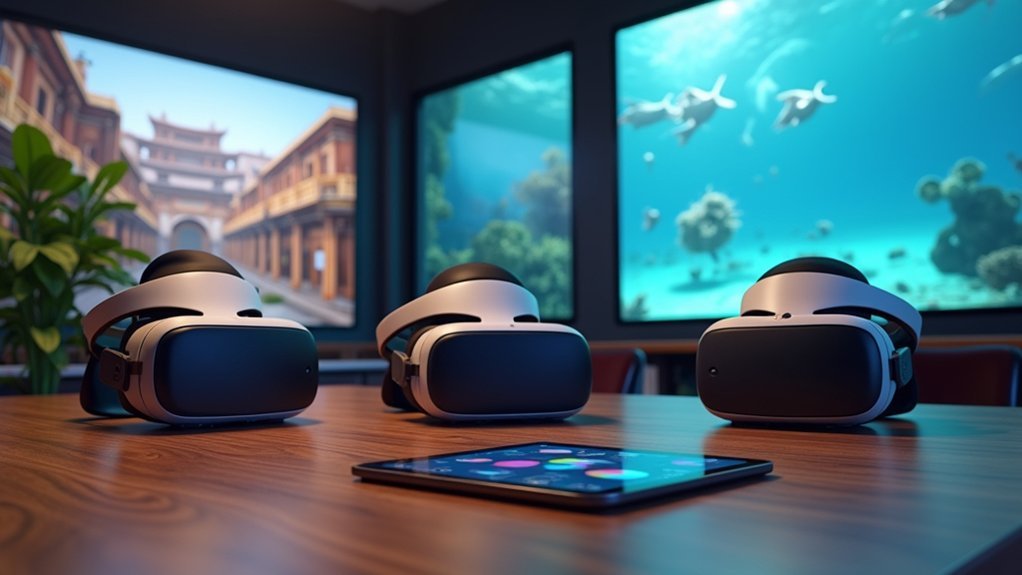
You’ll find Unity VR Development Platform leading the pack with its cross-platform deployment capabilities and minimal programming requirements, making it accessible for educators without extensive coding skills. Unreal Engine 5 excels in creating photorealistic environments with advanced AI integration, trusted by prestigious institutions like Columbia and Harvard. Strivr Platform streamlines development through pre-built frameworks and proven training methodologies, earning a 4.4/5 rating. Each platform offers unique strengths that’ll help you discover which solution best fits your educational needs.
Unity VR Development Platform for Educational Content Creation
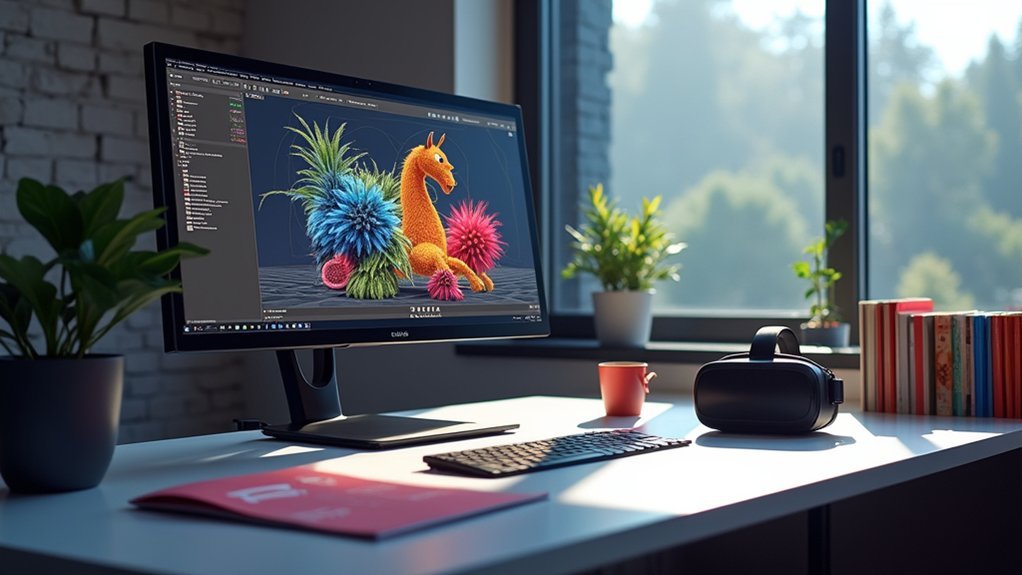
When you’re looking to create compelling educational VR experiences, Unity stands out as the premier development platform that transforms traditional learning into immersive 3D adventures.
Unity VR Development empowers you to craft interactive experiences across multiple subjects through educational content creation tools that support cross-platform deployment. You’ll reach learners on various VR hardware, PCs, and mobile devices seamlessly.
The platform’s powerful physics and rendering capabilities enable realistic simulations perfect for teaching complex scientific and engineering concepts.
You can integrate AR/VR SDKs without extensive programming knowledge, making VR applications accessible to educators.
Unity’s extensive documentation and active community provide essential support for developing immersive learning experiences that engage students through hands-on exploration rather than passive consumption.
Unreal Engine 5 for Immersive Learning Experience Development
While Unity excels in accessibility, Unreal Engine 5 pushes the boundaries of visual fidelity and realism in educational VR development.
You’ll leverage its advanced real-time rendering capabilities to create stunning interactive environments that captivate students across science, engineering, and arts curricula. The platform’s AI integration enables personalized learning experiences, adapting content creation to individual student needs while improving knowledge retention.
Educational institutions like Columbia University and Harvard trust Unreal Engine for immersive learning applications. You’ll deploy across VR technology, AR, and mobile platforms, reaching diverse audiences effectively.
Key advantages you’ll experience:
- Photorealistic environments – Students explore ancient Rome’s Colosseum with architectural precision.
- Dynamic simulations – Witness molecular interactions in real-time chemistry labs.
- Adaptive scenarios – AI adjusts difficulty based on individual progress and comprehension levels.
Strivr Platform for Interactive Educational VR Solutions

Beyond high-end visual engines, you’ll find specialized platforms like Strivr that streamline educational VR development with pre-built frameworks and industry-focused solutions.
You’ll appreciate how this immersive learning platform removes complex coding requirements while delivering sophisticated virtual environments for education and training applications.
Strivr’s compatibility with major VR hardware like Oculus Rift and HTC Vive guarantees you can deploy interactive learning solutions across diverse educational institutions and corporate settings.
The platform excels at merging VR content with existing educational workflows, making skill development more engaging and effective.
With its 4.4/5 rating, you’ll benefit from proven training methodologies that enhance student engagement through hands-on experiences.
Whether you’re developing corporate training modules or academic curricula, Strivr provides the tools needed for creating impactful immersive learning experiences.
Frequently Asked Questions
What Is the Best VR for Education?
You’ll find VictoryXR offers the most extensive educational VR platform, partnering with 50+ universities for digital twin campuses. It provides immersive learning simulations that greatly enhance student engagement and knowledge retention across disciplines.
What Is the Best Platform to Make a VR Game?
You’ll find Unity’s the top choice for VR game development. It’s beginner-friendly, offers extensive assets, and provides strong community support. Unreal Engine’s also excellent if you’re prioritizing high-quality graphics and immersive experiences.
What Is the VR Company for Schools?
You’ll find VictoryXR leads VR education for schools, partnering with over 50 institutions to create Digital Twin Metaversities. They’re building extensive virtual campuses where students can attend classes and learn through immersive experiences.
How Much Does VR Cost in Education?
You’ll spend $1,000 to $10,000 for initial VR setup in education, plus annual licensing fees ranging from hundreds to thousands of dollars. Expect ongoing maintenance costs adding 15-20% yearly to your original investment.