
You can create professional VR experiences affordably using A-Frame’s web-based HTML framework, Unity Personal Edition’s extensive development suite, or Blender’s complete 3D modeling toolkit—all completely free. Mozilla Hubs offers browser-based virtual worlds, while Google Cardboard SDK transforms smartphones into VR devices. SketchUp Free provides intuitive 3D modeling, CoSpaces Edu democratizes classroom VR creation, and WebXR guarantees cross-platform compatibility. These platforms rival expensive alternatives while maintaining zero licensing costs, and exploring their specific features reveals even greater cost-saving opportunities.
A-Frame: Open Source Web-Based VR Development

While most VR development platforms require expensive software licenses and specialized programming knowledge, A-Frame breaks down these barriers by offering a completely free, web-based framework that you can start using immediately.
This open-source solution lets you build VR experiences using familiar HTML and JavaScript, making it accessible even if you’re new to VR development.
You’ll appreciate A-Frame’s entity-component system, which simplifies creating 3D scenes through HTML-like markup.
The framework works across various VR devices and web platforms, ensuring your immersive projects reach broad audiences.
Thanks to extensive community contributions, you’ll find abundant templates and plugins that accelerate development.
While performance depends on browser capabilities, A-Frame remains ideal for developers seeking cost-effective VR creation solutions.
OpenSpace 3D: Multi-Platform VR Creation Tool
OpenSpace 3D delivers true cross-platform versatility, letting you deploy VR projects across multiple hardware and software environments without rebuilding from scratch.
This multi-platform VR creation tool features a powerful game engine that enables you to build interactive 3D environments without extensive coding knowledge. You’ll appreciate its seamless deployment capabilities, which make creating immersive VR applications straightforward across various devices.
The platform’s integration with Blender provides robust 3D modeling capabilities, streamlining your design workflow considerably.
You’ll find OpenSpace 3D particularly valuable if you’re prioritizing cross-platform accessibility for multi-device VR experiences.
With pricing available upon request, it represents a budget-friendly choice for organizations seeking to develop professional-quality virtual reality content without breaking their development budget.
Unity Personal Edition: Free Game Engine for VR

You’ll discover that Unity Personal Edition offers an all-encompassing suite of VR development tools at zero cost, making it an exceptional choice for budget-conscious creators.
The platform supports major VR headsets including Oculus Rift, HTC Vive, and PlayStation VR, ensuring your projects reach diverse audiences without compatibility concerns.
You can also access extensive documentation and community tutorials that’ll accelerate your VR development journey from beginner to advanced creator.
Free Unity VR Features
Unity Personal Edition stands as a powerhouse among free game engines, offering aspiring VR developers everything they need to create immersive experiences without spending a dime.
You’ll gain access to the XR Interaction Toolkit, which streamlines VR interaction development across multiple platforms without complex coding.
The engine’s real-time rendering capabilities let you craft visually stunning environments that captivate users. You can tap into Unity’s extensive Asset Store, featuring thousands of free resources to accelerate your project development and prototyping process.
When you’re stuck, thorough documentation and robust community support guarantee you won’t struggle alone.
These combined features make Unity Personal Edition an unbeatable choice for budget-conscious developers seeking professional-grade VR creation tools.
Platform Compatibility Support
When developing VR experiences, you need confirmation that your creations will run seamlessly across different headsets and platforms.
Unity Personal Edition delivers exceptional platform compatibility, supporting major VR platforms including Oculus Rift, HTC Vive, and PlayStation VR. This broad compatibility means you can develop once and deploy across multiple devices, maximizing your audience reach without additional development costs.
The engine’s real-time rendering capabilities guarantee consistent performance across different hardware configurations.
You’ll benefit from Unity’s optimized VR pipelines that automatically handle platform-specific requirements, reducing technical barriers and development time.
- Cross-platform deployment to Oculus Rift, HTC Vive, and PlayStation VR
- Real-time rendering optimizations for consistent VR performance
- Extensive asset store integration for platform-specific VR content
- Automated handling of platform compatibility requirements
Learning Resources Available
Although VR development can seem intimidating for newcomers, Unity Personal Edition removes barriers with its vast collection of learning resources designed specifically for beginners.
You’ll access detailed tutorials and extensive documentation that guide you through creating immersive VR experiences step-by-step. The Unity Learn platform offers guided projects and structured pathways tailored for VR development, helping you master essential skills progressively.
You can explore thousands of free assets through the Asset Store to enhance your projects without additional costs.
Online courses and learning materials provide hands-on experience with real-world scenarios. Community forums connect you with experienced developers who share valuable insights.
This free and open-source approach guarantees you’re never stuck, making professional VR creation achievable regardless of your technical background or budget constraints.
Blender: Complete 3D Creation Suite at No Cost
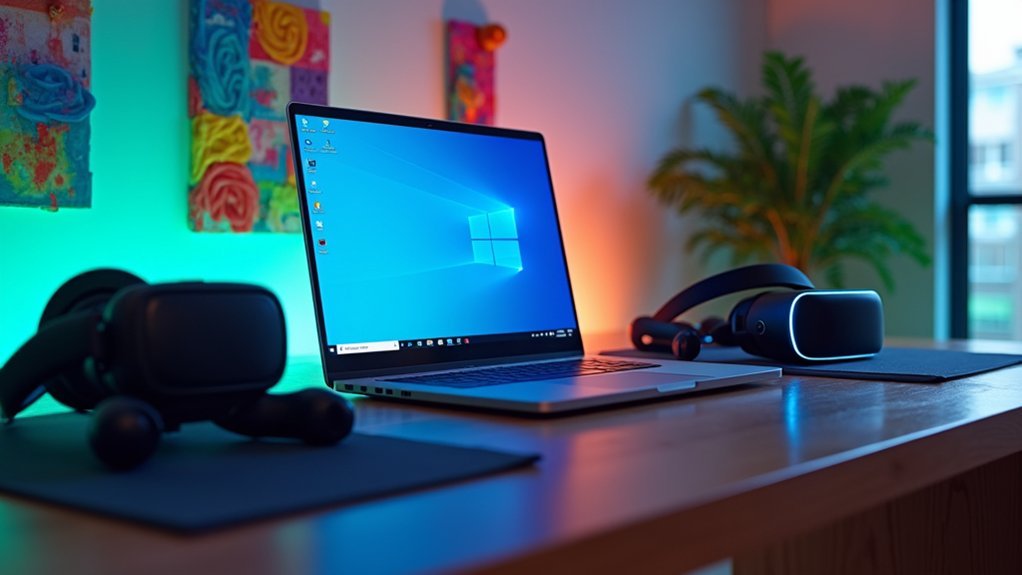
Since creating professional VR content typically requires expensive software licenses, Blender stands out as a remarkable exception that won’t cost you a penny.
This thorough 3D creation suite delivers everything budget-conscious developers need for crafting immersive experiences across multiple VR platforms.
You’ll access sculpting, rigging, animation, and video editing tools within one integrated application, eliminating the need for multiple paid software packages.
Blender’s export compatibility guarantees seamless integration with various VR platforms, while its robust Python API enables extensive customization without expensive add-ons.
Key advantages include:
- Complete 3D modeling and animation toolkit at zero cost
- Built-in VR platform compatibility for streamlined development
- Extensive documentation and active online community support
- Powerful Python API for workflow automation and customization
Mozilla Hubs: Browser-Based Virtual World Builder
While most VR platforms demand hefty downloads and complex installations, Mozilla Hubs revolutionizes virtual world creation by running entirely in your browser. You’ll access immersive environments instantly without any software requirements, making it perfect for budget-conscious creators.
| Feature | Capability |
|---|---|
| Platform Access | Browser-based, no downloads needed |
| Device Support | Multiple VR headsets and desktop |
| Avatar System | Customizable avatars for personalization |
| Collaboration | Real-time interaction with voice chat |
| Development | Open-source with community contributions |
Mozilla Hubs allows you to create virtual spaces that support seamless real-time interaction across different devices. You’ll customize environments for meetings, events, or social gatherings while sharing 3D models effortlessly. The open-source nature guarantees continuous improvements through community contributions, giving you access to evolving features without additional costs.
Babylon.js: JavaScript Framework for 3D Experiences
You’ll find Babylon.js stands out as a powerful open-source 3D engine that won’t cost you anything to start building immersive VR experiences.
The framework’s WebXR compatibility means you can deploy your creations across multiple VR platforms without worrying about device-specific limitations.
What makes it especially attractive for budget-conscious developers is its seamless AWS integration, giving you access to cloud-based features and scaling options as your projects grow.
Open Source 3D Engine
When budget constraints limit your VR development options, Babylon.js emerges as a powerful JavaScript framework that transforms how you create 3D experiences directly in web browsers.
This open source 3d engine eliminates expensive licensing fees while delivering professional-grade results for VR development platforms.
You’ll access WebXR API support that seamlessly integrates immersive experiences into web applications without additional plugins.
The framework’s physically-based rendering and extensive animation capabilities provide a robust toolkit for developing metaverse applications with sophisticated user interaction features.
Key advantages include:
- Cost-effective development with no licensing fees
- Cross-platform compatibility across various devices
- Active community support with thorough documentation
- Lightweight design optimized for web-based VR experiences
Babylon.js democratizes VR creation, making high-quality immersive content accessible regardless of your budget limitations.
WebXR Platform Compatibility
Since WebXR standardizes immersive web experiences across different browsers and devices, Babylon.js leverages this technology to deliver consistent VR performance whether you’re targeting Meta Quest headsets, HTC Vive systems, or mobile devices.
You’ll find that WebXR compatibility eliminates platform-specific coding requirements, streamlining your VR development process considerably.
Babylon.js’s WebXR integration allows you to create interactive VR content that runs seamlessly on web browsers without additional plugins. You can develop a virtual reality environment once and deploy it across multiple platforms, reducing development costs and time.
The framework’s extensive documentation provides clear WebXR implementation guides, helping you understand how to optimize your immersive experience for different devices. This cross-platform compatibility makes Babylon.js particularly valuable for budget-conscious developers seeking maximum reach for their VR projects.
AWS Integration Features
Beyond cross-platform deployment capabilities, Babylon.js offers robust AWS integration features that amplify your VR development potential through cloud-powered resources.
You’ll access powerful VR software solutions that leverage AWS services for enhanced performance and scalability. The framework’s cloud capabilities enable you to create immersive VR experiences with superior computing power and storage options.
- Real-time rendering optimization through AWS computing resources for smoother performance
- Physically-based rendering enhancement utilizing cloud processing for realistic visual accuracy
- Built-in web hosting tools that streamline deployment on AWS infrastructure
- Extensive documentation and community support simplifying AWS integration processes
You’ll benefit from seamless cloud integration that transforms your budget-friendly VR projects into professional-grade applications without compromising quality or breaking your development budget.
Google Cardboard SDK: Mobile VR Development Kit
Accessibility stands at the heart of Google Cardboard SDK’s design philosophy, transforming any smartphone into a capable VR device without breaking your budget.
This mobile VR development kit enables you to create immersive virtual reality experiences across Android and iOS platforms using an open-source toolkit that costs nothing to implement.
You’ll leverage sophisticated user interaction features including motion tracking that responds to head movements and touch inputs, letting users naturally engage with your virtual environments.
The Google Cardboard SDK’s straightforward integration process makes it perfect for beginners and hobbyists who want to experiment with VR development.
You can build compelling VR applications that tap into Google’s software ecosystem while maintaining the no-cost model that democratizes virtual reality creation for developers at every level.
SketchUp Free: 3D Modeling for Virtual Environments
You’ll find SketchUp Free offers powerful 3D modeling capabilities without breaking your budget, making it perfect for creating virtual environments from scratch.
The platform’s intuitive tools let you build everything from architectural spaces to game-ready assets that’ll work seamlessly in your VR projects.
Whether you’re designing realistic building interiors or fantastical gaming worlds, SketchUp’s browser-based approach means you can start modeling immediately without complex software installations.
Free 3D Design Tools
SketchUp Free stands out as one of the most accessible entry points into 3D modeling for virtual reality creation. This web-based 3D modeling tool empowers you to create detailed virtual environments without spending money, making it particularly accessible for beginners entering VR development.
You’ll appreciate the intuitive drag-and-drop interface that lets you easily create complex structures from basic shapes.
Key features that make SketchUp Free essential for VR creators:
- Supports multiple file formats to import and export models seamlessly
- Provides access to 3D Warehouse’s extensive library of pre-made models
- Offers cost-free entry into professional-grade 3D design tools
- Delivers sufficient functionality for virtual reality applications despite lacking pro features
While you won’t get advanced capabilities, SketchUp Free delivers everything needed for fundamental VR environment creation.
VR Environment Creation Process
Creating virtual environments with SketchUp Free begins with understanding the fundamental workflow that transforms basic geometric shapes into immersive 3D spaces.
You’ll start by sketching foundational structures using the user-friendly interface, then push and pull surfaces to create depth and dimension. This 3D modeling tool streamlines virtual reality creation by providing intuitive drawing functions that don’t require extensive technical knowledge.
You can access the library of assets through 3D Warehouse to populate your virtual environment with pre-made components, accelerating development time considerably.
Once you’ve completed your design, you’ll export your model in formats like STL or OBJ to integrate models into VR applications. This workflow enables you to create immersive experiences efficiently, making SketchUp Free perfect for virtual reality projects.
Architecture and Gaming Applications
When architects and game developers need cost-effective 3D modeling solutions, SketchUp Free delivers professional-grade capabilities that excel in both architectural visualization and gaming environment creation.
This accessible virtual reality software transforms complex design workflows into streamlined processes, enabling you to craft detailed environments without expensive licensing fees. The 3D modeling tool’s browser-based platform supports real-time collaboration, letting teams work simultaneously across locations while maintaining project continuity.
- Access thousands of pre-made models through 3D Warehouse for rapid prototyping
- Export STL and OBJ files for seamless integration with VR development pipelines
- Utilize intuitive interface for quick architectural mockups and gaming level design
- Collaborate instantly with team members without software installation requirements
Whether you’re designing virtual buildings for architecture presentations or crafting immersive gaming applications, SketchUp Free provides the essential foundation for professional VR content creation.
WebXR Device API: Native Browser VR Integration
While traditional VR development often requires expensive software and specialized skills, the WebXR Device API revolutionizes how you can create virtual reality experiences by bringing them directly into web browsers.
This standardized API eliminates the need for additional plugins, enabling you to build immersive applications using familiar web technologies like JavaScript and HTML.
You’ll benefit from cross-platform compatibility across different VR devices, including headsets and smartphones. The API supports essential features like tracking user position and orientation, allowing realistic interactions within virtual environments.
With major browsers like Chrome, Firefox, and Edge providing browser support, your WebXR applications reach wider audiences. This accessibility makes VR creation budget-friendly, requiring only web development knowledge rather than expensive specialized tools or extensive training.
CoSpaces Edu: Educational VR Content Platform
CoSpaces Edu transforms how educators and students approach VR creation by offering an intuitive platform that doesn’t require prior coding experience or expensive equipment.
CoSpaces Edu democratizes VR creation through intuitive design, eliminating coding barriers and expensive hardware requirements for educational environments.
This educational VR content platform features a user-friendly interface that enables you to build immersive virtual reality experiences across smartphones, tablets, and VR headsets.
You’ll access an extensive library of 3D objects and coding tools to create interactive animations that bring learning to life.
The platform’s collaborative learning environment allows multiple users to work on real-time projects simultaneously, fostering teamwork and creativity in your classroom.
Key features include:
- Device compatibility across multiple platforms and VR headsets
- Rich 3D object library with built-in coding tools
- Real-time collaboration capabilities for group projects
- Subscription-based pricing as a cost-effective solution for schools
Frequently Asked Questions
What Is the Best Platform to Make a VR Game?
You’ll find Unity’s your best choice for VR game development. It offers extensive community support, a robust asset store, and works across multiple VR devices while remaining accessible for developers at any skill level.
How Much Does It Cost to Create VR?
You’ll spend anywhere from free using open-source tools like A-Frame or Blender to several thousand dollars for premium software, hardware, and skilled developers, depending on your project’s complexity.
How Expensive Is a VR Setup?
You’ll spend $300-$1,000 for a basic VR headset, plus $800-$2,000 for a gaming PC if needed. Add $100-$500 for accessories and $10-$50 monthly for VR content subscriptions.
What Software Is Used to Create Virtual Reality?
You’ll use Unity or Unreal Engine for extensive VR development, A-Frame for web-based experiences, and Blender for creating 3D assets. These tools offer different approaches depending on your programming skills and project requirements.