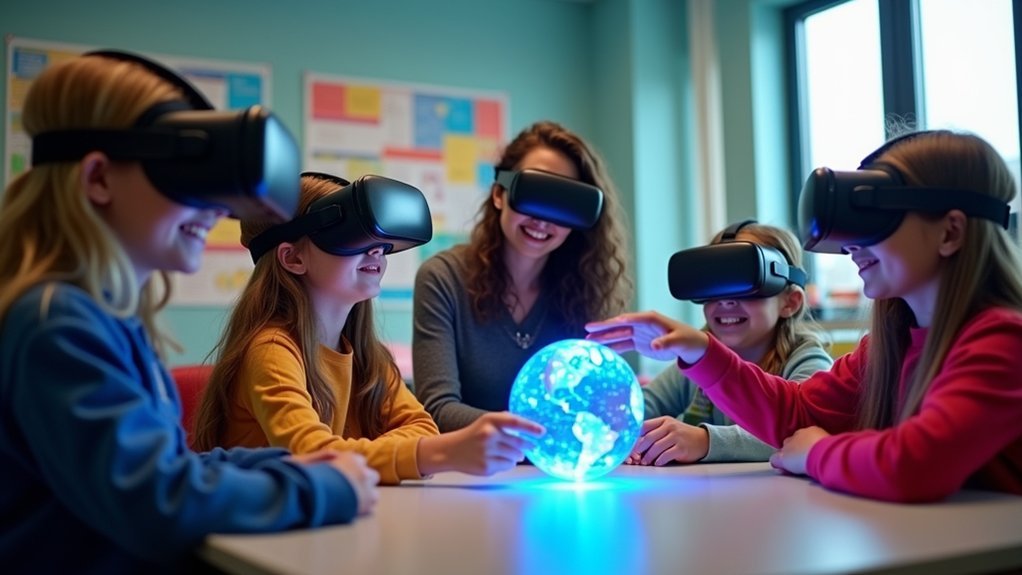
Virtual reality transforms your mobile learning by converting traditional textbooks into immersive experiences you can access anywhere. You’ll explore dangerous chemical reactions safely, walk through ancient civilizations, practice languages in authentic conversational environments, and collaborate on group projects with enhanced engagement. VR personalizes your learning path, provides real-time feedback, and increases retention rates considerably. Whether you’re studying science, history, or developing technical skills, VR breaks physical constraints and creates adaptive learning experiences that respond to your unique needs and open up deeper educational possibilities.
Traditional Classroom Learning Experiences
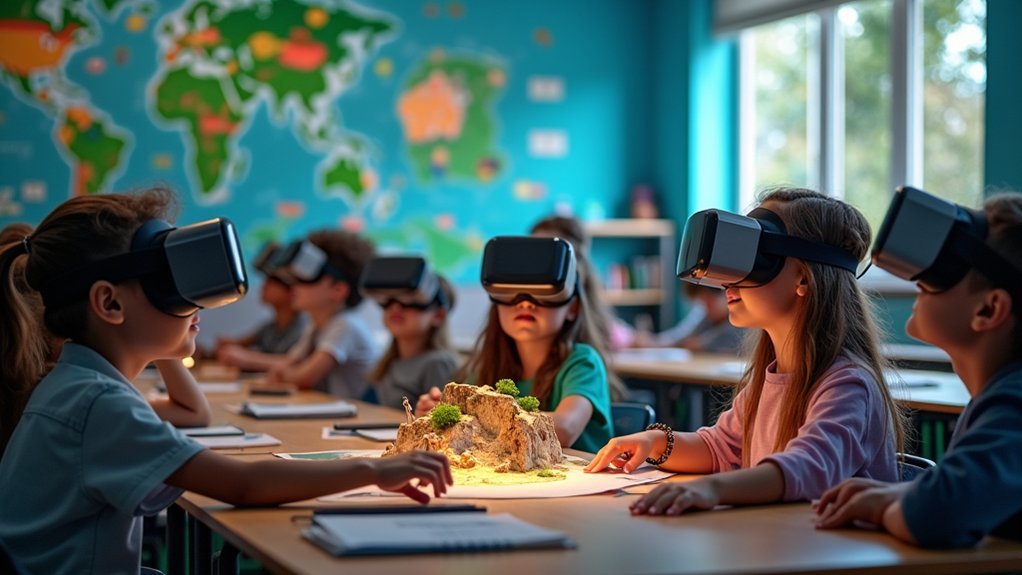
While traditional classrooms have served as education’s foundation for centuries, they’re increasingly showing their limitations in today’s dynamic learning landscape.
You’ll find that static textbooks can’t capture your attention like immersive learning experiences could. When you’re confined to a physical classroom, you miss out on real-world applications that could deepen your understanding of complex subjects.
Standard assessment methods don’t effectively measure your true learning potential, creating a one-size-fits-all educational approach that doesn’t serve everyone.
Traditional testing fails to recognize your unique strengths and learning style, forcing everyone into the same educational mold.
You’re also limited by physical constraints that reduce collaboration opportunities with your peers, minimizing valuable discussion and peer learning moments.
Without interactive elements that boost motivation and retention, traditional methods often fail to maintain student engagement, leaving you less enthusiastic about the material you’re studying.
Remote and Distance Education Access
When you’re studying from a remote location or can’t physically attend traditional classes, virtual reality transforms your educational experience by connecting you to immersive learning environments that transcend geographical boundaries.
You’ll access virtual classrooms where you can engage with educators globally through real-time lessons, regardless of your physical location.
VR headsets enable you to explore historical sites and scientific concepts through 360-degree experiences, making complex subjects more comprehensible.
You can participate in virtual field trips that expose you to diverse cultures and environments, fostering global awareness while learning from home.
Distance education becomes more engaging as VR increases your motivation and retention rates, delivering superior comprehension compared to traditional remote learning methods.
Hands-On Laboratory and Scientific Experiments
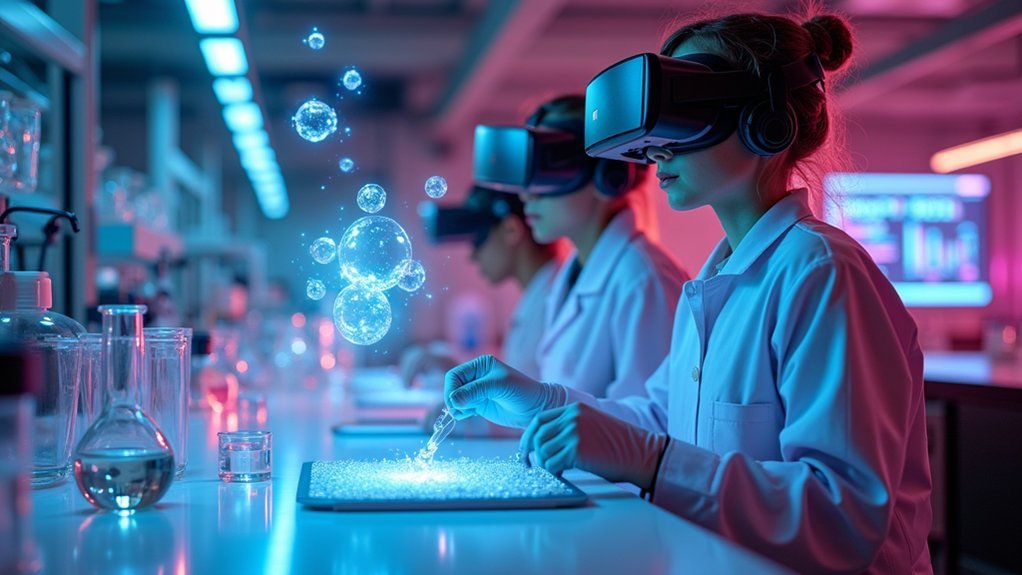
You can now conduct dangerous chemical reactions without risking burns or toxic exposure through VR’s safe simulation environment.
Virtual microscopes let you explore cellular structures and microscopic worlds that physical equipment limitations would otherwise restrict.
Physics demonstrations become interactive experiences where you’ll manipulate forces, observe wave behaviors, and test scientific laws in real-time simulations.
Safe Chemical Reaction Simulations
Although traditional chemistry labs pose significant safety risks when handling volatile compounds and toxic substances, VR technology transforms dangerous experiments into secure learning environments where you can’t get burned by acids or inhale harmful fumes.
VR simulations let you conduct complex chemical reaction studies without physical constraints, manipulating variables and observing outcomes in real time. You’ll retain concepts better through these immersive experiences compared to conventional teaching methods.
The technology provides personalized feedback and adaptive learning paths based on your individual performance during simulations. You can also collaborate with classmates on experiments regardless of your physical location, sharing insights and working together on challenging chemical processes while maintaining complete safety throughout your learning journey.
Virtual Microscope Exploration
Microscopic worlds that once required expensive equipment and delicate specimen preparation now unfold before your eyes through virtual reality technology. VR microscopes let you explore cellular structures, microorganisms, and tissues through immersive simulations that surpass traditional laboratory limitations.
| Feature | Traditional Microscope | VR Microscope |
|---|---|---|
| Sample Preparation | Required | None needed |
| Zoom Capabilities | Limited magnification | Unlimited scaling |
| Specimen Availability | Physical samples only | Vast digital library |
| Interactive Controls | Basic adjustments | 360-degree rotation, filters |
| Accessibility | Lab-dependent | Anywhere with headset |
You’ll conduct guided experiments safely while manipulating specimens impossible to obtain physically. Students demonstrate improved retention rates and engagement compared to conventional methods. These experiences bridge resource gaps, providing underserved schools access to advanced laboratory tools and fostering STEM interest in remote areas.
Physics Law Demonstrations
Complex physics principles become tangible experiences when you step into virtual reality laboratories designed for hands-on experimentation.
You’ll explore Newton’s laws through immersive environments where theoretical concepts transform into interactive demonstrations.
VR simulations let you manipulate variables in real-time, watching projectile dynamics unfold before your eyes. You can design virtual roller coasters, applying physics laws to guarantee proper gravitational and centripetal forces guide each thrilling loop and turn.
Key Benefits of VR Physics Demonstrations:
- Safe experimental environments – Conduct dangerous or expensive experiments without physical risks
- Real-time variable manipulation – Adjust friction, gravity, and force parameters instantly
- Enhanced retention rates – Immersive experiences create deeper understanding than traditional methods
- Unlimited laboratory access – Practice complex experiments without equipment constraints
You’ll measure friction effects on motion and visualize abstract concepts that textbooks can’t adequately convey.
Historical and Cultural Site Exploration
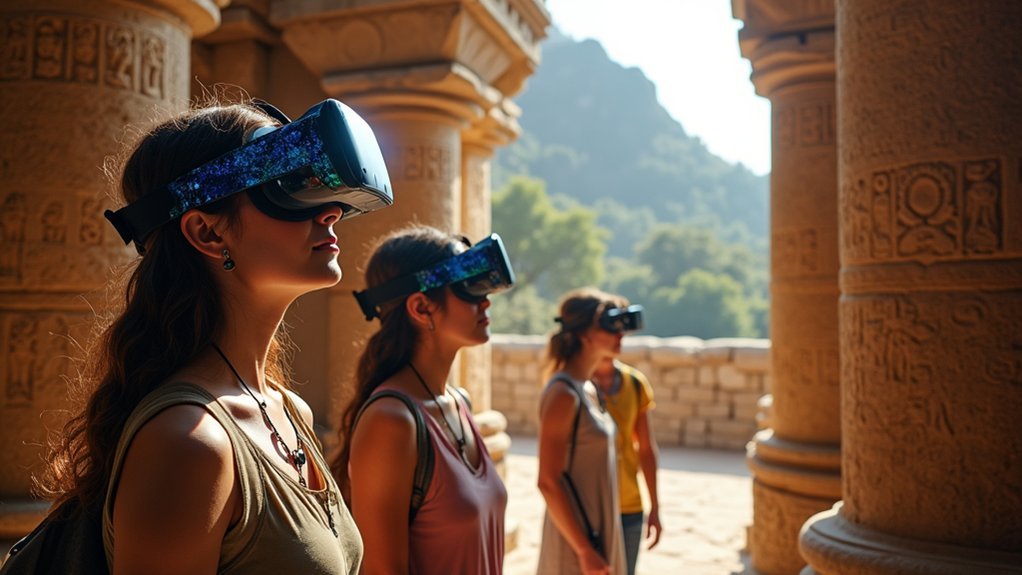
You can explore ancient civilizations through immersive virtual tours that transport you directly to historical sites like Pompeii and the Acropolis.
Virtual reality grants you access to museums worldwide, allowing you to examine artifacts and exhibits that would otherwise be geographically impossible to visit.
Interactive archaeological experiences let you participate in historical moments and engage with ancient cultures in ways that traditional textbooks simply can’t match.
Ancient Civilizations Virtual Tours
When you step through the virtual gates of ancient Rome or descend into the preserved streets of Pompeii, you’re experiencing history in ways previous generations could only imagine.
VR in education transforms how you explore ancient civilizations, making distant cultures tangible and immediate.
These immersive experiences offer unprecedented access to historical worlds:
- 360-degree exploration of archaeological sites and cultural landmarks otherwise inaccessible to visitors
- Interactive artifact examination allowing detailed study of ancient tools, artwork, and architectural elements
- Historical event recreation letting you witness pyramid construction or daily marketplace activities firsthand
- Cultural immersion scenarios where you participate in ancient customs and social practices
You’ll develop deeper understanding through experiential learning that promotes retention and critical thinking.
Virtual tours spark curiosity about historical significance while highlighting cultural differences across civilizations.
Museum Access Worldwide
Although physical distance once limited which museums you could visit, VR technology now opens the doors to world-renowned institutions from your classroom or home. You can now explore the Louvre’s masterpieces or examine ancient artifacts without expensive travel costs.
VR allows students to explore 360-degree museum tours that provide unprecedented access to exhibits typically reserved for in-person visitors. These immersive experiences transform how you engage with cultural heritage.
Instead of viewing static images in textbooks, you’re walking through gallery halls, examining artwork up close, and accessing detailed information about each piece. This technology particularly benefits students in remote or underserved areas who previously couldn’t access these world-class collections.
VR democratizes museum education, ensuring geographical location doesn’t determine your cultural learning opportunities.
Interactive Archaeological Experiences
Beyond museum walls, VR technology transforms archaeological exploration by transporting you directly to ancient civilizations and historical sites.
You’ll walk through Pompeii’s preserved streets and explore the Acropolis in immersive 360-degree environments that bring history to life.
VR and AR technologies revolutionize how you experience archaeological discoveries:
- Immersive Site Exploration – Navigate ancient ruins like Pompeii and the Acropolis with complete 360-degree freedom
- Historical Event Simulation – Witness pivotal moments in civilizations firsthand, creating emotional connections to the past
- Detailed Artifact Interaction – Examine archaeological findings up close as if you’re physically present at excavation sites
- Global Collaborative Projects – Connect with students worldwide to analyze historical data and share cultural heritage insights
This interactive approach promotes critical thinking while breaking geographical barriers to archaeological education.
Language Learning and Communication Skills
Virtual reality transforms language learning by placing you directly into authentic conversational environments where you’ll interact with virtual native speakers and practice real-world scenarios.
You’ll experience immersive situations like ordering food at restaurants or maneuvering through airports, applying your skills in practical contexts that mirror real life.
Virtual reality greatly improves your vocabulary retention and pronunciation accuracy through contextual learning experiences.
You’ll absorb cultural nuances and social cues naturally, developing deeper understanding and empathy toward different cultures while mastering the language.
This technology boosts your motivation and engagement compared to traditional methods, making learning more enjoyable and effective.
You’ll find yourself more confident in conversations as VR’s interactive applications provide safe spaces to practice without fear of judgment.
Medical and Healthcare Training Programs
Medical training revolutionizes through immersive technology that places you in operating rooms where you’ll perform complex surgeries without risking patient safety.
VR simulation transforms how medical students learn by creating lifelike scenarios that build confidence and expertise before treating real patients.
VR simulation creates realistic medical scenarios that allow students to build essential skills and confidence safely before patient interaction.
Key Benefits of VR in Medical Education:
- Enhanced Knowledge Retention – You’ll retain 30% more information compared to traditional learning methods.
- Risk-Free Practice – Perfect complex procedures without endangering patients during your learning process.
- Immersive Anatomy Education – Explore detailed 3D organ models that deepen your understanding of biological systems.
- Improved Patient Outcomes – Develop superior skills and confidence that directly translate to better healthcare delivery.
Medical students now access unprecedented training opportunities that prepare them for real-world challenges while eliminating traditional educational limitations.
Engineering and Technical Skill Development
You can now create and test complex engineering designs through virtual prototyping methods that let you build, modify, and analyze structures without physical materials or costly mistakes.
VR transforms how you learn technical skills by providing immersive safety training where you’ll practice dangerous procedures in risk-free environments before facing real-world scenarios.
These technologies enable you to visualize abstract engineering concepts in three dimensions while developing practical expertise through hands-on simulation experiences.
Virtual Prototyping Methods
As engineering education evolves to meet modern industry demands, virtual prototyping methods have emerged as transformative tools that revolutionize how students develop technical skills.
Virtual reality enables engineering students to create and test 3D models in simulated environments, eliminating the risks and costs of physical prototypes while providing invaluable hands-on experience.
You’ll benefit from these key advantages:
- Real-time collaboration – Work simultaneously with peers and professionals from different locations
- Enhanced spatial visualization – Better understand complex designs and mechanical functions
- Immersive skill development – Practice assembly, maintenance, and troubleshooting in realistic scenarios
- Improved learning outcomes – Studies show markedly higher retention rates compared to traditional methods
This technology transforms how you’ll approach engineering challenges throughout your career.
Immersive Safety Training
While traditional safety training often relies on theoretical knowledge and static demonstrations, immersive VR safety training transforms how engineering students master critical safety protocols by placing them directly into realistic hazardous scenarios. You’ll practice emergency responses without real-world dangers while experiencing authentic equipment malfunctions and environmental risks.
| Training Method | Retention Rate | Risk Level |
|---|---|---|
| Traditional Classroom | 20% | Low engagement |
| Hands-on Practice | 60% | High danger |
| VR Immersive Training | 80% | Zero risk |
VR allows you to receive real-time feedback during training sessions, enabling quick adjustments and deeper understanding of consequences. You’ll build confidence through repeated practice in controlled environments, preparing you for actual workplace scenarios with enhanced safety awareness and proven skills.
Art and Creative Expression Education
Virtual reality transforms art education by creating immersive studio environments where you can explore three-dimensional creative techniques without traditional material constraints.
You’ll experiment with painting, sculpture, and digital mediums that expand your creative boundaries beyond physical limitations.
Key VR Art Education Benefits:
- Unlimited Creative Tools – Access diverse artistic mediums without material costs or storage constraints
- Global Gallery Access – Showcase your work and discover international artists through virtual exhibitions
- Enhanced Learning Retention – Interactive experiences make artistic concepts more memorable and engaging
- Collaborative Communities – Connect with fellow artists worldwide for inspiration and feedback
Programs like Google Tilt Brush let you paint in three-dimensional space, redefining what’s possible in creative expression.
Virtual Reality’s immersive nature makes art education more accessible while fostering innovation in traditional artistic practices.
Mathematics and Abstract Concept Visualization
Mathematics education faces a fundamental challenge: helping you grasp abstract concepts that exist beyond physical reality.
Virtual Reality (VR) transforms this learning experience by making invisible mathematical relationships tangible. You can manipulate 3D geometric shapes, explore calculus functions in immersive environments, and visualize complex algebraic equations through interactive problem-solving scenarios.
Studies reveal VR increases retention rates by nearly 9% compared to traditional methods. When you’re learning mathematics through VR, you’ll experience immediate visual feedback as you manipulate variables, making abstract concepts more relatable and practical.
The multi-sensory nature of VR boosts your motivation and engagement, transforming challenging topics into enjoyable explorations. You’ll develop deeper spatial understanding while experiencing mathematics as an interactive adventure rather than memorizing formulas.
Career Exploration and Professional Training
Beyond mathematical exploration, VR opens doors to real-world professional experiences that were once impossible to access during your education. You can now practice complex procedures and explore diverse career paths through immersive simulations that prepare you for actual workplace challenges.
Key Benefits of VR Career Exploration:
- Risk-free skill development – Practice virtual surgeries, flight simulations, and engineering projects without real-world consequences.
- Enhanced knowledge retention – Immersive environments boost engagement and memory recall considerably.
- Informed career decisions – Experience authentic job environments before committing to educational paths.
- Equal access opportunities – Virtual internships and professional training connect low-income students with industries previously out of reach.
This technology transforms career exploration and professional training by building your confidence and competence through hands-on experience in controlled virtual environments.
Special Needs and Accessibility Learning
Everyone deserves equal access to quality education, and VR technology is revolutionizing how students with special needs engage with learning content.
You’ll find that VR creates tailored experiences that meet unique requirements, offering supportive environments where students can interact with material at their own pace.
For accessibility learning, VR breaks down communication barriers by providing simulated social scenarios that encourage language development.
You can customize these tools to accommodate various disabilities—visual cues help students with hearing impairments, while haptic feedback supports those with sensory processing disorders.
Studies show VR increases learning outcomes by up to 30% for students with disabilities.
You’ll see improved engagement and retention as students follow personalized learning paths with real-time feedback tailored to their specific learning styles.
Collaborative Group Projects and Teamwork
You’ll discover that VR transforms group work through virtual team building exercises that strengthen bonds between remote participants.
Your team can share digital workspaces where everyone manipulates the same 3D objects and environments simultaneously, creating unprecedented collaboration opportunities.
Real-time project collaboration becomes seamless as you and your teammates work together in immersive virtual environments, breaking down geographical barriers that traditionally limit teamwork.
Virtual Team Building Exercises
Virtual reality transforms traditional team-building activities by creating immersive digital spaces where remote team members can collaborate as if they’re physically together.
You’ll discover VR platforms offer unprecedented opportunities for meaningful team-building experiences that surpass conventional methods.
VR revolutionizes team development through:
- Real-world scenario simulations – Practice problem-solving and decision-making in controlled, risk-free environments
- 30% higher engagement rates – Experience considerably more interactive participation compared to traditional team-building methods
- 3D visualization capabilities – Understand complex concepts and data through immersive visual representations
- Real-time collaboration tools – Experiment with ideas and receive instant feedback from teammates
You’ll find VR environments enable your team to develop stronger communication skills, enhance problem-solving abilities, and create more cohesive group dynamics while eliminating geographical barriers that typically limit team-building effectiveness.
Shared Digital Workspaces
While traditional group projects often struggle with coordination challenges and geographical limitations, shared digital workspaces in VR create immersive environments where you can collaborate seamlessly with teammates from anywhere in the world.
These virtual spaces let you manipulate 3D models together, visualize complex concepts, and engage in real-time problem-solving that wouldn’t be possible in physical classrooms.
You’ll find VR chat rooms and project boards streamline idea sharing and resource management, making collaborative group projects more organized and efficient.
When you participate in role-playing scenarios within these shared environments, you’ll develop stronger communication skills while working through tasks together.
Research demonstrates that these immersive collaborative experiences boost your engagement levels and satisfaction, ultimately improving your learning outcomes and teamwork abilities considerably.
Real-Time Project Collaboration
Building on these collaborative foundations, real-time project collaboration in VR transforms how students work together by eliminating the delays and miscommunications that plague traditional remote teamwork.
You’ll experience seamless communication and instant feedback as you manipulate 3D models together, making complex concepts tangible and accessible.
This collaborative learning approach offers several key advantages:
- Simultaneous interaction with project components allows you to see changes as teammates make them
- Enhanced communication skills develop naturally through immersive face-to-face interactions
- Adaptive learning paths accommodate your unique learning style within group dynamics
- Global collaboration connects you with diverse peers, enriching your cultural perspectives
You’ll find higher engagement levels and satisfaction as VR breaks down geographical barriers, creating meaningful teamwork experiences that mirror real-world professional environments.
Assessment and Performance Evaluation Methods
The integration of mobile learning with virtual reality transforms how you assess student performance by creating immersive environments that mirror real-world scenarios.
VR-powered mobile learning revolutionizes student assessment through immersive, real-world scenario simulations that enhance evaluation accuracy.
You can evaluate students’ skills authentically as they demonstrate competencies in controlled virtual settings, providing more accurate assessment data than traditional testing methods.
Real-time feedback capabilities let you track progress instantly, enabling personalized learning interventions when needed. Your students experience reduced test anxiety in engaging VR environments, leading to better performance evaluation outcomes that truly reflect their abilities.
You’ll gather extensive analytics on student interactions, decision-making processes, and task completion times. These detailed metrics offer deeper insights into learner engagement and understanding.
Additionally, VR facilitates collaborative assessment experiences where students can evaluate each other’s performances and provide constructive peer feedback in shared virtual spaces.
Teacher Training and Professional Development
As educators face increasingly complex classroom challenges, virtual reality revolutionizes professional development by offering immersive training simulations that you can’t replicate through traditional methods.
VR transforms how you approach teacher training by creating risk-free environments where you can practice classroom management and test instructional strategies without real-world consequences.
Key benefits of VR-based professional development include:
- Enhanced confidence – You’ll gain greater preparedness through realistic practice scenarios that improve student engagement outcomes.
- Flexible accessibility – You can access training remotely, eliminating travel requirements and accommodating your busy schedule.
- Superior retention – You’ll experience higher satisfaction and better technique retention compared to conventional methods.
- Collaborative learning – You can connect with educators worldwide, sharing best practices and gaining diverse teaching perspectives.
Frequently Asked Questions
How Will Virtual Reality Change Education?
You’ll experience immersive learning environments that boost retention by 9%. VR lets you practice complex skills safely, take virtual field trips, and learn at your own pace while accommodating your unique learning style.
What Is Mobile Virtual Reality?
Mobile virtual reality’s an immersive technology you’ll access through your smartphone or VR headset. You’ll experience interactive virtual environments anywhere, making learning more engaging and cost-effective than traditional methods require.
How Can VR Be Used for Learning?
You can use VR for immersive simulations, virtual field trips, and 3D visualizations that enhance understanding. You’ll experience improved retention rates while exploring complex subjects at your own pace through interactive environments.
What Is VR Mostly Used For?
You’ll find VR’s primarily used for gaming and entertainment, but it’s also heavily utilized in training simulations for medicine and aviation, educational experiences, therapy treatments, and architectural visualizations for real estate.