Cross-platform VR training architecture uses Open XR Framework to eliminate device compatibility issues, letting you deploy training content seamlessly across all VR hardware. You’ll create materials once and utilize no-code tools like iQ3Connect for intuitive drag-and-drop content development without programming expertise. Real-time multiuser collaboration connects remote teams in shared virtual environments while reducing training costs by 40-60% and boosting knowledge retention by 80%. Continue exploring to discover how these solutions transform your enterprise training strategy.
Understanding Cross-Platform VR Training Architecture

As organizations increasingly adopt virtual reality for employee development, understanding cross-platform VR training architecture becomes essential for maximizing your training investment. This architecture leverages the Open XR Framework to guarantee seamless content operation across various devices, from standalone VR headsets to mobile devices and desktop computers.
You’ll benefit from immersive training experiences that offer exceptional flexibility for users, regardless of their hardware preferences. The device-agnostic approach eliminates costly separate development versions while enabling real-time collaboration between trainees and instructors across different locations.
Integration with Learning Management Systems centralizes your scheduling and tracking capabilities, consolidating training records and performance analytics.
Seamless LMS integration streamlines administrative workflows while providing comprehensive visibility into learner progress and training outcomes across your entire organization.
Cross-platform VR training transforms how you deliver enterprise education, creating scalable solutions that adapt to your organization’s diverse technological ecosystem.
Device-Agnostic Content Creation and Deployment
Building on this architectural foundation, device-agnostic content creation empowers you to develop training materials once and deploy them across every platform in your organization’s ecosystem.
You’ll leverage frameworks like Open XR to guarantee your VR training programs operate seamlessly across multiple hardware options, reducing development costs while future-proofing your solutions.
Platforms such as iQ3Connect let you create immersive experiences without coding, automatically optimizing content for different devices to maintain consistent training quality.
You’ll benefit from multi-language support that enables global deployment, making training accessible to diverse teams worldwide.
Real-time multiuser collaboration features enhance training effectiveness by allowing your teams to engage and interact in shared immersive environments, regardless of their chosen device.
No-Code Development Tools for Enterprise Teams
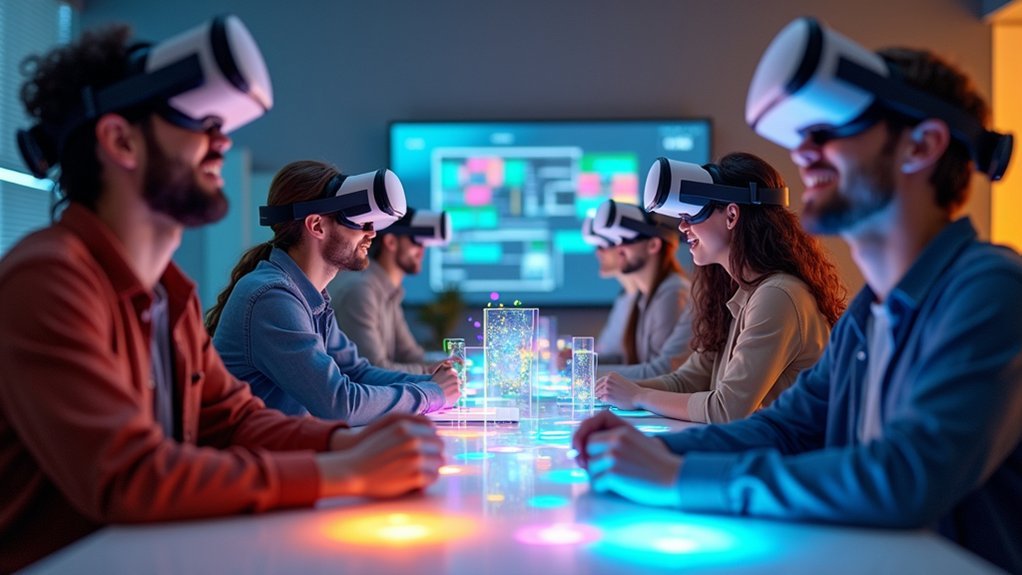
When your enterprise teams lack coding expertise, no-code development tools like RoT STUDIO and iQ3Connect eliminate technical barriers by providing intuitive drag-and-drop interfaces for creating customized VR training content.
You’ll streamline content creation processes while designing tailored immersive learning experiences that meet specific organizational needs.
These platforms reduce development time and costs considerably, allowing you to deploy VR training programs faster and maximize your return on investment.
You’ll benefit from multi-device compatibility, ensuring seamless access across VR headsets, PCs, and mobile devices.
Integration capabilities with existing Learning Management Systems enable centralized tracking and performance assessment, simplifying thorough training program management.
Real-Time Multiuser Collaboration Capabilities
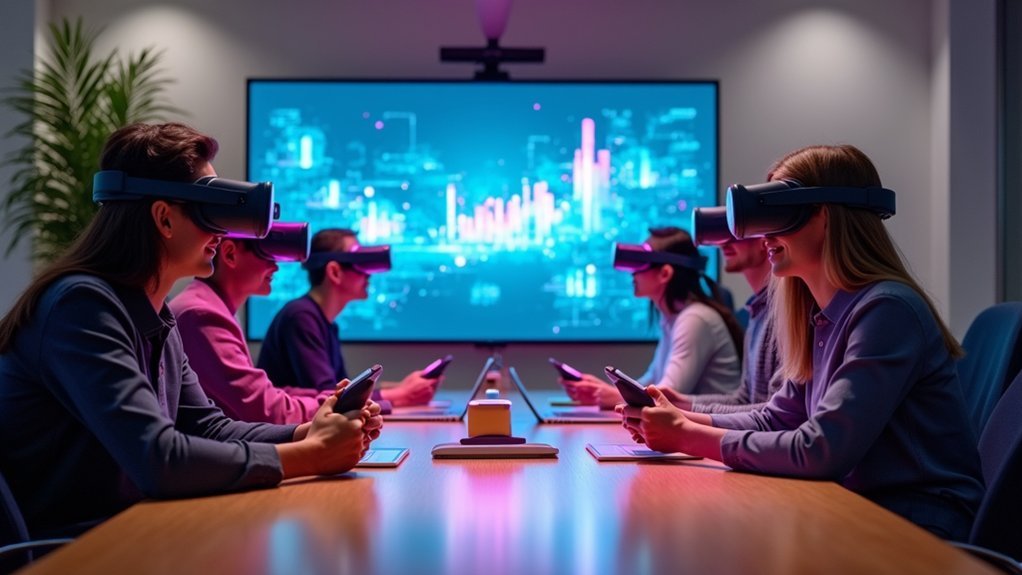
Beyond streamlining content creation, modern VR training platforms release powerful real-time multiuser collaboration capabilities that transform how your distributed teams learn together.
You’ll connect multiple participants in shared virtual training environments, enabling enhanced teamwork regardless of physical location. Platforms like iQ3Connect let your teams engage through web browsers without complex installations.
You can practice interpersonal skills through role-playing scenarios where participants receive immediate instructor feedback. This collaborative approach builds stronger connections among remote team members while improving collaborative decision-making skills.
Your teams maintain high engagement levels during immersive training experiences, creating a genuine sense of presence.
Data shows these capabilities deliver superior training outcomes, including increased retention rates and measurable performance improvements across your organization.
Integration With Learning Management Systems
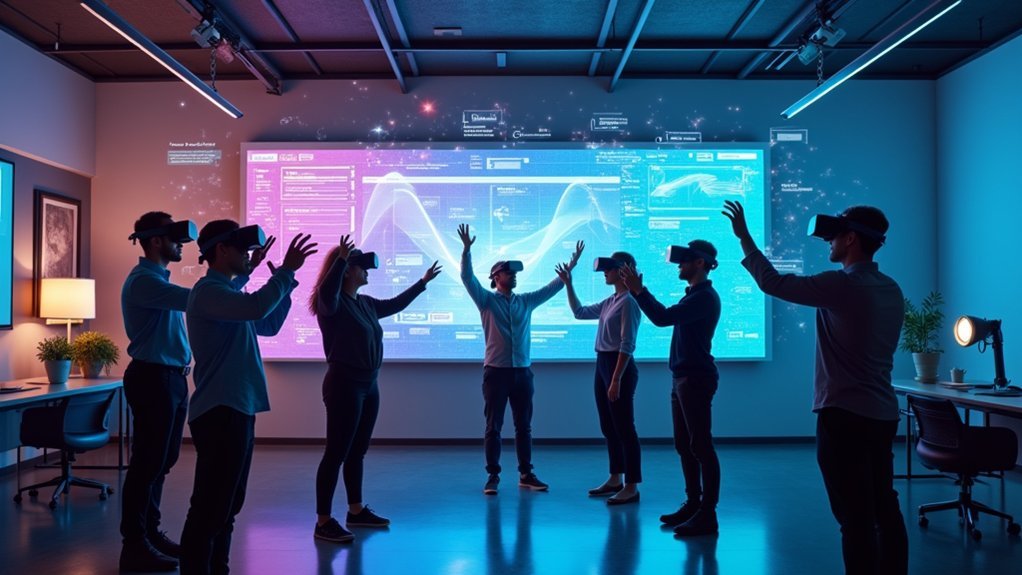
While collaborative capabilities enhance your team’s learning experience, seamless integration with Learning Management Systems (LMS) guarantees you can efficiently manage and track every aspect of your VR training program.
This integration centralizes scheduling, performance assessment, and training records management, creating a unified platform for immersive learning initiatives.
Your LMS integration delivers four key advantages:
- Automated compliance tracking through SCORM or xAPI standards, streamlining enrollment and certification processes
- Real-time progress monitoring that provides actionable insights for continuous program improvement
- Enhanced engagement via automated reminders and notifications, boosting completion rates considerably
- Centralized content management that combines VR experiences with traditional assessment methods seamlessly
You’ll transform fragmented training programs into cohesive, data-driven Learning Management ecosystems that maximize both efficiency and learning outcomes.
Scalability and Cost-Effectiveness in VR Training
As enterprise training demands continue to escalate, VR training platforms deliver unprecedented scalability that transforms your cost structure while maintaining training quality.
You’ll achieve 40-60% reduction in training time while accommodating everything from small teams to large enterprise deployments without significant additional costs.
No-code platforms like RoT STUDIO eliminate technical barriers, letting you create customized immersive environments without extensive expertise.
This dramatically reduces development costs and deployment time. Multi-user capabilities enable collaborative learning experiences that improve job performance and safety outcomes, maximizing your return on investment.
Integration with Learning Management Systems centralizes your training operations, automating administrative processes and reducing overhead.
You’ll streamline management tasks while scaling programs efficiently. This cost-effectiveness makes VR training viable across departments, ensuring consistent quality regardless of your organization’s size.
Measuring ROI and Training Effectiveness Metrics
You’ll need concrete metrics to justify your VR training investment and demonstrate its value to stakeholders.
Start by establishing baseline measurements for training costs, employee performance levels, and knowledge retention rates before implementing your VR solution.
Track these same metrics post-implementation to calculate tangible savings, quantify performance improvements, and measure how well employees retain critical information compared to traditional training methods.
Tangible Cost Savings Analysis
When organizations invest in cross-platform VR training solutions, they’re expecting measurable returns that justify the initial technology costs and implementation efforts.
Your virtual environment delivers substantial cost savings through multiple channels that directly impact your bottom line.
The tangible benefits you’ll experience include:
- Reduced training time – Achieve 40-60% faster completion rates compared to traditional methods, lowering instructional costs.
- Improved workforce efficiency – Experience over 70% job performance improvements that boost productivity.
- Enhanced learning retention rates – Gain 80% better knowledge retention, eliminating repetitive training sessions.
- Minimized operational errors – Reduce costly mistakes by 60% through immersive technical skills development.
VR training transforms your cost structure by accelerating competency development while reducing both human error expenses and ongoing educational overhead.
Performance Improvement Tracking
Three critical measurement phases determine whether your VR training investment delivers the promised returns.
First, you’ll establish baseline metrics before implementing immersive learning programs, creating benchmarks for accurate performance improvement comparisons.
Next, you’ll deploy analytics tools during training to capture real-time participant feedback and track engagement levels across your cross-platform enterprise system.
Finally, you’ll conduct post-training assessments measuring job performance improvements, which research shows can exceed 70% with effective VR training.
Your ROI assessment should include reduced human errors, decreased training time, and enhanced skill retention rates.
By continuously monitoring these training effectiveness metrics, you’ll identify optimization opportunities and demonstrate concrete value.
This systematic approach guarantees your immersive learning initiatives align with organizational objectives while providing measurable returns on investment.
Knowledge Retention Metrics
How effectively can your organization measure the lasting impact of VR training on employee knowledge retention?
Analytics tools provide essential insights that demonstrate VR training’s superior effectiveness compared to traditional methods. Your immersive experiences can boost knowledge retention rates by up to 80% while reducing training time by 40-60%.
Key metrics for measuring VR training effectiveness include:
- Retention rate comparisons – Track knowledge persistence over 30, 60, and 90-day periods.
- Skill acquisition speed – Monitor how quickly employees master competencies.
- Performance improvement percentages – Measure job performance increases exceeding 70%.
- Employee safety incident reductions – Document workplace safety improvements post-training.
You’ll gain real-time visibility into trainee engagement and progress, enabling continuous strategy adjustments that maximize your training ROI and demonstrate tangible business value.
Frequently Asked Questions
What Are 3 Disadvantages to VR Training?
You’ll face significant initial costs for hardware and software. You might experience motion sickness or eye strain during sessions. You’ll need specialized skills to develop quality VR content effectively.
Does Jayden Daniels Use VR Training?
You’ll find that Jayden Daniels does use VR training to enhance his quarterback skills. He’s leveraging immersive platforms to practice reading defenses and improve reaction time in simulated game scenarios.
How to Create a VR Training?
You’ll start by choosing no-code platforms like RoT STUDIO or iQ3Connect. Guarantee Open XR compatibility, add multiplayer features for collaboration, prioritize high visual quality, and measure ROI through performance analytics.
What Is Virtual Reality in Simple Words?
You’ll wear a special headset that creates a computer-generated world around you. You can look around, move, and interact with virtual objects as if they’re real, making you feel like you’re actually there.