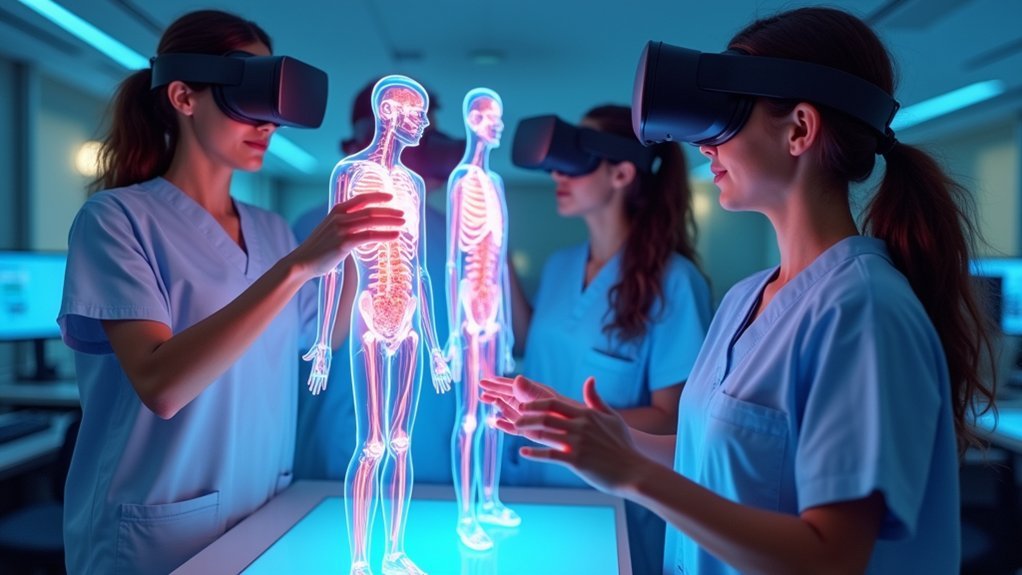
You’ll transform your healthcare education through virtual reality by accessing immersive simulations that boost retention rates from 5% to 75%. VR technology lets you practice complex procedures safely, develop patient empathy by experiencing their perspectives, and master clinical skills without patient safety risks. You can repeat procedures in mistake-friendly environments while building confidence through diverse scenarios. This cost-effective solution bridges theoretical knowledge with practical application, preparing you for real-world clinical challenges ahead.
The Current State of Medical Education and Training Challenges
While medical education has evolved considerably over the decades, today’s training programs face mounting challenges that threaten to undermine the quality of healthcare preparation.
You’ll find that nursing students encounter limited clinical placements, restricting their hands-on learning opportunities. Traditional teaching methods demonstrate alarmingly low retention rates of just 5% compared to immersive simulations’ impressive 75%.
These training challenges extend beyond engagement issues – you’re dealing with strained educational budgets that can’t support expensive physical resources. Additionally, you’ll notice nursing students lack exposure to diverse clinical scenarios, limiting their readiness for real-world healthcare scenarios.
Budget constraints and limited clinical exposure create significant barriers to preparing nursing students for the complexities of modern healthcare practice.
Faculty reluctance toward adopting new technologies further compounds these problems, creating barriers to innovative medical education approaches that could address these systemic issues.
Virtual Reality Technology Revolutionizing Healthcare Learning
You’re witnessing a fundamental shift in healthcare education as Virtual Reality technology transforms how medical professionals learn and practice.
VR’s immersive simulations let you master clinical skills safely while developing deeper patient empathy through realistic scenarios that traditional methods can’t replicate.
This isn’t just innovation for innovation’s sake—it’s a cost-effective solution that’s proving more engaging and effective than conventional teaching approaches.
Immersive Clinical Skill Training
As healthcare education evolves at breakneck speed, virtual reality technology is fundamentally transforming how nursing students acquire critical clinical skills.
You’ll experience immersive training environments that simulate real-world scenarios without patient safety risks. This VR approach bridges the gap between theoretical knowledge and practical application, allowing you to practice complex procedures repeatedly in mistake-friendly settings.
You’ll develop enhanced confidence through safe experimentation and error-based learning. Studies demonstrate VR’s superiority over traditional methods, showing significant improvements in both theoretical understanding and hands-on competencies.
The technology sharpens your decision-making abilities by exposing you to diverse clinical situations before entering actual healthcare environments. This innovative nursing education model guarantees you’re better prepared for the demanding realities of modern clinical practice.
Enhanced Patient Empathy Development
How can nursing students truly understand their patients’ experiences without walking in their shoes? Virtual Reality (VR) transforms healthcare education by placing you directly into patients’ perspectives through immersive experiences.
You’ll encounter age-related sensory limitations affecting geriatric patients, developing genuine empathy that translates into superior patient care.
Studies show 79% improvement in communication skills following VR empathy training. You’re not just learning about conditions—you’re experiencing them firsthand in a safe environment.
This technology helps you understand mobility challenges, visual impairments, and cognitive difficulties patients face daily.
VR’s human-centered approaches enhance retention of empathetic behaviors, ensuring nursing students graduate with deeper compassion.
You’ll develop stronger interpersonal connections, leading to more effective patient-centered care practices throughout your healthcare career.
Cost-Effective Educational Solutions
While traditional nursing education demands substantial investments in physical equipment, cadavers, and extensive clinical placements, VR technology slashes these costs dramatically.
You’ll find that Virtual Reality transforms healthcare education by providing cost-effective solutions that don’t compromise quality. Through immersive simulations, nursing students can practice clinical skills repeatedly without expensive resources.
You’re able to reach underserved areas through remote learning opportunities, breaking down geographical barriers that traditionally limit access to quality training.
The scalability guarantees you can deliver standardized training across diverse settings while maintaining consistency.
Studies demonstrate remarkable student satisfaction levels, proving VR’s effectiveness as an educational investment.
You’ll discover that this technology addresses logistical challenges while enhancing engagement, making healthcare education more accessible and efficient than ever before.
Key Benefits of VR Implementation in Medical Training Programs
You’ll discover that VR implementation transforms medical training through three critical advantages that directly impact your educational outcomes.
These benefits create a thorough learning framework that addresses both practical and economic challenges in healthcare education.
Let’s examine how enhanced skill development, cost-effective training solutions, and risk-free practice environments work together to revolutionize your medical training experience.
Enhanced Skill Development
Virtual Reality transforms how you develop essential healthcare skills by providing standardized mean differences of 0.52 in practical competencies compared to traditional teaching methods.
You’ll experience enhanced skill development through immersive learning environments that let nursing students practice complex procedures repeatedly without risk. This risk-free environment builds your confidence and competence while eliminating potential harm to actual patients.
You’ll find increased student satisfaction with standardized mean differences of 1.14, demonstrating VR’s engaging nature in healthcare education.
The technology simulates diverse clinical scenarios, preparing you for real-world patient interactions and emergency situations.
You’ll retain practical skills more effectively, achieving higher assessment scores than students using conventional methods, ultimately enhancing your readiness for actual healthcare settings.
Cost-Effective Training Solutions
Beyond improving learning outcomes, VR training delivers substantial financial advantages that make it an attractive investment for healthcare institutions.
You’ll eliminate expenses for physical lab equipment and materials while providing immersive experiences that don’t require costly clinical placements. Virtual Reality enables repeated practice without consumable resources, making medical training incredibly cost-effective.
You can scale these training solutions across multiple programs simultaneously, maximizing your return on investment.
Healthcare education benefits from VR’s ability to address resource limitations effectively – you’re not dependent on expensive cadavers or specialized equipment. The technology enhances skill retention through repeated practice, improving practical skills by 52% while reducing overall training costs.
This scalability guarantees you can deliver quality education regardless of budget constraints or geographical limitations.
Risk-Free Practice Environment
When students practice medical procedures in virtual environments, they can make mistakes without consequences while building essential clinical skills. Virtual Reality creates a risk-free practice environment where nursing students can repeatedly perform complex procedures like wound care and CPR without patient safety concerns.
This immersive technology enables mistake-friendly practice, allowing you to learn from errors in a controlled environment that’s impossible with live patients. You’ll develop critical decision-making skills through hands-on experience while building confidence in your abilities.
Research shows VR training healthcare programs boost enhanced theoretical knowledge scores considerably, with students achieving better foundational understanding. The technology transforms traditional learning by providing engaging, interactive experiences that increase satisfaction levels while ensuring you master essential competencies before entering real clinical settings.
Essential Applications of Virtual Reality for Healthcare Students
As healthcare education evolves, you’ll find that VR applications are revolutionizing how students develop critical clinical skills across multiple specialties.
Virtual Reality transforms healthcare education by providing nursing students with immersive simulations that greatly improve practical skills development. You can practice clinical procedures repeatedly without risk, building confidence through mistake-friendly environments that enhance training effectiveness.
Customized VR modules deliver personalized learning experiences tailored to specific specialties like pediatric and trauma care. You’ll engage with diverse patient scenarios that replicate real-world emergencies, preparing you for unpredictable clinical challenges.
This interactive technology boosts student engagement considerably, with retention rates reaching 75% compared to traditional methods. Through these applications, you’ll master complex procedures while developing critical thinking skills essential for successful healthcare practice.
Cost-Effective Solutions for Enterprise Healthcare Training
Although initial VR implementation requires substantial upfront investment, you’ll discover that enterprise healthcare training programs achieve considerable cost reductions within the first few years of deployment.
Cost-effective VR technology eliminates expensive physical resources like cadavers and lab equipment while delivering standardized training across multiple locations. You’ll provide consistent, high-quality healthcare training regardless of geographic constraints through remote learning capabilities.
VR technology delivers standardized healthcare training across multiple locations while eliminating costly physical resources and geographic constraints.
Immersive VR environments enable unlimited practice repetitions, accelerating skill mastery without risks associated with real patient interactions. Your nursing education programs will see dramatic improvements in student engagement, with studies showing satisfaction levels increasing considerably.
This scalable solution addresses resource limitations in traditional methods while expanding access to quality training for healthcare professionals in underserved areas, making it an invaluable investment for enterprise-level organizations.
Overcoming Implementation Barriers in Healthcare VR Adoption
While VR technology offers transformative potential for healthcare education, you’ll encounter several vital barriers that require strategic planning to overcome successfully.
High initial investment costs can strain institutional budgets, making phased implementation approaches essential. You must address technical compatibility issues by conducting thorough system assessments before integrating VR systems with existing infrastructure.
Faculty reluctance often stems from unfamiliarity, so you’ll need extensive professional development programs to build confidence. Network interruptions can disrupt learning experiences, requiring robust IT support and backup solutions.
You should also establish clear protocols addressing ethical concerns and privacy concerns when handling patient data. Ongoing research into VR training effectiveness remains essential for validating outcomes and refining VR technology integration strategies.
Future Innovations and Advancements in Medical VR Education
Since healthcare education continues evolving rapidly, you’ll witness groundbreaking innovations that’ll revolutionize how medical professionals train and learn.
Enhanced AI integration will deliver tailored learning experiences, tracking your individual progress and personalizing Virtual Reality simulations for maximum effectiveness.
Advancements in VR technology will create incredibly realistic immersive environments where nursing education becomes more interactive and lifelike. You’ll practice complex procedures in scenarios that mirror actual clinical settings perfectly.
Future developments will emphasize interdisciplinary collaboration, preparing medical students to work seamlessly within diverse healthcare teams.
Remote learning capabilities will expand access to quality healthcare education globally, breaking geographical barriers.
Specialized nursing areas like geriatric care and trauma management will feature customizable modules, ensuring you develop critical competencies in focused fields essential for modern healthcare delivery.
Frequently Asked Questions
How Virtual Reality Is Transforming Healthcare?
You’re experiencing VR’s transformation of healthcare through enhanced medical training simulations, improved pain management during procedures, virtual rehabilitation programs, and better patient engagement. You’ll see market growth from $628 million to $6.2 billion by 2029.
How Is Virtual Reality Used in Medical Education?
You’ll practice complex procedures through immersive VR simulations that let you experience rare clinical scenarios safely. This technology boosts your theoretical knowledge, increases satisfaction, and builds confidence while developing technical skills in realistic environments.
How Virtual Reality Is Changing Education?
You’re experiencing education’s transformation as VR creates immersive learning environments. You’ll practice skills safely, retain information better, and access training anywhere. It’s revolutionizing how you learn by making education interactive and risk-free.
What Can VR Be Used for in Education?
You can use VR for immersive simulations, virtual field trips, interactive 3D models, language immersion experiences, historical recreations, scientific experiments, skills training, collaborative learning environments, and practicing dangerous procedures safely.