
You’re experiencing a revolution in virtual interfaces as finger tracking eliminates traditional controllers, allowing natural hand movements to directly manipulate digital objects with unprecedented precision. This technology dramatically reduces learning curves by transforming intuitive gestures into seamless virtual actions, making interfaces accessible across all ages and skill levels. Real-time tracking delivers responsive interactions that mirror your exact finger movements, creating immersive experiences in gaming, education, and professional training that feel remarkably natural and enhance skill development.
The Evolution From Controllers to Natural Hand Movements
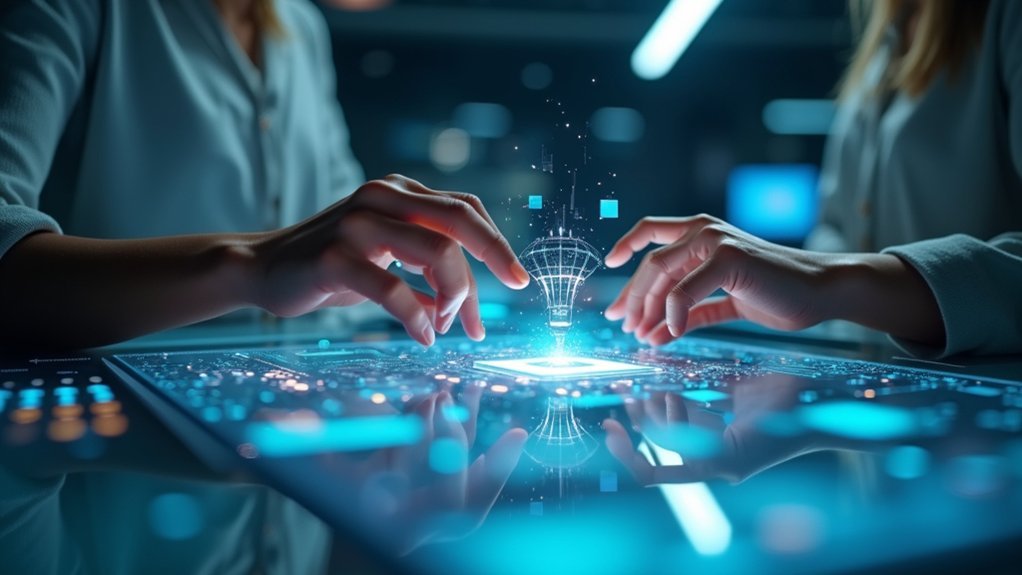
As virtual reality technology matured, developers recognized that traditional controllers created an artificial barrier between users and digital environments.
You’ve witnessed this transformation firsthand as hand tracking evolved from basic motion-sensing controllers in gaming to sophisticated depth-sensing cameras that capture your natural hand movements. This shift eliminated the need for physical devices, allowing you to interact directly with virtual interfaces using gesture recognition.
The advancement fundamentally changed how you approach VR technology, making user interactions more intuitive and immersive. Instead of learning complex button combinations, you now manipulate virtual objects naturally through finger movements.
Hand tracking transformed VR from button-heavy complexity to natural finger movements, creating truly immersive and intuitive virtual experiences.
Early gaming implementations paved the way for broader applications across industries, where you can access hands-free controls and data, creating seamless workflows in healthcare and industrial settings.
Precision and Accuracy in Virtual Object Manipulation
Precision becomes paramount when you’re manipulating delicate virtual objects that mirror real-world counterparts. Finger tracking technology delivers the accuracy you need to interact with virtual elements using natural hand movements, eliminating the limitations of traditional controllers.
You’ll experience three key advantages with advanced finger tracking:
- Real-time responsiveness – Your subtle finger gestures translate instantly into virtual actions.
- Fine motor control – Complex tasks requiring delicate manipulation become achievable.
- Natural interaction patterns – You can mirror real-world movements seamlessly.
This enhanced precision creates a truly immersive experience where virtual objects respond exactly as you’d expect physical ones to behave.
Studies demonstrate that improved accuracy in finger tracking considerably boosts user satisfaction, particularly in training simulations where realistic feedback is essential for developing practical skills.
Enhanced Immersion Through Intuitive Gesture Recognition
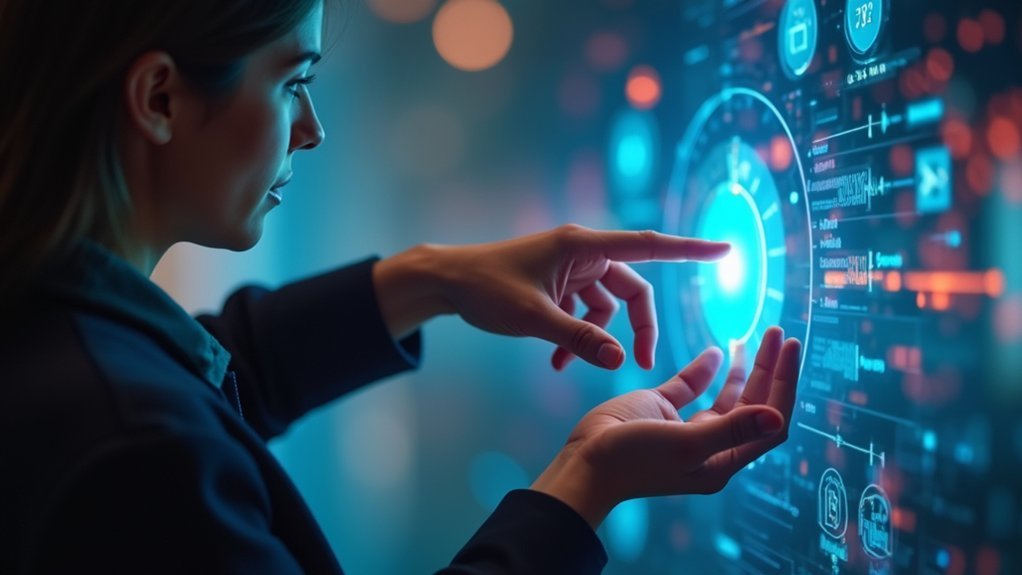
When your fingers naturally point, pinch, and swipe in virtual space, gesture recognition technology transforms these instinctive movements into meaningful digital commands.
Finger tracking eliminates the learning curve associated with traditional controllers, allowing you to interact with virtual environments exactly as you’d in the physical world.
This intuitive gesture recognition creates a seamless bridge between your intentions and digital responses. When you reach out to grab a virtual object or wave to navigate menus, the system instantly translates these familiar motions into precise actions.
Your brain doesn’t need to adapt to artificial input methods, resulting in a more immersive experience that feels genuinely natural.
Enhanced user engagement emerges as gesture recognition responds to subtle hand movements, creating dynamic interactions that keep you fully absorbed in the virtual environment.
Accessibility Benefits for Diverse User Populations
Beyond creating immersive experiences, finger tracking technology fundamentally transforms how diverse user populations access and engage with virtual interfaces. This advancement addresses critical accessibility concerns by eliminating traditional controller dependencies that often exclude users with limited mobility or dexterity challenges.
Gesture-based interfaces create opportunities for natural interaction through three key benefits:
- Reduced cognitive load – Natural hand movements simplify navigation for users of all ages and skill levels.
- Lowered entry barriers – Elimination of complex physical controllers enables broader participation in virtual environments.
- Intuitive engagement – Everyday gestures make technology less intimidating and more approachable.
You’ll find that finger tracking technology allows users to interact with virtual content in ways that feel comfortable and familiar.
This inclusive and accessible approach guarantees that diverse populations can fully participate in virtual experiences without traditional technological barriers.
Real-Time Tracking Technology and Sensor Advancements
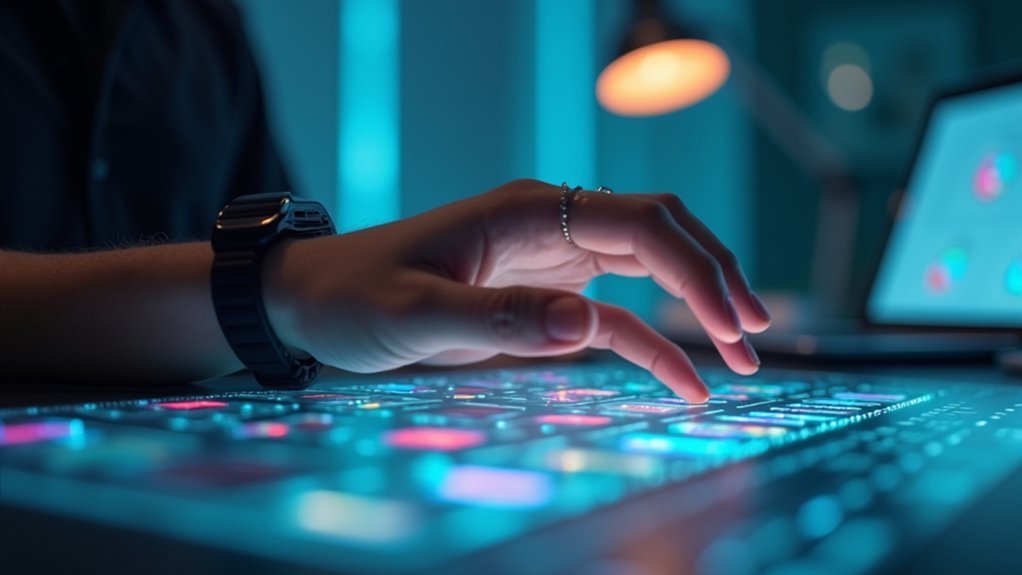
Although traditional hand tracking systems struggled with accuracy and speed, modern real-time tracking technology has revolutionized finger detection through sophisticated sensor arrays and machine learning algorithms. You’ll experience dramatically reduced latency as advanced sensor technology captures your hand movements with unprecedented precision. Multiple data streams work together, creating seamless interactions that feel natural and responsive.
| Feature | Traditional Systems | Modern Real-Time |
|---|---|---|
| Latency | 50-100ms delay | <20ms response |
| Accuracy | 70-80% detection | 95%+ precision |
| Tracking Range | Limited gestures | Full finger detail |
| User Experience | Frustrating gaps | Smooth immersion |
Predictive models guarantee your virtual presence continues even when sensors temporarily lose sight of your hands, maintaining immersion and enhancing overall user experience in virtual environments.
Applications Across Gaming, Education, and Professional Training
You’ll notice finger tracking has revolutionized gaming interfaces by replacing traditional controllers with natural hand movements that provide unprecedented precision in virtual environments.
This same technology transforms professional training programs, where you can practice complex procedures with lifelike feedback in controlled settings.
Whether you’re manipulating virtual objects in educational simulations or accessing critical data hands-free during medical procedures, finger tracking delivers the fine motor control needed for demanding applications.
Gaming Interface Evolution
When you move your fingers through the air to cast a spell in a fantasy game or manipulate a 3D molecular model in chemistry class, you’re experiencing the revolutionary shift that finger tracking has brought to interactive interfaces.
Gaming has transformed dramatically as hand gestures replace traditional button mashing, creating truly immersive VR interfaces that respond to your natural movements.
This evolution in gaming and entertainment has fundamentally changed user engagement through:
- Natural spell casting – You can trace mystical symbols in mid-air rather than memorizing button combinations
- Object manipulation – Direct interaction with virtual items using precise finger movements
- Enhanced accessibility – Complex actions become intuitive for players of all skill levels
You’ll find that finger tracking makes virtual worlds feel tangible, bridging the gap between imagination and reality in ways traditional controllers never could.
Professional Training Enhancement
Beyond entertainment, finger tracking transforms professional training by creating realistic simulations where your hands become precision instruments for mastering complex skills.
In healthcare, you’ll practice surgical procedures through virtual objects that respond naturally to your movements, while accessing patient data hands-free during training sessions. This immersive experience enables you to develop critical skills safely before entering real operating rooms.
Industrial training benefits enormously as you manipulate complex machinery and execute intricate tasks within virtual environments.
The technology provides lifelike feedback that mirrors actual workplace conditions, allowing you to practice dangerous or expensive procedures without risk.
Through finger tracking’s precision control, your skill development accelerates remarkably, improving retention and application of learned techniques in professional settings.
Overcoming Latency and Recognition Limitations
You’ll encounter two primary obstacles when implementing finger tracking systems: latency that disrupts your immersion and recognition limitations that miss your intended gestures.
Reducing system latency requires optimizing software algorithms and utilizing powerful processing hardware to minimize the delays between your hand movements and the virtual response.
Improving gesture recognition involves implementing machine learning algorithms that adapt to your specific behaviors while designing interactions that remain responsive even with minor tracking imperfections.
Reducing System Latency
Although latency represents one of the most critical barriers to effective finger tracking in virtual interfaces, you can dramatically improve system responsiveness through strategic optimization of both software algorithms and hardware configurations.
Hand tracking systems require powerful processing hardware to deliver fluid interactions that maintain immersion and user comfort.
To minimize latency issues effectively, focus on these key strategies:
- Optimize software algorithms to reduce processing delays and enhance real-time response capabilities
- Deploy machine learning algorithms that adapt gesture recognition patterns for improved accuracy over time
- Design simplified interactions that reduce sensitivity to minor delays while maintaining functionality
When you implement these approaches systematically, your virtual interfaces become more responsive and intuitive.
The combination of hardware upgrades and intelligent algorithm design creates seamless gesture recognition experiences that users can navigate confidently.
Improving Gesture Recognition
While latency challenges form the foundation of hand tracking difficulties, gesture recognition limitations create an equally substantial barrier that requires targeted solutions to access the full potential of virtual interfaces.
You’ll find that improving gesture recognition requires strategic design approaches that accommodate these technological constraints. By creating interactions less sensitive to minor delays and providing clear gesture instructions, you can markedly enhance tracking in VR environments.
Machine learning algorithms offer powerful solutions for advancing recognition accuracy over time. These systems adapt to your behavior patterns, creating more personalized responses.
When you combine gesture recognition with user’s gaze tracking, you achieve enhanced precision and context awareness. This thorough approach reduces your reliance on traditional controllers, promoting a more intuitive experience that accommodates diverse abilities and motor skills effectively.
Future Developments in Haptic Feedback Integration
As finger tracking technology continues to evolve, haptic feedback integration stands at the forefront of creating truly immersive virtual experiences.
You’ll soon feel realistic tactile sensations when manipulating digital objects, transforming how you interact with virtual environments.
Advanced developments will revolutionize your virtual interactions through:
- Synchronized Eye-Tracking Integration – You’ll experience context-aware haptic responses that adapt based on where you’re looking, creating more intuitive interactions.
- Enhanced Actuators and Materials – You’ll feel diverse textures and resistances through sophisticated technology that simulates real-world materials with unprecedented accuracy.
- Precision Hand Tracking Fusion – You’ll perform intricate tasks with immediate tactile feedback, improving skill development in training simulations.
These innovations extend beyond entertainment, potentially transforming remote surgery and rehabilitation by allowing practitioners to feel physical responses in real-time immersive experiences.
Frequently Asked Questions
What Are the Minimum Hardware Requirements for Finger Tracking Systems?
You’ll need a depth-sensing camera or infrared sensors, processing unit with decent computational power, and compatible software. Most systems require USB 3.0 connectivity and work with standard computers or dedicated VR headsets.
How Much Does Finger Tracking Technology Typically Cost for Consumers?
You’ll spend $200-800 for consumer finger tracking devices like Leap Motion or Ultraleap controllers. VR headsets with built-in tracking cost $300-1,000. Smartphone-based solutions offer cheaper alternatives at $50-200 through specialized apps.
Can Finger Tracking Work Effectively in Low-Light Environments?
You’ll find finger tracking struggles in low-light conditions since most systems rely on optical cameras. However, newer technologies like infrared sensors and machine learning algorithms are improving performance, making tracking more reliable even when lighting isn’t ideal.
Does Finger Tracking Drain Device Battery Faster Than Traditional Controllers?
You’ll find finger tracking does consume more battery than traditional controllers because your device’s cameras and processors work harder to continuously analyze hand movements and interpret gestures in real-time.
Are There Any Health Concerns From Prolonged Finger Tracking Usage?
You’ll experience eye strain from prolonged camera exposure and potential repetitive stress injuries from unnatural hand positions. There’s also mental fatigue from constantly maintaining precise finger movements during extended sessions.